The Thread That Runs Through Here |
How sheep, a century of loneliness, a meal millions of soldiers never forgave, and a subsidy for goat hair connect the Colorado high country to a building full of alpacas on Rooftop Way this weekend |
How sheep, a century of loneliness, a meal millions of soldiers never forgave, and a subsidy for goat hair connect the Colorado high country to a building full of alpacas on Rooftop Way this weekend
What Did the High Country Look Like Before the Hikers Got Here?Before the tourists. Before the national park. Before Trail Ridge Road and the timed entry reservations.
The high meadows above what became Rocky Mountain National Park were working ground. Spanish colonists had brought churro sheep north into the Colorado mountains centuries before American settlement. By the time ranchers were pushing into the high country in the 1870s and 1880s, flocks were already moving up the mountain valleys every summer, following the same routes through the same meadows that hikers cross today with trekking poles.
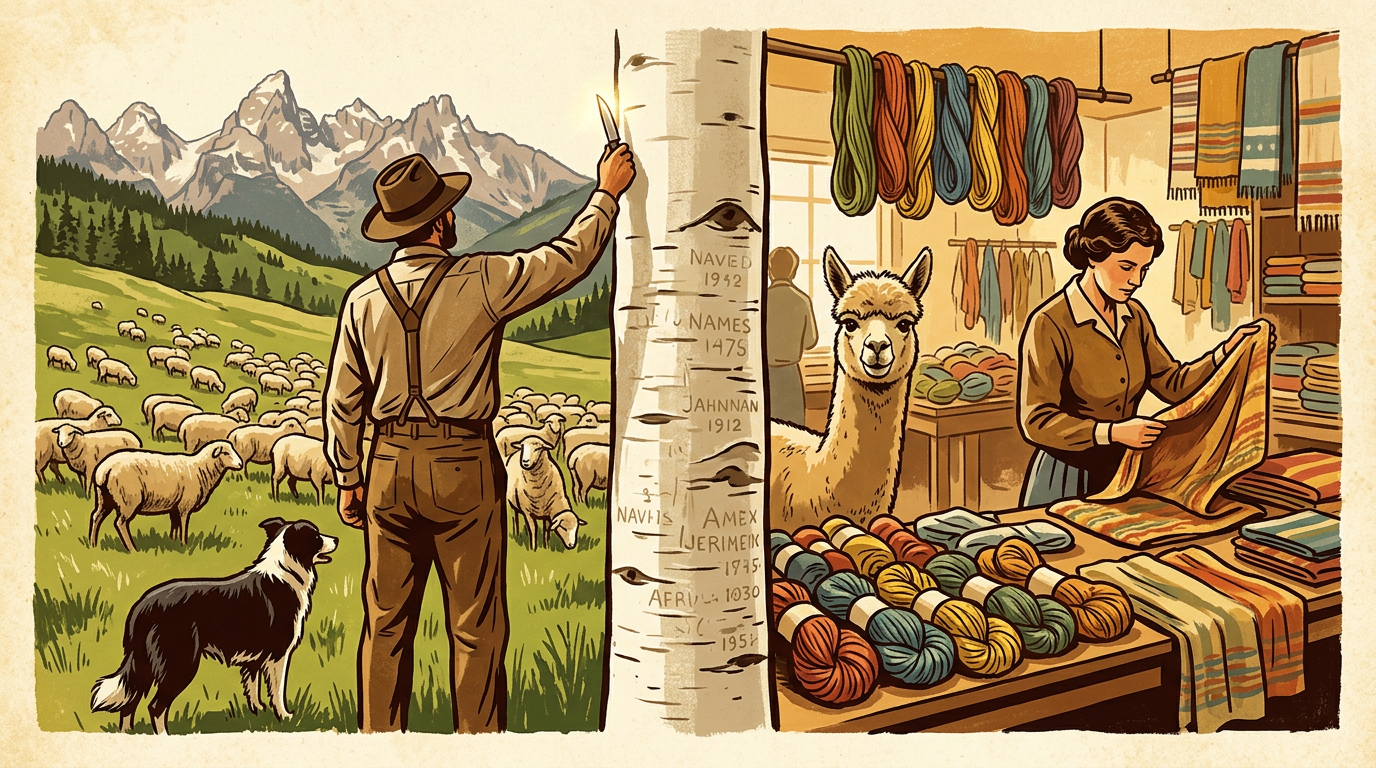
Tens of thousands of sheep worked their way through the Colorado Rockies each summer, watched over by men who were alone in the high country for months at a stretch. Most of them were recent immigrants. Basque men from the Pyrenees. Greek herders who had come looking for work. Young men sent up into the mountains with a dog, a flock, and a season to get through. One of them was a French Basque man named Dominique Laxalt, who came to Nevada to work in the sheep business. His son Robert later wrote about his father's experience in a 1957 memoir called Sweet Promised Land, recalling that his father had been sent into the desert with a dog and three thousand sheep, and that in the first months he had cried himself to sleep at night. Dominique Laxalt was sixteen years old when he started. He was not unusual.
To pass the time on long lonely summer days in the high country, Basque sheepherders carved into aspen trees. These carvings are called arborglyphs. Names. Dates. Hometowns. The church from the village they had left. Messages meant for the next herder who would pass through the same camp the following summer. Arborglyphs can be found across the West, especially in aspen groves throughout Idaho, Nevada, California, and Colorado, places once home to Basque and Hispanic sheepherding communities. The most documented Colorado concentrations are in the San Juan Mountains and the Sangre de Cristo range in the southern part of the state. If you have hiked through an aspen grove anywhere in the Colorado Rockies and noticed markings on the pale bark, you may have been reading something a lonely man wrote a hundred years ago and left for the next person who came through.
The NPS administrative history confirms that livestock grazing was heavy throughout the Estes Valley before and after the park was established in 1915. When domestic flocks moved through the mountain valleys, they carried diseases the native bighorn had never encountered.. Scabies. Pneumonia. Pathogens that were invisible to the animals carrying them and lethal to the animals that had no immunity.
The bighorn population inside what became Rocky Mountain National Park fell to around 150 animals by the mid-twentieth century. One hundred and fifty. In country that should have supported thousands.
The Taylor Grazing Act of 1934 reorganized the federal grazing system, requiring operators to own land to qualify for permits. The era of the itinerant herder moving open-range flocks through the high country was finished. The national park had been established in 1915. Grazing was phased out. The sheep left.
The bighorn, slowly and painfully, started coming back. It took reintroduction programs in the 1970s and 1980s to accelerate the recovery. Today roughly 300 to 400 bighorn live in and around the park. If you have driven up Trail Ridge Road in the spring you may have seen them near Sheep Lakes in Horseshoe Park, coming down for the minerals in the water. The NPS manages that corridor specifically to support them. The signs asking you not to stop your car in the road are not decorative.
What Did a Soldier's Bad Dinner Do to an Entire Industry?This is the part of the story that is almost too specific to be true. But it is.
At its peak in 1942, the United States had approximately 49 million sheep. Wool was essential for military uniforms. The federal government was actively encouraging production. Colorado's high country operations were doing well. The industry looked solid.
Then the war ended and a few million American soldiers came home from the Pacific theater with opinions about food they had not had before they left.
They had been fed mutton. In the field. Repeatedly. Canned mutton, specifically, which preserved and shipped well and tasted, by most accounts, like something that had made the trip without improving in the process. After the war, per capita consumption of sheep meat in the United States was only five pounds per year, versus 67 pounds of beef and 71 pounds of pork.
To be fair, historians argue about how much credit the GI mutton experience actually deserves. American tastes were shifting away from lamb for other reasons too. Synthetic fibers were undercutting wool in the marketplace. The industry was already under pressure. The GI mutton theory is disputed by some historians, who point to broader changes in American eating habits as the more significant cause.
But millions of soldiers who came home and never ordered lamb again did not help.
The U.S. sheep inventory fell from 49 million head in 1942 to 9 million by 1989. That is an 80 percent decline over four decades. At the low point, some wool producers were dumping their fleeces or burning them rather than selling them, because the price they could get was not enough to cover the cost of shearing.
What Did Congress Do About It?Something that made sense at the time, sort of, and then kept going long after it stopped making sense.
During World War II and the Korean conflict, the United States imported half the wool required for military uniforms. Determined to reduce dependence on foreign fibers, Congress declared wool a strategic material and enacted the National Wool Act in 1954, providing direct payments to farmers based on their wool production. Wool was removed from the Pentagon's strategic materials list in 1960.
The subsidy program kept going anyway.
Then it gets better. About one-third of the payments went to ranchers who raised Angora goats for mohair. Although mohair never had strategic value, it was included in the 1954 Act as an offshoot of the wool industry.
Mohair is the fiber from Angora goats. It makes soft, lustrous yarn. It has no military application. It was never on any list of strategic defense materials. Congress included it in the wool subsidy program essentially as a favor to the industry, and it stayed there for decades.
Wool program subsidies cost an estimated $923 million over the 1994-98 period alone. The program was finally wound down in the mid-1990s. It was briefly revived in the 2002 farm bill before being phased out again.
The federal government spent decades subsidizing goat hair for national security. The goats were not consulted.
What Kept the Craft End Alive?When the commodity sheep industry was burning its own wool, something else was happening quietly.
The hand spinners kept going. The small-flock raisers who cared about the quality of a fleece more than the commodity price kept going. The natural dyers and the fiber artists and the people who had learned to work with wool from someone who had learned it from someone before them kept going.
They were not producing for the military. They were not producing for the fashion industry. They were producing because the work itself was worth doing and there were other people who understood that.
They built their own market.
What Is in the Events Complex This Weekend?The Estes Park Wool Market, now in its fourth decade.
The market brings together natural animal fiber producers, educators, retailers, and consumers. It is free and open to the public. Saturday June 13, 9 a.m. to 5 p.m. Sunday June 14, 9 a.m. to 4 p.m. Estes Park Events Complex, 1125 Rooftop Way.
Over 70 vendors display hand-dyed yarns, raw fleece, fiber tools, and finished goods. The market includes animal shows, fiber contests, sheep shearing, working sheepdogs, kids activities, and live alpacas, vicunas, goats, llamas, sheep, and rabbits.
The sheepdogs are worth your time. A well-trained border collie working a flock is one of the more specific pleasures available in this valley on a June morning. Plan twenty minutes and end up staying an hour.
Moe heard there were alpacas and asked if they were friendly.
I told him the sign at the pen would answer that better than I could.
He said that was not satisfying.
I told him that was also the reason to go find out in person.
The thread that connects a young Basque herder carving his hometown church into an aspen tree in the Colorado mountains a hundred years ago, through the bighorn collapse and the slow recovery, through the range wars and the Taylor Act and the government subsidizing goat hair for the Air Force, lands this weekend in a building full of hand-dyed yarn and fiber tools and animals that will look you directly in the eye.
That is a longer thread than most people walking through that door will realize.
It is worth pulling on.
Estes Park Wool Market |
0 Comments
Join the conversation
Be the first to comment
Share your thoughts above.