Thirty Years of Thursdays |
Five thousand years of farmers, buyers, a pile of produce on a government lawn, and one parking lot in Estes Park that opens every Thursday at 8 a.m. This is the story of how the oldest form of commerce in human history nearly disappeared, how a pile of peaches on a government lawn brought it back, and why thirty years of Thursdays in the same parking lot is not a trend. It is a tradition. |
How Old Is This Idea?
Before the grocery store. Before the supermarket chain. Before the refrigerated truck and the centralized distribution center and the produce aisle that looks the same in Denver as it does in Dallas.
Before all of that, there was a person with something to sell, another person who needed it, and a place they both agreed to show up.
The first recorded open-air markets trace back more than 5,000 years to ancient Egypt, where people gathered along the Nile to trade wheat, fruit, vegetables, and the basic goods of daily life. The Romans had them. Every city in the ancient world had some version of them. They were not a trend. They were not a lifestyle choice. They were how people ate.
When European settlers arrived in America they brought the concept with them. Governor John Winthrop established a formal market in Boston in 1634. Hartford got one in 1643. New York City by 1686. Philadelphia in 1693. By the time the country was a century old, most American cities of any size had a municipal market at their center. It was infrastructure. As essential as a road or a well.
George Washington sold produce from his farm at Mount Vernon at the Old Town Farmers Market in Alexandria, Virginia. The man who commanded the Continental Army and presided over the Constitutional Convention loaded up vegetables and sent them to market. That happened.
The Lancaster Central Market in Pennsylvania has been operating continuously since 1730. It started on a 120-square-foot plot of land, about the footprint of a small bedroom, conveyed from a private estate for public use. It is still running today, nearly three centuries of uninterrupted commerce, and it received its charter from King George II personally, back when Pennsylvania was still a British colony.
Think about that. The oldest farmers market in America was there before the country was. What Nearly Killed It?
Then came refrigeration.
Then came the interstate highway. Then came the supermarket, which could carry a thousand products from a hundred different places and keep them cold and stack them in neat rows under fluorescent lights year round.
The farmers market, by comparison, was inconvenient. Seasonal. Weather-dependent. Limited in selection. You could not get strawberries in January at a farmers market in Colorado. You could not get bananas at any point, ever, from anyone selling things they grew near Estes Park.
By the 1950s and 1960s, farmers markets across the United States had largely withered. The USDA counted fewer than 2,000 operating markets in the entire country as late as 1993. The thing that had fed American cities for 350 years had nearly disappeared in a single generation.
It took a pile of produce on a government lawn to start bringing it back. What Happened in California?
By the mid-1970s, California had regulations on the books that made direct farm-to-customer sales practically impossible outside the farm itself.
Until 1977, regulations required farmers to properly pack, size, and label their fresh fruits, nuts, and vegetables in standard containers to transport and sell in markets anywhere other than the farm site. The rules had been designed to protect the established grocery distribution system. The practical effect was that a farmer who grew something could not simply set up a table and sell it to the person who wanted to buy it. There was paperwork. There were middlemen. There were rules that made the oldest form of commerce in human history technically impractical in the most agriculturally productive state in the country.
The way Buck heard it, California farmers found themselves sitting on a surplus of peaches the distribution system could not move. They had a product. People wanted to buy it. The rules said the transaction could not happen directly.
So they loaded up their trucks, drove to Sacramento, and left their surplus on the lawn of the state capitol.
Governor Jerry Brown, faced with produce outside his office window and farmers who had run out of patience, moved to change the regulations. In 1977, certified farmers markets were created by regulation, exempting farmers from the packing, sizing, and labeling requirements that had made direct sales so difficult.
One of the first farmers markets in Southern California followed shortly after.
Whether the peaches actually ended up on the capitol lawn or whether that is just how the story got told over the years is a matter of some debate. What is not debated is that the farmers were angry, the rules were changed, and the markets came back.
By the 1980s and 1990s, farmers markets were returning across the country. People had spent a generation eating food that traveled a thousand miles to reach them and had started to wonder what had been lost. The health movement helped. The local food movement helped. The simple human preference for buying something from the person who made it helped.
Today there are more than 8,600 farmers markets operating in the United States. From fewer than 2,000 in 1993 to more than 8,600 today, in a single generation.
The peach farmers probably did not see that coming. Neither did the supermarket. What Is in the Parking Lot on Big Thompson Avenue?It started in 1996 with an idea from the Estes Park Newcomers Club.
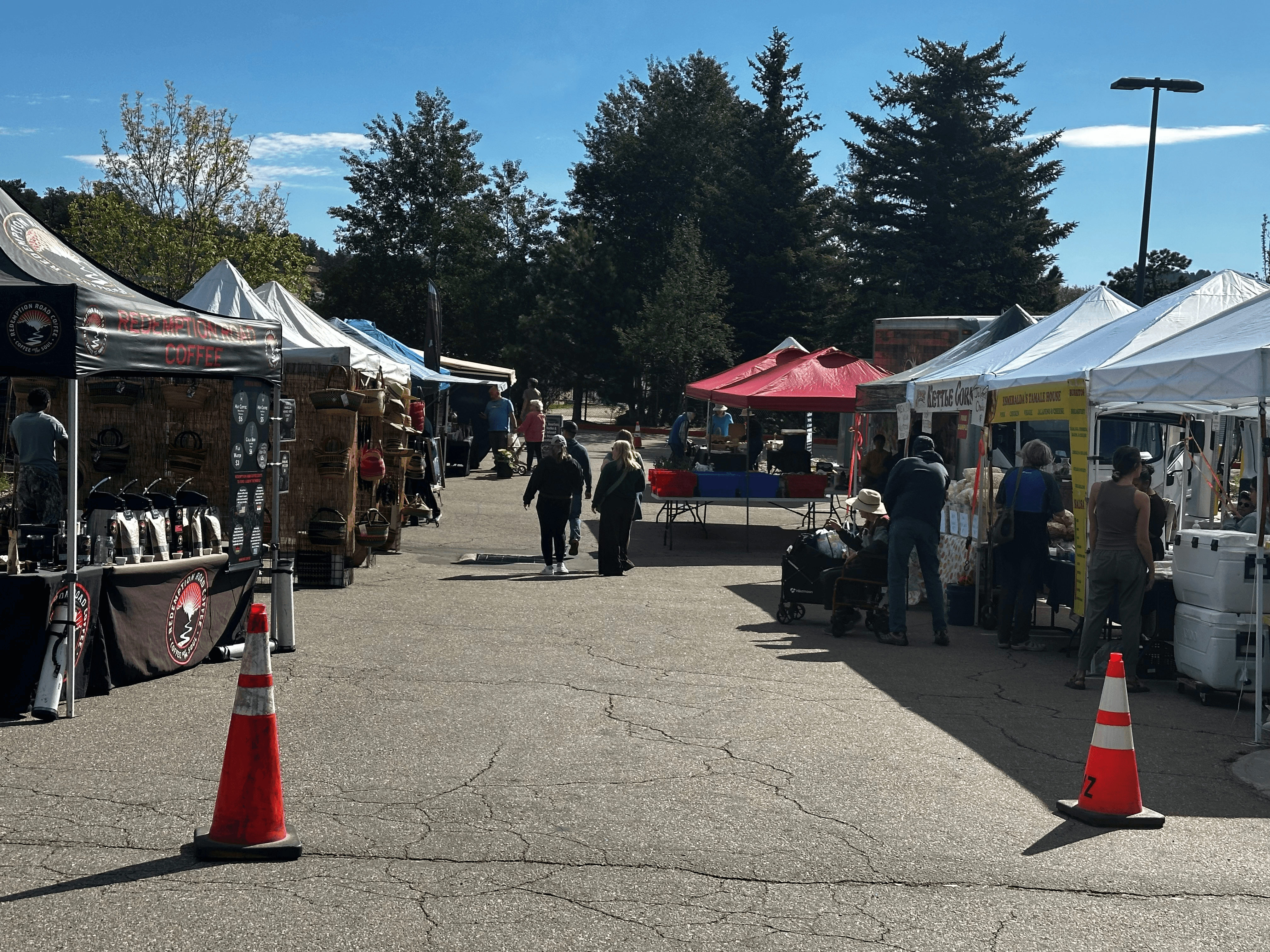
Back then it went by a different name. The Estes-Big Thompson Valley Farmers Market. It has changed names and moved around town over the years, the way things in a small mountain community tend to do, and it has landed where it is now. East lot of the Visitor Center. 500 Big Thompson Avenue. Every Thursday morning from June through September.
This is its 30th season. (per the Estes Valley Voice) Three rows of vendors. Forty stalls. All of it set up and running by 8 a.m. while most of Estes Park is still on its first cup of coffee.
What is out there right now: fresh-ground coffee, a French bakery running cinnamon rolls and sticky buns and pies out of a tent that smells like the best possible reason to get up early, handwoven baskets, kettle corn, chips and salsa, pickles, CBD creams, tallow balm, jewelry, smoked salmon and latkes, breakfast burritos, and boozy nuts in bourbon and rum and whiskey-infused flavors that require a second look at the label to fully appreciate.
Scofield Fruits is one of only two vendors who have been at this market since the first Thursday in 1996. They were there at the beginning and they are there now. This week they had sweet corn that one of their people said was good enough to eat raw right off the cob. Buck has not verified this personally. Buck is also not ruling it out. The Palisade peaches are not in yet. They will be. When they arrive later in the summer, Scofield will have them. They are worth coming back for.
A handful of other vendors have been making the drive up from the valleys below since the early years. Same faces, or their families, loading up before dawn to set up a table in a mountain parking lot because they figured out a long time ago that people up here wanted what they had. Thirty years later, they are still right.
Estes Valley Farmers Market Every Thursday, 8 a.m. to 1 p.m., June through mid-September East lot, Estes Park Visitor Center, 500 Big Thompson Avenue Rain or shine. What Moe Said
Moe asked which booth had the best tomatoes.
I told him to go find out. That is the whole point. You show up, you walk the stalls, you buy what looks good from the person who grew it or made it or hauled it up here before you finished your coffee.
He said that sounded like more effort than the grocery store.
I told him that was also the whole point.
He said he would go Saturday. I told him it is on Thursdays.
He said he would go today.
That is the right answer. The market will be there. It has been showing up every Thursday for thirty years. It is not going anywhere. Estes Valley Farmers Market |
0 Comments
Join the conversation
Be the first to comment
Share your thoughts above.