Sempre Avanti |
How the men who trained in the Colorado Rockies climbed an unclimbable cliff, won a war, and came home to build everything you see when you look at a Colorado mountain |
How Did the 10th Mountain Division Start?
It started with a ski patrol president and a letter to a general. In the late 1930s, Charles Minot "Minnie" Dole, head of the National Ski Patrol, watched newsreels of Finnish soldiers on skis defeating a larger Soviet invasion force during the Winter War of 1939. He had a thought. He wrote to General George C. Marshall, Army Chief of Staff, proposing a division trained specifically for mountain and winter warfare.
Marshall was not initially interested. Dole kept writing.
Eventually Marshall said yes.
The recruiting process was unlike anything the Army had done before. Volunteers had to provide three letters of recommendation attesting to outstanding character and athletic ability. Joining felt more like applying to an exclusive club than enlisting. The National Ski Patrol became the only civilian recruiting agency in U.S. military history.
They needed a place to train. They needed mountains. They needed cold.
They built Camp Hale.
What Was Camp Hale?
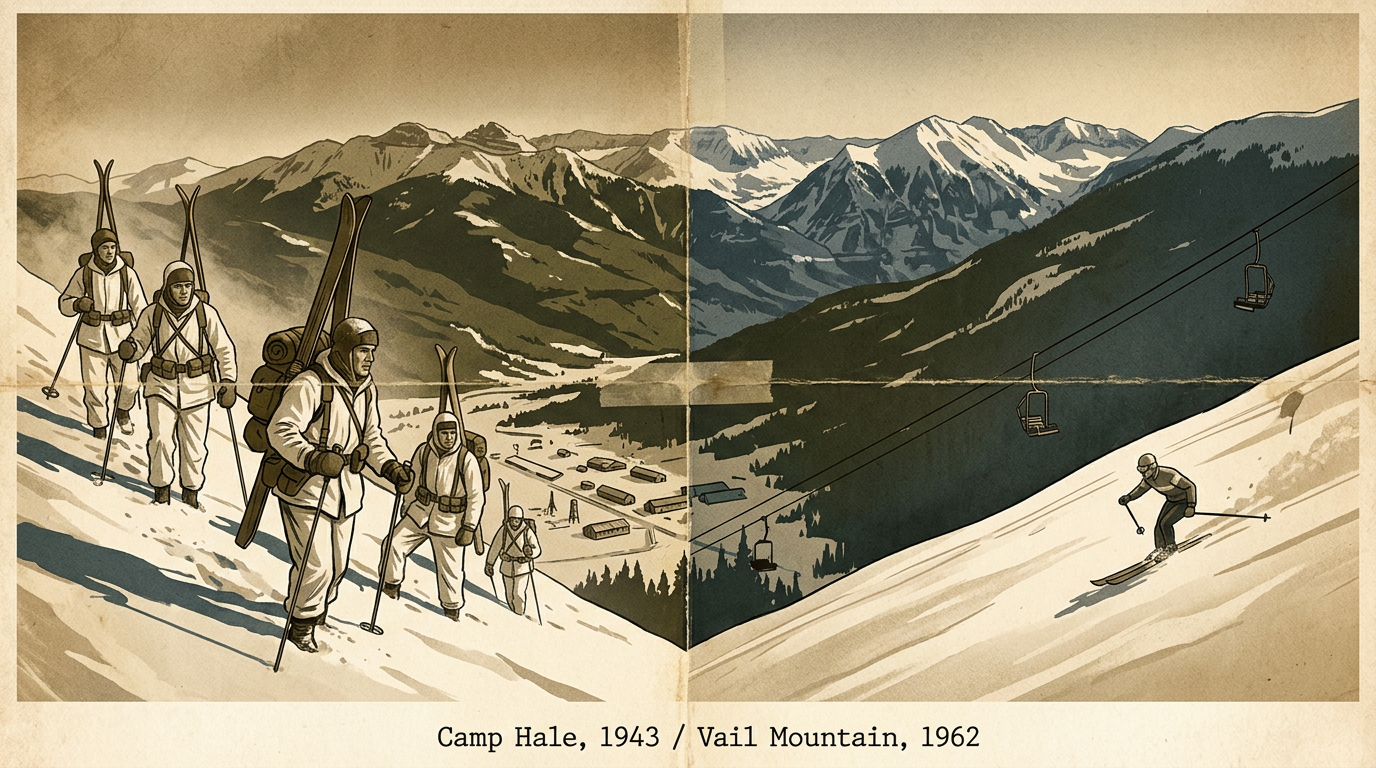
In April 1942, construction began on a military installation in the Pando Valley near Leadville, Colorado, at an elevation of 9,238 feet. By November of that year it was done. The entire camp, 1,457 acres, built in seven months at a cost of $30 million.
At peak, approximately 14,000 to 15,000 soldiers trained there simultaneously.
The training was what you would expect from a division being prepared to fight in the Alps. Skiing from morning to night. Summer hikes of 25 miles with full packs. Rock climbing. Cold-weather survival. Mule teams and sled dogs for supply transport. Winter maneuvers called the "D-Series" conducted at temperatures as low as 35 degrees below zero, with orders banning open fires for tactical realism.
Some soldiers skied from Camp Hale all the way to Aspen on their days off. Some of those soldiers would later build Aspen.
The altitude caused constant health problems. The coal-powered camp sat in a narrow valley that trapped its own pollution in toxic inversion layers. Soldiers coughed through the winter. They called it "Camp Hell."
They trained there anyway. For two years.
What Happened at Riva Ridge?
By the winter of 1944-45, the 10th Mountain Division had been shipped to northern Italy. The Allies were stalled. The Germans held the high ground in the Apennines, specifically a ridge called Riva Ridge, from which their observation posts could see every Allied position in the valley below.
As one soldier described it: "One felt like he was in the bottom of a bowl with the enemy sitting on two-thirds of the rim looking down upon you."
Other units had tried to take the German positions. They had failed. The Germans were not especially concerned. The cliff below their positions was 1,600 feet of near-vertical rock. Nobody could climb it. They knew this because nobody had.
On the night of February 18-19, 1945, between 700 and 1,000 soldiers from the 86th Infantry Regiment of the 10th Mountain Division started up that cliff.
They climbed in total darkness. Single file. Weapons unloaded so no friendly fire in the dark. Piton hammers muffled with cloth so the sound would not carry. Fixed ropes on the worst sections. Multiple routes up the face simultaneously.
The BBC reported the division expected 90 percent casualties before the operation began.
Most soldiers reached the summit by 2 or 3 a.m. All were on top by dawn.
The Germans were asleep in their dugouts.
Not a single man died during the ascent.
When dawn came, the Germans counterattacked. Seventeen Americans were killed holding that ridge through five days of fighting. The capture of Riva Ridge unlocked Monte Belvedere, which cracked the Nazi Gothic Line, which opened the Po River Valley to Allied advance.
The 10th Mountain Division was the first American unit across the Po River. The first to reach Lake Garda. The Germans in Italy surrendered on May 2, 1945.
In 114 days of combat, the 10th Mountain Division suffered 992 killed and approximately 4,000 wounded.
The division's motto is Sempre Avanti. It means Always Forward.
What Did They Do When They Came Home?
This is the part that connects directly to the mountains you are looking at right now.
Approximately 260 soldiers from the 10th came home to the United States and started building the American ski industry.
They started ski patrols. They started ski schools. They built resorts.
Pete Seibert had been wounded in combat on March 3, 1945, by German mortar shells that shattered both arms and severely injured his face and right leg. He came back to Colorado. He became a ski patrolman at Aspen Mountain. In 1957, he and a rancher named Earl Eaton made a seven-hour climb to the top of a mountain in the Eagle River Valley. Seibert later wrote: "Beneath the brilliant blue sky, we slowly turned in a circle and saw perfect ski terrain no matter which direction we faced. We looked at each other and realized what we both knew for certain: This was it." — Pete Seibert, from his memoir Vail: Triumph of a Dream"
To hide their plans from competitors, they purchased the land under the name "Transmontane Rod and Gun Club."
Vail opened on December 15, 1962, with two chairlifts and one gondola. Lift tickets were $5. One of Vail's longest and most famous ski runs is named Riva Ridge. Now you know why.
Arapahoe Basin was founded by Lawrence Jump, a 10th Mountain veteran, in 1946, built almost entirely with the help of other veterans from the division. Aspen, Steamboat, Loveland, Winter Park — across Colorado and across the country, the resorts that define American skiing trace a direct line back to men who trained at Camp Hale at 9,238 feet and then climbed an unclimbable cliff in Italy in the dark.
The entire Colorado outdoor recreation economy that Estes Park tourism depends on was built by men who came home from that.
The Hut System — A Living Memorial
Fritz Benedict, Aspen architect and 10th Mountain veteran, had seen the European Alps' backcountry hut network while serving in Italy. He thought Colorado deserved the same.
In 1980, he and fellow veterans founded the 10th Mountain Division Hut Association, naming it as a living memorial to the fallen.
Today the system includes 38 backcountry huts connected by 350 miles of trails in the central Colorado Rockies.
Every person who skis or hikes into one of those huts is moving through a monument that walks you somewhere instead of standing still.
Where Is Camp Hale Now?
In October 2022, President Biden designated Camp Hale–Continental Divide National Monument, covering approximately 54,000 acres near Leadville. It was the first national monument designation of his presidency.
Most of the original buildings were dismantled in 1945. What remains are concrete ruins, wide meadows at altitude, and live munitions from WWII training exercises still being found and removed from the ground. A federal cleanup project is ongoing.
The site is considered the birthplace of the modern American ski industry.
The men who trained there called it Camp Hell. The rest of us have been living off what they built in it ever since.
The Bridge Back to Last Week
Robert Heron built portable tramway cables for the 10th Mountain Division to use in Italy and Germany. Those same cable systems were used at Riva Ridge to bring wounded soldiers down the mountain.
He came home. He studied European tramway design. He built the red car above Estes Park in 1955.
The men he built cables for came home and built Vail.
One engineer. Two legacies. Both of them are still running. |
0 Comments
Join the conversation
Be the first to comment
Share your thoughts above.