Trail Ridge Road - The Highway Above the Clouds |
The 73-year-old contractor, the half-ton blast, and the men who built a road where roads don't belong |
12,183 feet. Half a ton of explosives. One contractor who used 492 of his 500 allotted days.
Before the Coffee Gets ColdMoe Pass stopped by Tuesday morning with coffee and a look on his face that meant he had been thinking about something on the walk over. He had been up to the Many Parks Curve overlook earlier that morning, as far as the road goes this time of year, and stood there looking at the tundra. What he saw up there did not make him feel better. Some measurements are calling it the lowest snowpack on record for this time of year. Trail Ridge is bare in places that are not supposed to be bare in March. That is not a weather inconvenience. That is a water supply problem for everyone downstream.
He came inside, set down his coffee, and asked if I had ever thought about what it actually took to build the road we all take for granted every summer. I told him I had been thinking about it all week. There is a gate up there right now, closed at Many Parks Curve. Plowing crews will work it when conditions allow and the road will open when it is ready. Given what little snow is up there, it may open earlier than most years. But most people driving it in June give the road itself about as much thought as they give the asphalt in a grocery store parking lot. They should think about it more. Because the story of how that road got there is genuinely one of the better ones in the history of this valley.
It involves:
Moe picked up his coffee and said, "Well let's hear it" So here it is. SIT DOWN. THIS ONE'S GOOD.
The Road That Shouldn't ExistHow a 73-year-old contractor, a Bureau of Public Roads engineer with a feel for the country, and a trail the Arapaho had been using for centuries became the highest paved road in North America
Why Did They Build It at All?Before Trail Ridge Road, there was Fall River Road. Fall River Road was the park's first high-country route, built between 1913 and 1920. It was:
It got the job done the way a bad tool gets the job done: technically, but not well. By the late 1920s the National Park Service wanted something better. Something that could handle real traffic, connect the east side of the park to the west reliably, and let visitors actually see what they had come to see instead of gripping the dashboard on a switchback. The answer was a road over the top:
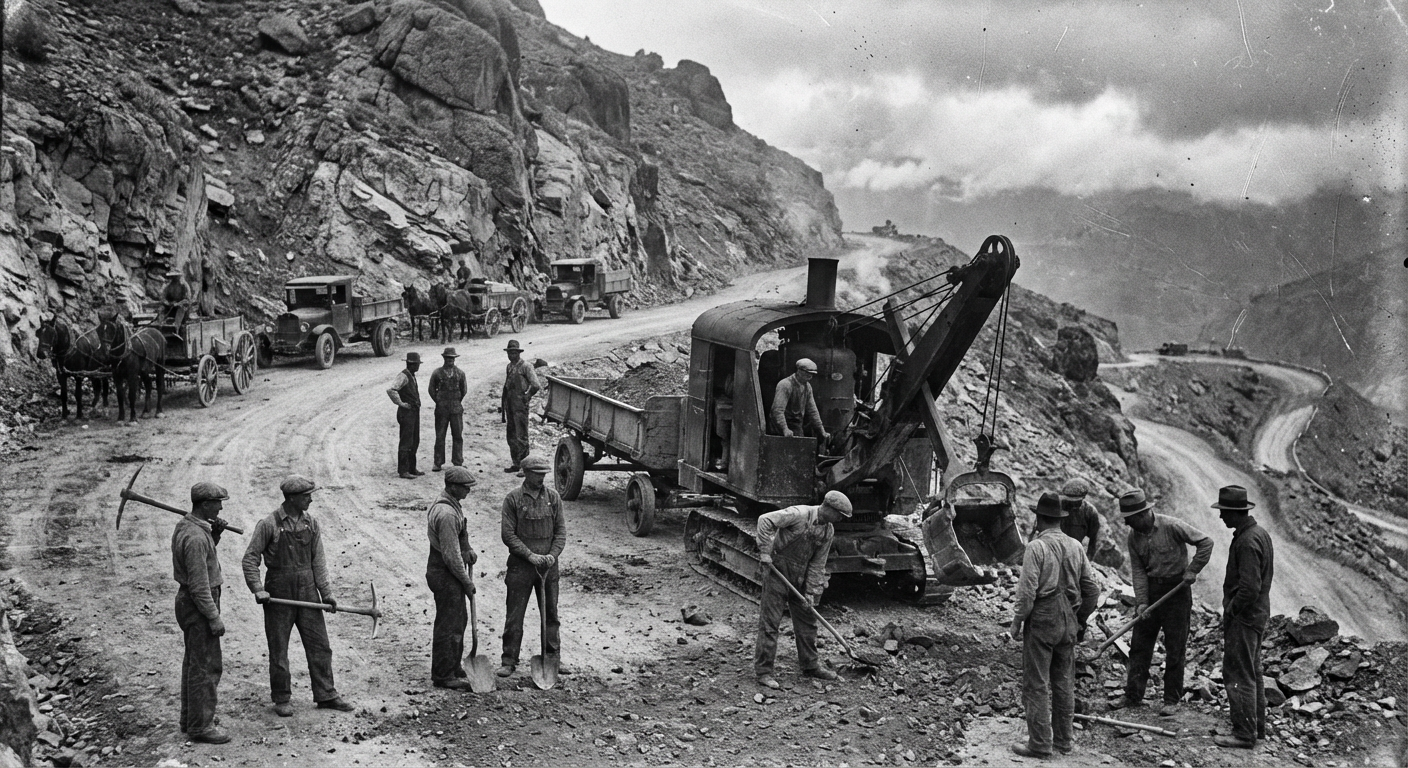
The reasons were practical: Jobs. The Depression meant men needed work and the government needed projects. Trail Ridge Road was both. Access. Scientists wanted to study the alpine tundra. Tourists wanted to see it. Before the road you walked in or you did not go. Connection. The road would link Estes Park to Grand Lake without going around the entire park. They started construction in September 1929. The full route to Grand Lake was not completed until 1938. But the first section, east side to Fall River Pass, opened on July 15, 1932. The Estes Park Trail newspaper called the whole project the "Eighth Wonder of the Modern World" in 1931. It was not finished yet when they wrote that. Who Was the Man Who Built It?The east side contract, 17.2 miles from Deer Ridge to Fall River Pass, was awarded on September 3, 1929 to W.A. Colt and Son of Los Animas, Colorado, for $393,674.80. Colonel W.A. Colt was 73 years old at the time. He had started his career working on the Erie Canal in the 1870s. From there he moved through railroad construction in Texas, Missouri, and Colorado. He had built the road over Wolf Creek Pass in the San Juan Mountains. He was not a newcomer to difficult terrain. Trail Ridge was different. Colt's construction strategy:
At peak, in late summer 1930, Colt had 150 laborers on site, plus foremen, shovel operators, cooks, blacksmiths, and mechanics. The contract was for 500 days. Colt used 492 of them. That is 98 percent of the time budgeted, on a project that involved custom equipment, frozen ground, violent weather, and terrain that had never seen a road. Not much margin. All of it used well.
How Do You Build a Road Where Nothing Grows?The problems started before anyone drove a stake. A Bureau of Public Roads engineer named Steven A. Wallace conducted the location survey on horseback, packing in with field camps set six miles apart, carrying heavy equipment up to three miles by hand. His colleagues called him the "Bull of the Woods" for his ability to find roads through impossible terrain. One colleague said he possessed "a feel for the country" — a complete understanding of the land that let him see a road line where others saw only cliff. Wallace made winter trips into the park specifically to study snow and avalanche conditions. He specified a maximum ruling grade of 5 percent, with short stretches up to 7 percent. A radical improvement over the 16-percent grades of Fall River Road. Then the crews arrived and the real problems began. Weather. One minute shirtsleeves. Next minute the wind is trying to knock you off the mountain and the temperature has dropped twenty degrees. Summer does not mean much at 12,000 feet. Rock. They used dynamite to blast through sections that would not move any other way. Every charge had to be measured. Too much and you would bring down half the mountain. Too little and you would be chipping until winter shut you down. The biggest single blast: Rock Cut on Monument Ridge, August 1930
Frozen tundra. Above treeline, standard drills would not penetrate the permafrost. New equipment had to be custom-designed on site. In December 1930, jackhammers froze solid during drilling operations. Only about 30 men could work at a time in those conditions. Thin air. Men working at altitude tired faster. Breathing was work. Lifting was work. Walking uphill with tools was work that left you sitting down whether you planned to or not. One worker, recalled in the construction records: "We had no guard rails, no modern equipment. We carved that road out with dynamite."
What Were the Rules Up There?Trail Ridge Road is unusual among Depression-era construction projects for the degree to which landscape protection was written directly into the engineering specifications. The design philosophy, stated in the engineering documents, was that the road was to "flow across but not dominate the landscape." In practice this meant real requirements:
National Park Service Landscape Architecture staff made multiple inspection visits during construction. Chief Engineer Frank Kittredge, who had overseen construction of the Going-to-the-Sun Highway in Glacier National Park, walked the entire proposed line before a shovel moved. This was not PR. It was specification.
The Road That Was Already ThereBefore any surveyor arrived, there was already a trail. The Arapaho called it taieonjbaa. It means "Where the Children Walked." It was named that because the trail was so steep that children could not be carried on travois. They had to walk alongside. In 1914, Arapaho elders Gun Griswold and Sherman Sage came back to Estes Park and identified Trail Ridge as the location of that old trail. The man who led that expedition was Oliver W. Toll, a Princeton ethnographer. Years later, Toll became the first person to formally propose routing a modern road along Trail Ridge. The Bureau of Public Roads survey noted specifically that the new road would follow the route of an existing pack trail and would cross rather than run atop it, leaving segments intact as foot trails. The route was not invented. It was borrowed.
If you have been driving Trail Ridge Road for years thinking you were going somewhere new, you were not. You were following a path that families walked long before anyone thought to put asphalt on it. One More Thing Worth KnowingIn December 1930, a spark from the construction camp started a forest fire in Hidden Valley. Park rangers and 25 construction workers fought it in violent wind before bringing it under control mid-morning. If the wind had been from the opposite direction, the construction camp would have been destroyed. That old burn is now a splendid aspen grove. Despite the altitude, the blasting, the frozen ground, the custom equipment, and the December fire, the construction records contain no mention of worker fatalities. They built a road where roads do not belong. It took three years, custom equipment, half a ton of explosives in a single blast, and a 73-year-old contractor who had started on the Erie Canal. It is still there. Still the highest. Still closes every winter because some things do not change. The snow comes back and the crews go back out and the road opens again, the same way it has every spring since 1932.
Moe finished his coffee and put his jacket on at the door. He said he was going back up to Many Parks Curve to look at that snowpack one more time. I told him it would still be thin when he got there. He said he knew that. He just liked looking at it anyway. - Buck |
0 Comments
Join the conversation
Be the first to comment
Share your thoughts above.