Two Oxen, a Fraud, a Horror Novel, and a National Park |
The people who built Estes Park, the federal income tax, and the eleven-month window that changed everything
BEFORE THE COFFEE GETS COLD
Yesterday was April 15th.
You know what that means. The government sent you its annual reminder that it exists. Most of you filed on time. Some of you filed an extension and are currently pretending that is not a problem. All of you, at some point yesterday, had a thought about how much you handed over and what exactly it bought you.
Buck's answer to that question, for what it's worth, is Rocky Mountain National Park. But we will get to that.
The people who built this valley never had that conversation. Not once. Joel Estes arrived in 1859. Lord Dunraven arrived in 1872. Isabella Bird climbed Longs Peak in 1873. F.O. Stanley drove his steam car up the switchbacks in 1903. Squeaky Bob Wheeler opened his tent resort in 1907. Enos Mills spent twenty-six years lobbying for a national park.
The 16th Amendment was ratified on February 3, 1913. The Revenue Act followed on October 3, 1913—when returns were first due. Rocky Mountain National Park was signed into law January 26, 1915.
Moe heard that and said it was the most interesting thing anyone had told him on a tax day. I told him the story gets better from there. SIT DOWN. THIS ONE'S GOOD.
Nobody Here Paid Taxes Until 1913 The people who built Estes Park, the federal income tax, and the eleven-month window that changed everything
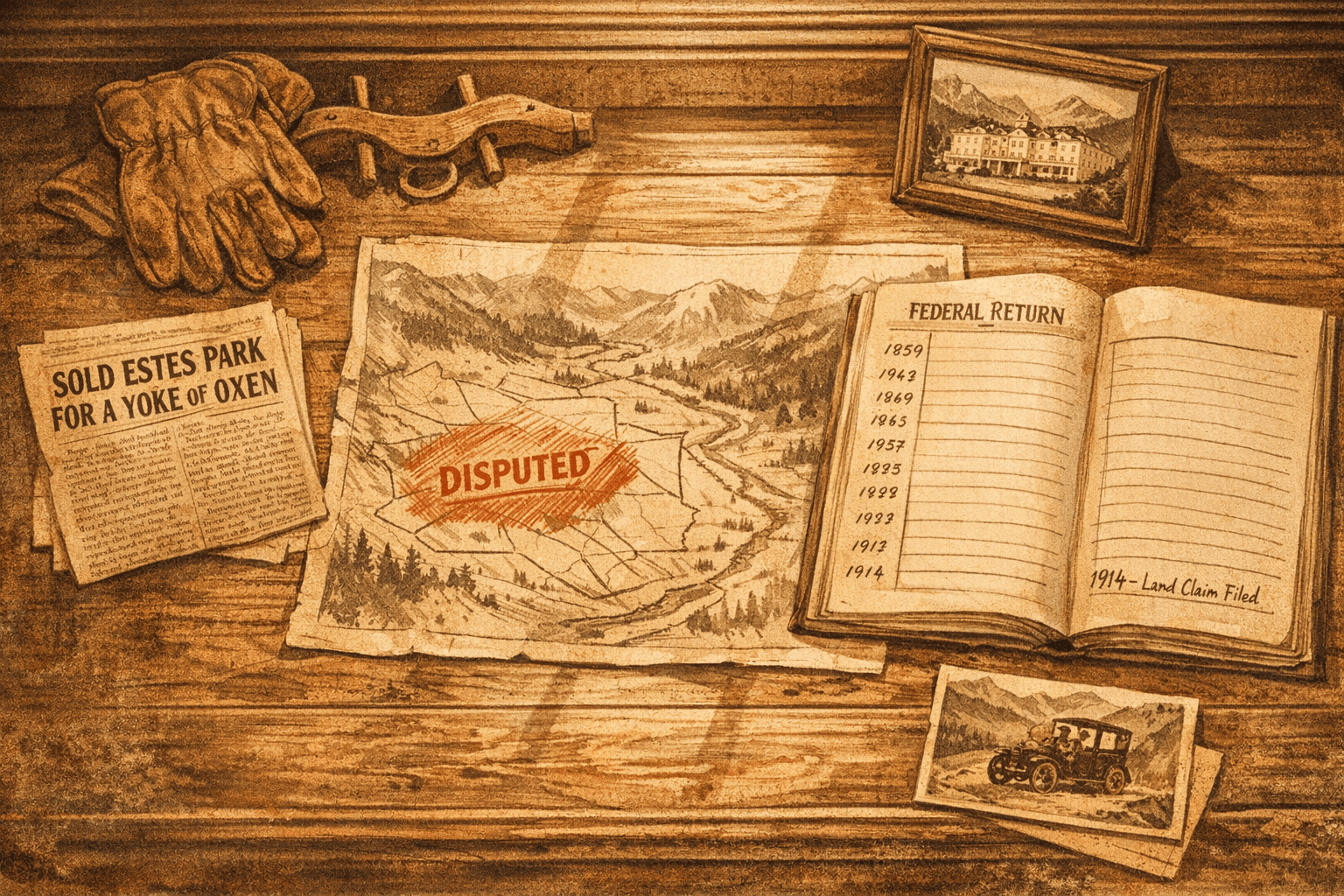
How Did Joel Estes Leave? Joel Estes arrived in the valley in 1859 on a hunting trip with his son Milton. He was the kind of man who moved west to get away from neighbors and found Colorado because Denver had already gotten too crowded for his taste. He moved his family in permanently in 1860. Two log cabins near Fish Creek. His son Charles, born there in February 1865, was the first white child born in the valley. They ran cattle. They hunted. They supplied the mining camps in Denver with elk and whatever else the mountain provided. Then the winters got to them. In the spring of 1866, the Estes family left for the warmer climate of New Mexico. Joel Estes never came back. He sold out for a yoke of oxen. A Colorado newspaper ran the headline in December 1899: "SOLD ESTES PARK FOR A YOKE OF OXEN." The valley that still carries his name was a place he could not wait to leave. He never paid federal income tax. He sold everything he had up here for two oxen and a fresh start somewhere warmer. By any measure, he got out clean.
Who Tried to Steal the Whole Thing? After the Estes family left, the valley eventually landed in the possession of an Irish peer named Windham Thomas Wyndham-Quin, the fourth Earl of Dunraven. Dunraven first visited in 1872 while hunting bison on the plains with Buffalo Bill. He heard about Estes Park at a Denver club, came up to look, and decided he wanted all of it. His method was specific. He paid men between $10 and $100 each to file 160-acre Homestead Act claims in their own names. As soon as each claim was proven up, the man handed it over to Dunraven. His name never appeared on the original filings. By the mid-1870s he had assembled somewhere between 8,000 and 15,000 acres of what had been open valley. The Denver newspapers found out and published the story. Dunraven found himself facing legal challenges. The man who stopped him was Alexander Q. MacGregor, a Milwaukee lawyer who had come to Estes Park on a camping trip in 1872, met his wife there, and never left. MacGregor built a toll road, filed fraud charges against Dunraven's agents, and took him to court. He won. MacGregor was later struck dead by lightning while working his ranchland. He was 51 years old. His ranch still operates today as a living history museum adjacent to Rocky Mountain National Park. Dunraven eventually gave up. By 1907 he had only 6,600 acres left and sold them to F.O. Stanley and B.D. Sanborn. Thirty years of fraud and legal battles, and the valley outlasted him. He never paid American income tax either.
Who Came to Die and Stayed to Build? Freelan Oscar Stanley arrived on June 30, 1903, in a steam automobile of his own design. He had tuberculosis. His doctor had told him he was dying. He came for the mountain air. The mountain air saved his life. Stanley built the Stanley Hotel in 1909. He built the first power plant, established the water system and the first bank, and created a fleet of steam-powered vehicles to bring guests up from the railheads in Lyons and Longmont. He also helped acquire Dunraven's remaining land and eventually gifted much of the valley to the town. He came to Estes Park to die. He stayed until he was 91. He died in 1940. His hotel later inspired Stephen King to write The Shining. The man who opened Estes Park to the modern world also, indirectly, gave the world one of its most famous horror novels. He filed income tax returns for the last 27 years of his life. He did not appear to enjoy it any more than anyone else does.
Who Fought for the Park? Enos Mills arrived in Estes Park in 1884 at age 14, alone, looking for work. He settled at the base of Longs Peak, built the Longs Peak Inn, and became the valley's most dedicated naturalist and guide. In 1889, Mills went to California and met John Muir on a camping trip. Muir told him to go home and fight for his mountains. Mills spent the next 26 years doing exactly that. Sixteen books. Lectures across the country. Letters to Congress. On November 24, 1914, two months before the park was signed, Mills wrote to Muir that he was heading to Washington to "set things moving for the conservation of scenery." On January 26, 1915, President Woodrow Wilson signed the Rocky Mountain National Park Act. The 16th Amendment authorizing a federal income tax had been ratified on February 3, 1913. The first returns under the Revenue Act of 1913 were due March 1, 1914. The park was signed into law eleven months later. The park Mills spent 26 years fighting for arrived just as the federal government, for the first time in American peacetime history, had a revenue stream to fund it. By eleven months. Mills died in 1922 at age 52. He filed income tax returns for nine years before he died. Given everything, it seems like the least the valley could do.
What Did It All Cost? Joel Estes sold the valley for two oxen and left. Lord Dunraven tried to steal it with $10 homestead claims and lost to a Milwaukee lawyer who got struck by lightning. F.O. Stanley came to die and instead built a hotel that inspired a horror novel. Enos Mills spent 26 years lobbying for a park he would only live to enjoy for seven years. None of them paid federal income tax for most or all of that work. The law did not exist. You filed yours yesterday. The park is still there. The switchbacks are the same ones Stanley drove in 1903. Whatever the government did with your money this year, some of it went to maintain something that took all of those people and most of a century to build. Moe thought about it and said: "At least we got the park." That is probably the right way to look at it. |
0 Comments
Join the conversation
Be the first to comment
Share your thoughts above.