The Road Before the Road |
How convict labor, horses, and cars in reverse built the first road into the high country — and why everything that went wrong with it gave us Trail Ridge Road |
What Was the First Road Into Rocky Mountain National Park?
The park existed before the road did. That is not how most people think about it. They picture Trail Ridge Road and assume it came with the place. It did not. Rocky Mountain National Park was established on January 26, 1915, and for the first five years of its existence, if you wanted to reach the high country you got on a horse or you walked.
The automobile was changing everything about how Americans traveled. The new park had no way to serve them.
Congress had authorized a road through the park back in 1913, two years before the park officially existed. Work started in September of that year, then World War I interrupted it in 1914. Construction resumed in 1918 and the road was dedicated on September 14, 1920. Nine and a half miles of one-way dirt. It nearly broke every car that tried to drive it.
Who Built It?
The first three miles were built by state prisoners. Not contract workers. Not a construction crew. Men serving state sentences, working with hand tools on the side of a mountain. Pickaxes. Shovels. Horses moving rock that the horses could move and men moving the rest. No mechanized equipment on that section. No shortcuts available at that elevation.
The rest of the road was built under Bureau of Public Roads supervision with contract labor, horse teams, and early mechanized equipment. The crews had a seasonal window of a few months each year. The high country above 11,000 feet does not negotiate on that point. They worked when the snow allowed and stopped when it did not.
The route they followed was not new. Native American hunters had moved through that valley for centuries in search of game. The path existed long before any automobile did. What changed in 1920 was that someone graded it, packed it, and told people to drive single file going uphill. Going uphill turned out to be the interesting part.
Why Did Early Drivers Go Up in Reverse?
The grades on Old Fall River Road reach sixteen percent. Go look that up if you want to understand what that means in practice. Modern highway design considers anything above six percent to be steep. Eight percent is significant. Interstate standards rarely allow more than five or six percent. Old Fall River Road, in places, is sixteen percent.
In 1920, the automobiles that drove it used gravity-fed fuel systems. The fuel tank sat above the carburetor. Fuel flowed downward into the engine by gravity. On a flat road or a gentle grade this worked fine. On a grade steep enough, the angle of the car interrupted the flow. The fuel did not reach the engine. The car stalled on the mountainside.
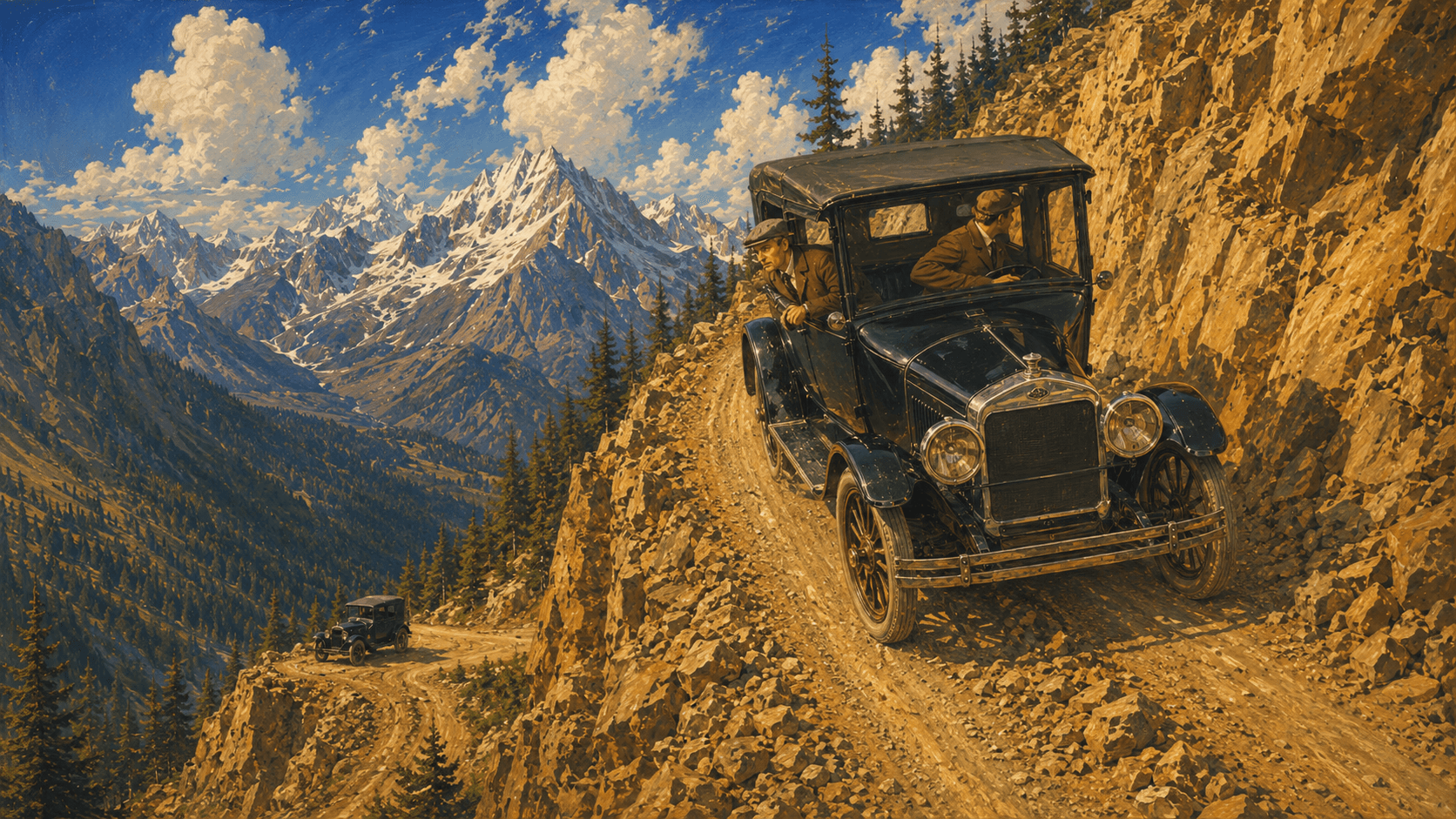
The solution was not a mechanical fix. There was no time for that. You put the car in reverse. In reverse, the geometry shifted. The tank fed the carburetor. The engine ran. You drove backward up the steepest pitches of the first automobile road in Rocky Mountain National Park, with the mountains in front of you and nothing but air and valley behind you, and the general understanding among everyone present that you did not look down.
This was not a workaround for unusual vehicles or inexperienced drivers. This was how it worked. Drivers knew before they started that certain sections required reverse. Families made the trip in reverse gear as a matter of routine. The mountain did not care which direction you were facing. It cared whether your fuel system was working.
Moe heard this story and said it explained a lot about early American tourism.
Why Did They Build Trail Ridge Road?
People loved it. The first automobile road into the high country of Rocky Mountain National Park. Views that had previously required a horse and a long day. The Continental Divide reachable by car. It was exactly what the park needed and it drew visitors immediately.
It was also too narrow, too steep, prone to snowslides, and increasingly impossible to manage as traffic grew. Driving in reverse is charming once. It is considerably less charming when twenty cars are lined up behind you on a sixteen-percent grade and the afternoon clouds are building.
By the mid-1920s the park was already looking for a better route. Roger Toll, superintendent of Rocky Mountain National Park, envisioned a road that would climb above treeline and cross the Continental Divide without fighting the landscape. He wanted something spectacular and something safe. He wanted grades that did not require creative driving solutions.
Construction on Trail Ridge Road began in September 1929. The stock market crashed the following month. The Great Depression arrived. The road got built anyway, partly because the Depression made labor available and the federal government needed projects that put men to work. At peak, 150 laborers worked the road simultaneously. They had tractors, horse teams, graders, and a gas-powered steam shovel. They had four months per year to work.
The permafrost above treeline required careful technique. Workers placed disturbed rocks lichen-side up so the weathered surfaces blended back into the tundra. They salvaged sod and relaid it on road banks. They kept rock formations that could have been blasted away, using them as natural frames for the views. The maximum grade on the finished road does not exceed seven percent.
They finished in three years. Trail Ridge Road opened July 15, 1932. One million people visited Rocky Mountain National Park that first year.
Where Are Both Roads Now?
Old Fall River Road is still there. Nine and a half miles, unpaved, one-way, following the same route that hunters walked for centuries before anyone thought to grade it. It is one of the few unpaved roads in the National Park System still open to public vehicles. You drive it uphill in the correct direction now. The fuel systems have improved.
It typically opens around the Fourth of July. In a year like this one, with the late snowstorm that reset the high country calendar, do not count on earlier.
Trail Ridge Road will open first. Old Fall River Road will open after that. Both of them are waiting on the same snow.
The people who built those roads understood this better than most. They had about four months per year to work and they used them. Convicts with pickaxes. Depression-era crews with horses and a short season. They built two roads that are still carrying people into the high country a hundred years later.
The least we can do is wait for the plows to finish. |
0 Comments
Join the conversation
Be the first to comment
Share your thoughts above.