The Women Who Built This Place |
A Mother's Day tribute to the remarkable women of Estes Park history: Isabella Bird, Alberta Sprague, the Burnell sisters, Flora Stanley, and the women who saved the MacGregor Ranch. |
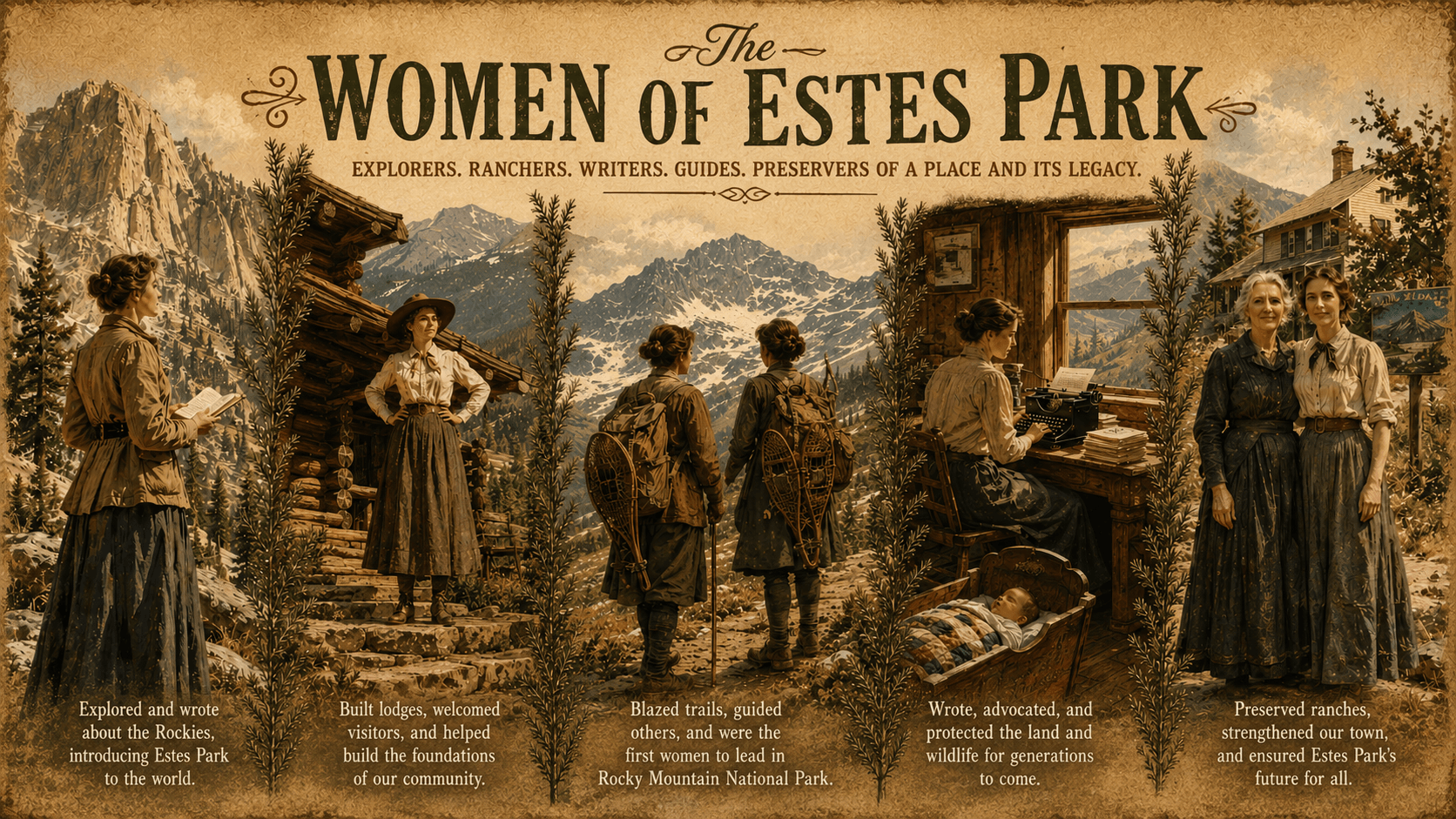
The history of Estes Park gets told a certain way.
Joel Estes discovers the valley. Lord Dunraven tries to steal it. Enos Mills fights for the park. F.O. Stanley builds the hotel. The men are in the foreground. The names on the peaks and the roads and the hotels are mostly men's names. The story moves through them like water through a familiar channel.
But go back. Look at who was actually here. Look at who was doing the work that held things together, built things that lasted, saved things that would otherwise be gone.
The picture changes considerably.
Who Put Estes Park on the Map Before Anyone Else?
She arrived with a bad back and a doctor's note.
Isabella Bird, a British explorer in her forties, traveled alone in the American West in 1873 on the advice of her physician, who thought mountain air might help. She was not supposed to climb anything. She was supposed to rest.
She climbed Longs Peak.
Her guide was a one-eyed mountain man named Rocky Mountain Jim, who dragged her up the final pitch, as she wrote later, like a bale of goods, by sheer force of muscle. She went home to England. She wrote a book called A Lady's Life in the Rocky Mountains. It sold seven editions. Her readers became the conservation-minded public that Enos Mills later turned into park supporters.
She never came back. She never knew what she started.
In 1892, at age 60, she became the first female Fellow of the Royal Geographical Society. She spent the rest of her life going places she was not supposed to go.
Who Built the First Guest Ranch and Named a Waterfall?
Alberta Sprague arrived with her husband Abner in 1874 when the valley was still mostly homestead claims and cattle.
Together they built Sprague's Lodge in Moraine Park, one of the first guest lodges in the region. Alberta did the innkeeping. The cooking. The coordination of hunting and fishing and hiking excursions for guests who arrived expecting wilderness and needed someone to organize it for them. She ran a high-altitude hospitality operation with no playbook, no precedent, and no off-season to recover from the previous one.
She served as president of the Estes Park Woman's Club in 1926-27. That organization funded the town's first library, promoted trail building, and supported the fish hatchery. None of those things happen without the women who showed up and did the work.
Alberta Falls in Rocky Mountain National Park was named for her by Abner as he mapped the area in the 1890s. She is still there every spring, as the snowmelt comes down off the peak and drops over those rocks on the way to the valley. Go find her this weekend. She is worth the hike.
Who Laid Out a Trail That Is Still There?
Eleanor Hondius ran the Elkhorn Lodge for 18 years.
She was a founding member of the Estes Park Woman's Club, a dedicated hiker, a fundraiser for trails and conservation efforts throughout the region, and a woman who did not wait for someone else to build the paths she wanted to walk. She laid out a trail herself, tracing a route from the hill behind Elkhorn Lodge up into Rocky Mountain National Park toward Deer Mountain.
That route still takes hikers into the park today.
She built something you can walk this weekend. Most people who walk it have no idea who put it there.
Who Were the First Women to Guide in the National Parks?
Esther Burnell arrived in Estes Park in the summer of 1916 for a two-week vacation.
She was 26. An interior designer from Cleveland. Burned out on corporate life and looking for two weeks of air that did not smell like the office. Her sister Elizabeth came with her. They stayed at the Longs Peak Inn. They met Enos Mills. Neither one of them left easily.
On Christmas morning 1916, Esther put on her snowshoes and walked 8 miles through what her friend Katherine called the dreariest winter ever known in the mountains. She was going to meet Katherine for a picnic by a stream halfway between their homestead claims. Canned tomato soup. Bacon sandwiches. Coffee in the snow. Katherine had dismissed Esther as a frail city slicker when she first arrived. She had since revised that opinion considerably.
Enos Mills heard the story. He offered to train Esther as a nature guide. Elizabeth joined the training.
In the summer of 1917, one year before the National Park Service hired its first two women park rangers, the Burnell sisters became the first female certified nature guides in the National Park System. Elizabeth became the first woman to guide groups to the summit of Longs Peak, routinely violating park rules that prohibited women from guiding above treeline without a male escort. She violated those rules every time she took a group to the top. Every single time.
Esther married Enos Mills in 1918. He died four years later. She was 32 years old with a daughter, an inn to run, a fight with the park service her husband had started and left unfinished, and a stack of his unpublished manuscripts on the table.
She did all of it.
She ran the Longs Peak Inn until 1946. She published his books. She co-authored his biography. She kept his legacy from disappearing the way so many things disappear when the person who built them is gone.
A woman who worked for Esther in the 1940s was asked about her decades later. She gave the interviewer an intense look and said three words.
She was formidable.
Who Built the Civic Heart of the Town?
F.O. Stanley came to Estes Park because his doctor told him he was dying.
He stayed. He built a hotel, a power plant, a water system, a bank. His name is on all of it.
Flora Stanley came with him.
She was a committed educator and suffragist who built the civic infrastructure that made the town worth living in. She ran a fortune-telling booth to raise money for the Estes Park Woman's Club. She advocated for lower-income women in the community. She helped the club earn membership in the Federated Woman's Club. She did the work that does not get a building named after it.
She and F.O. later donated 54 acres of meadowland to the town. That land is now Stanley Park, where the Rooftop Rodeo and the Scottish Festival and the summer concerts happen every year. Every person who has ever spread a blanket on that grass has Flora Stanley to thank for it.
She is still giving. Every single summer.
Who Saved the Last Ranch?
Clara MacGregor co-founded the MacGregor Ranch with her husband Alexander in 1873. The ranch passed through generations and became the last working cattle ranch in Estes Park.
Clara's granddaughter Muriel MacGregor had a master's degree in history from the University of Colorado. She spent her final years tending the ranch through serious illness, driving herself to Fort Collins and Boulder and Greeley trying to arrange for it to become an educational resource after her death. She had no children. She had no obvious heir. She had the ranch and a conviction that it was worth saving.
She found one person she trusted.
Orpha Kendall moved to Estes Park in 1964. She met Muriel that same year and became her closest friend, her ranch manager, and eventually her trustee. Muriel died in 1970. Orpha inherited a legal battle with MacGregor cousins who contested the will, a ranch that needed a museum built in it, $2,500, and a deadline of summer.
She opened the museum on time.
The MacGregor Ranch Museum has been operating since 1973. It is still the last working cattle ranch in Estes Park. Two women decided it was worth saving. One of them refused to let anyone take it away.
If you walk this valley with a trail map and a little curiosity, almost every meadow and museum has a woman's name in its roots, even when the plaque out front does not say so.
Happy Mother's Day. |
0 Comments
Join the conversation
Be the first to comment
Share your thoughts above.