No Roads. Lumpy Beds. Dirty Sheets. Presidents Welcome. |
Squeaky Bob Wheeler built the Rockies' most famous guest ranch with four tents, sourdough biscuits, and sheets he never once changed. The full story inside. |
PULL UP A CHAIR. THIS ONE'S GOOD.
Who Was Squeaky Bob Wheeler? Robert Lincoln Wheeler came from the Midwest, settled with his parents in Fort Collins, and spent his early years doing what young men in Colorado did in the late 1800s: looking for something worth doing at altitude. He served with Teddy Roosevelt's Rough Riders in the Spanish-American War. He came back to Colorado. He homesteaded 160 acres in Phantom Valley on the North Fork of the Colorado River around 1900, on the west side of what would eventually become Rocky Mountain National Park. His voice, reportedly the result of a severe bout of bronchitis in childhood, came out in a high-pitched squeak whenever he got excited. Which was often.The name Squeaky Bob stuck and never let go.
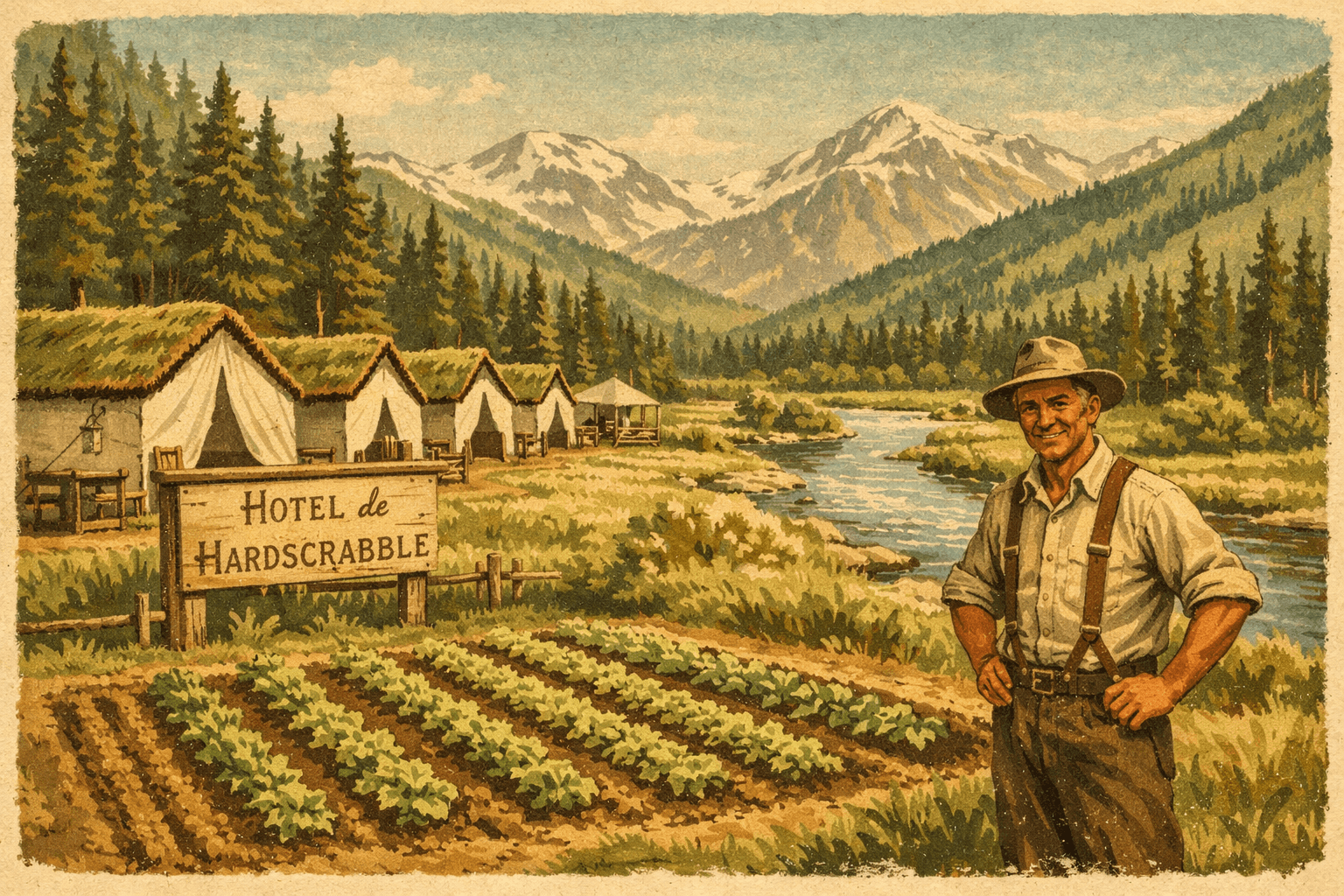
What Was the Hotel de Hardscrabble? In 1907, Wheeler got an idea. The meadow along the Colorado River was lush and green and far enough from everything that people who found it tended to stay longer than they planned. He set up four tent cabins and opened what he called the Hotel de Hardscrabble, also known as Camp Wheeler. He had no road to speak of. Access was by horseback or wagon over rough mountain terrain. The mattresses were lumpy. The accommodations were, by any reasonable standard, primitive. Nobody seemed to care.
What Wheeler had was food and stories. He was an exceptional cook. Sourdough biscuits. Venison steaks. Meals that people from Denver and Kansas City and Chicago talked about for years after they got home. And he had a voice that carried across a meadow and a fund of stories that kept guests around the fire long after the dishes were cleared. By the end of his first season he had expanded to 20 tent cabins. Word was moving fast.
How Did Squeaky Bob Handle the Sheets? Here is the part of the story Moe could not get past. Wheeler was known, widely and openly, for a particular approach to housekeeping. He did not change the sheets between guests. What he did instead was dust them with talcum powder, smooth them flat, and consider the matter handled. The guests kept coming anyway. This says something about the biscuits. It also says something about the stories.
Who Came to Stay at Camp Wheeler? The famous and the ordinary stayed at Squeaky Bob's. The well-known guests included President Theodore Roosevelt, who stopped by for sourdough biscuits and venison steaks, Charles Evans Hughes, the 1916 Republican presidential nominee and later Chief Justice of the Supreme Court, Stephen T. Mather, the first director of the National Park Service, Albert B. Fall, Secretary of the Interior under President Harding, and Otis Skinner, one of the most celebrated stage actors of the era. All of them slept on sheets that had been dusted with talcum powder. None of them apparently complained.
Wheeler also had a bulldog named Jack who could climb up and down a ladder with a skill that one visitor described as putting most firemen to shame. Johnnie Holzwarth, a neighboring rancher who watched the dog perform one afternoon, told Wheeler he was going to teach his own dog the same trick. "You got to know more than a dog to teach a dog tricks," Squeaky advised him.
What Was the Happy Lettuce Farm? This is the part of the story that stays with me longest. The land around Phantom Valley sits at high altitude on jackpine terrain. Everyone in the region knew you could not farm it. The soil was poor, the season was short, and the elevation was an obstacle that sensible men did not argue with. When Wheeler announced he was going to grow Los Angeles Head Lettuce on his homestead, the neighbors laughed. He grew the lettuce. He dry-land farmed it on ground that everyone had written off. He called it the Happy Lettuce Farm. It earned him over $750 per acre, a remarkable sum for the era and a number that made the neighbors considerably quieter on the subject of what was and was not possible at altitude. Squeaky Bob Wheeler ran a guest ranch that seated presidents, cooked food people talked about for decades, farmed lettuce on land everyone said was useless, and never once changed a sheet when talcum powder would do the job. He got the last laugh on all of it.
What Happened to Camp Wheeler? Wheeler married his housekeeper, Allie Farquher Corbley, in 1915. They ran the ranch together until his heart began to give him trouble. In 1926 he sold the resort to Lester Scott, who tore down the tents, built permanent cabins, and renamed the place Phantom Valley Ranch. Wheeler moved to Denver for the lower altitude. He died there in 1945 at the age of 80. The National Park Service purchased the property in the 1960s and razed every structure on it. Today it is the parking lot for the Colorado River Trail, 9.4 miles north of the Grand Lake entrance to Rocky Mountain National Park.
Moe finished his coffee and sat with that for a moment. "So the most famous guest ranch in the history of this park," he said, "is a parking lot." "With a very good trailhead," I said. He thought about that. "You think the lettuce is what he was most proud of?" I told him I thought it probably was. Presidents come and go. A good crop at altitude, on ground that everyone told you was no good, with neighbors watching and waiting for you to fail? That one you remember.
The mountains outside the window have been there long enough to know better than to tell a man what he can't grow. Squeaky Bob figured that out early. |
0 Comments
Join the conversation
Be the first to comment
Share your thoughts above.