The Red Car Is Running Again |
A WWII tramway engineer, a free‑span cable above town, and what to do in Estes Park this weekend |
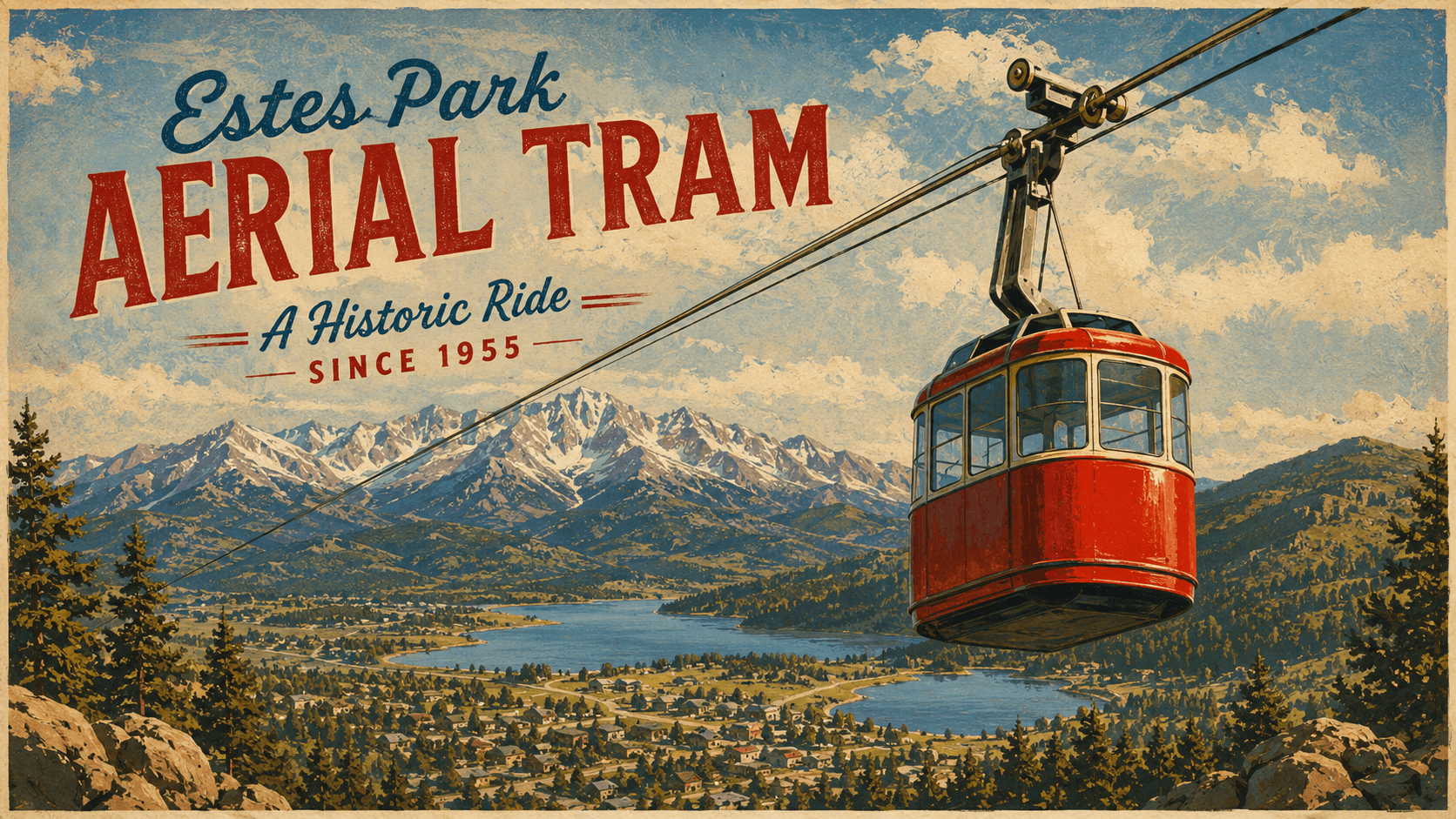
What Is That Red Car, Exactly?It lifts off from a small station near 2nd Street and Riverside. No towers. No intermediate supports. One long stretch of cable — 2,630 feet of free span — running in a clean arc from downtown Estes Park up the side of Prospect Mountain, where the cabin docks at a station perched on a rocky knoll at 8,708 feet with a view of the whole valley and most of Rocky Mountain National Park laid out behind it.
The cabin is cherry red. It has been cherry red since 1955. It carries twelve passengers and hangs, at mid-span, roughly 200 feet above the trees. The cable hums. The town gets smaller. The mountains get bigger. The vertical rise is 1,060 feet. More than three million people have made that trip since the summer it opened.
It is the oldest aerial tramway in Colorado and widely regarded as the first scenic-only aerial tramway in the United States. Built not for skiing, not for industry, but simply to take people from a valley floor to a better view.
Who had the idea? The Engineer and the Cliff Robert Heron was a Colorado engineer when the U.S. Army came looking for people who understood how to move things on cables up steep terrain.
The year was 1943. The Army had a problem in the Italian Apennines. The 10th Mountain Division was fighting on slopes that supply trucks could not handle. They needed food, ammunition, and medical equipment hauled up. They needed wounded soldiers brought back down. The task was assigned to Heron's firm: design a portable tramway for use in Italy and Germany, something that could be rigged on near-vertical terrain in winter, in a war zone, under fire.
He built it. The 10th Mountain Division used portable cableways in the assault on Riva Ridge in February 1945, one of the most difficult mountain operations in American military history. Soldiers and supplies went up. Casualties came down. The cables held.
When the war ended, Heron went to Europe to study what the Swiss and Austrians had been doing with permanent passenger tramways. He saw the free-span design: no towers, no intermediate supports, just two terminal stations and a long arc of cable between them, tensioned by counterweights. Elegant. Conservative. Honest engineering. He came home to Colorado and started Heron Engineering.
The Town With a Mountain and No Ski AreaBy the early 1950s, Heron Engineering had built some of the first double, triple, and quad chairlifts in the American West — at Berthoud Pass, Winter Park, Aspen Highlands, and Boyne Mountain in Michigan. Heron was well respected as a lift builder who understood both the physics and the field work.
But the Estes Park tram was something different. There was no ski area here. Just a resort town that had been drawing summer visitors since the 1870s, a mountain named Prospect sitting directly above downtown, and a man who had spent a decade thinking about cables.
Seventy SummersConstruction began April 1, 1955, with an estimated cost of $150,000. The Heron Engineering Company purchased 240 acres on Prospect Mountain for the project. Two gondola cars were designed, each carrying twelve passengers, fabricated at a shipyard that normally built boat hulls, then hauled to Estes Park and hung on the cable. The tram had its first passengers on June 20, 1955. The grand opening followed on August 3, 1955.
Free span. No towers. Conservative bolt-and-rivet construction throughout because Heron trusted bolts more than welds. One long run of cable from a station near downtown to a rocky knoll above the valley, counterweighted and tensioned below the lower station. The whole thing built for one reason: to show people the view.
It was the first scenic-only aerial tramway in the United States. The tram ran every summer after that. Robert Heron operated it until his death in 1999. His son John took over and ran it through 2022. More than three million people rode it. Families made it an annual tradition. Kids grew up, came back with their own kids, pointed at the same peaks from the same rocky knoll.
Then, a few years ago, it looked like the run might be ending. Maintenance costs. Aging infrastructure. A small family operation trying to keep a seventy-year-old piece of engineering running without the capital of a major ski resort behind it. The family announced they were selling a controlling interest to Gondola Ventures, while retaining a significant stake themselves. Gondola Ventures committed to keeping the original look, the original mission, and the tram operating.
Which is how Moe looked up from the Riverwalk last week and saw the red car moving along its line above town.
What You Actually See From the TopShort trails radiate from the upper station to overlooks in every direction. To the west and north: Rocky Mountain National Park, Longs Peak, the Continental Divide, ridgelines you could spend a lifetime hiking. To the east: the valley floor, the town grid, the Big Thompson working its way through, the Stanley Hotel white on its hill.
On a clear May morning, when the high country is still holding snow and the air is that particular shade of Colorado blue that follows a big storm, it is one of the finer views you can reach without a serious climb. There is a small cafe at the top and a flock of chipmunks that have been running the same grift on visitors for decades. Kids lean over the rail. Adults pretend not to, then lean over anyway.
You got there in about two minutes and twenty seconds on a cable that has been running since the Eisenhower administration. Moe said he thought he might ride it this weekend. I told him he had been in this town too long if he hadn't done it yet. He said he had been saving it. I told him that was a terrible reason to wait.
Practical Details: • The tram runs seasonally from late spring through early fall It has been worth the trip since 1955. Some things stay right. |
0 Comments
Join the conversation
Be the first to comment
Share your thoughts above.