The First Rodeo Really Was on the Fourth of July |
How a bronco busting contest in a baseball field in 1908 became the Rooftop Rodeo, why the sky goes dark this year, and what 118 years of the Fourth in Estes Park actually looks like |
What Happened in That Baseball Field on July 4, 1908?
Before it had a name, before it had a queen, before it had a parade theme or a professional stock contractor, the Rooftop Rodeo began with a man named Johnny Malmberg and some very bad horses.
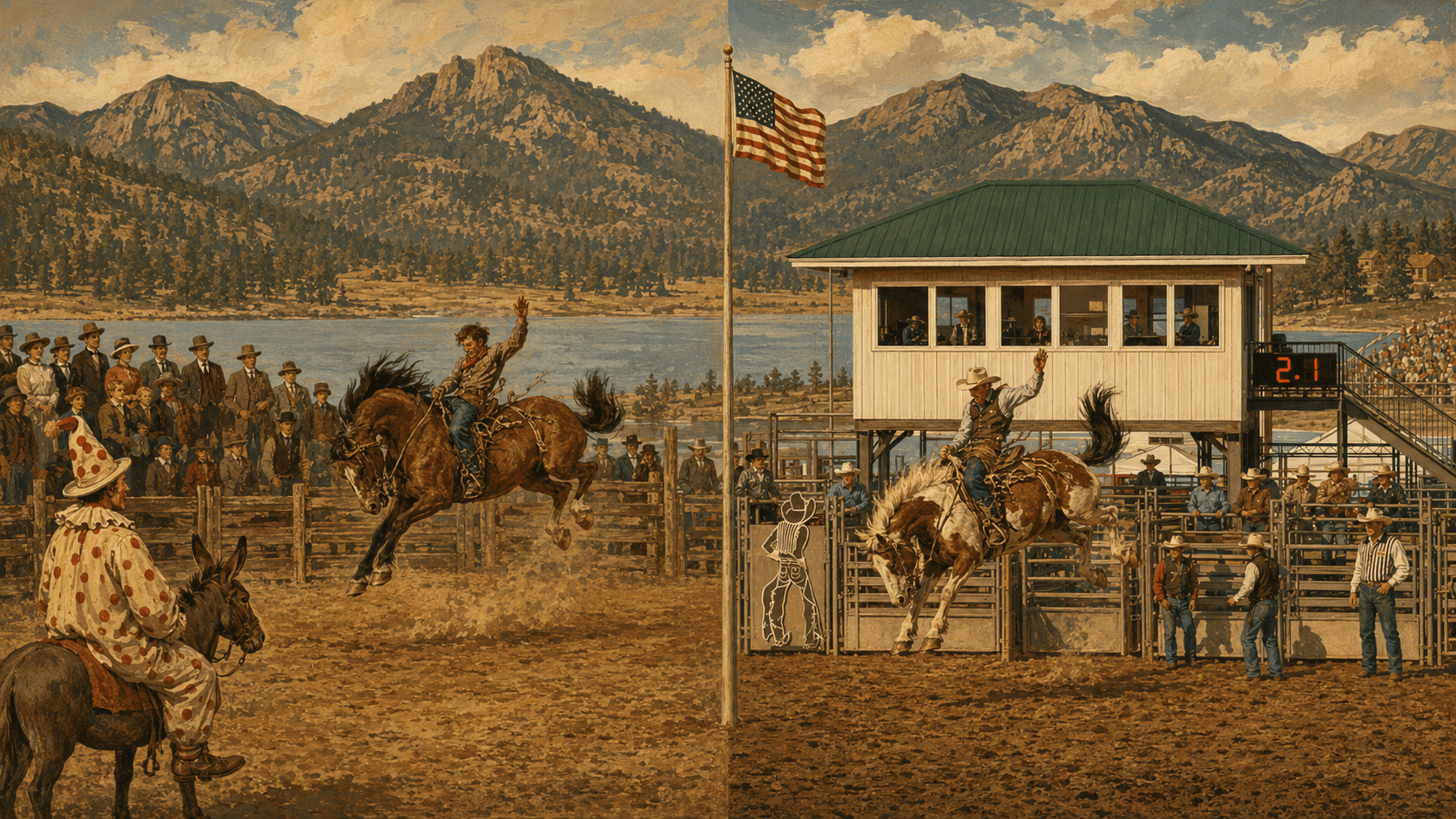
The Estes Park Mountaineer ran a preview notice on June 25, 1908, advertising what it called a "genuine old fashioned Wild West exhibition" to be held at the Baseball Park, a quarter mile east of town. Bronco busting. Roping and branding. Steer riding. The notice promised "noted riders and horses" and mentioned that "some bad outlaw horses are being rounded up." The word "rodeo" was not in common American use yet. It would not catch on for another four years. They called it Frontier Day instead, borrowing the name from Cheyenne's famous celebration, which had been running since 1897.
The July 9 edition of The Mountaineer documented what happened next. The crowd was enormous. They came on horseback, on foot, in rigs, and in automobiles, the autos apparently numerous enough that the reporter compared the scene to a Sunday afternoon drive in Coney Island. The bronco busting was so good that the judges could not pick a winner. The Mountaineer recorded it plainly: "the horsemanship displayed in these contests could scarcely have been better, and in the face of the riding done by all contestants, the judges threw up their hands and refused to go on record as declaring any one man the winner."
There was also a clown. A man named A.G. Birch dressed in full costume, rode a burro wearing trousers of the national colors, and attempted to enter a wooden horse in the bronco busting contest. Almost no one recognized him. The Mountaineer noted that when word spread who he was, "there were repeated calls for his appearance, and he graciously responded."
How Did a Fourth of July Celebration Become a Real Rodeo?The events in Estes Park grew and formalized in fits and starts over the next few decades, never quite settling into a single identity until the name gave it one.
By 1923, the Estes Park Trail was using the word "rodeo" for the first time in relation to local events, announcing a Wild West show at Stanley Field and noting that "Colorado Springs and other cities have been putting on rodeos for several years and Estes Park, not to be outdone, will break into the limelight this season." By 1924, the events had taken on a shape recognizable today: bareback riding, saddle bronc, bull riding, steer wrestling, tie-down roping.
The name "Rooftop Rodeo" didn't come until 1941, and it came from altitude, not architecture. Estes Park sits at 7,500 feet. The organizers billed it as the highest rodeo competition in America and chose the name to make that point. The first queen was selected that same year. Her name was Patty Moomaw, chosen by ballot from sixteen candidates at the Riverside Ballroom. Lana Turner had been named honorary queen by local cowboys earlier that spring when she visited for a Look magazine feature. Hollywood business kept her from attending. The parade went on without her.
What Makes This Year's Rodeo Different?
Two anniversaries arrived at the same moment, and the parade theme landed on both of them.
2026 marks 250 years of the United States and 150 years of Colorado statehood. Colorado was admitted to the Union on August 1, 1876, the year of the country's own centennial, which is the entire reason it has been called the Centennial State ever since. President Ulysses S. Grant signed the proclamation. Colorado came in as the 38th state, three days before the country turned 100.
This year's Rooftop Rodeo parade theme is "America 250, Colorado 150." The parade steps off Monday morning at 10 a.m. from Performance Park. The rodeo itself runs July 6 through July 11 at the Estes Park Events Complex, 1125 Rooftop Way, with bull riding, barrel racing, saddle bronc, mutton bustin', and more every night. That first Frontier Day celebration in 1908 is now 118 years behind us. Johnny Malmberg's unbeatable riders are long gone. The bad outlaw horses are long gone. The thing they started is still here.
Why Are the Fireworks Postponed This Year?The town made a hard call, and it was the right one. The Town of Estes Park announced the postponement of its annual fireworks show over Lake Estes after consulting with the Estes Valley Fire Protection District. The decision came after wildland fire risk increased significantly over the weekend and weather forecasts through the week remained unfavorable. Firefighting resources across the state are already stretched thin as crews are deployed to active fires elsewhere in Colorado.
Stage 2 Fire Restrictions are currently in effect for the Estes Valley. Under Stage 2, charcoal and wood grills, campfires, and all open flames are prohibited. Smoking is permitted only inside an enclosed vehicle or building, and discarding a cigarette outdoors is prohibited. Vehicles should not be idled or parked over dry grass, since a hot exhaust can ignite dry fuel in seconds. Personal fireworks are illegal in Estes Park at all times, fire restrictions or not.
Estes Park is not alone in this. Communities across Colorado, including Durango, Vail, Grand Lake, Ouray, and others, have canceled or postponed their displays this year. Three federal firefighters were killed battling the Snyder Fire near the Colorado-Utah border over the weekend. The Snyder Fire has burned approximately 30,000 acres. The Aspen Acres Fire near Rye has expanded to roughly 25,000 acres. These are not distant abstractions. They are the reason the sky over Lake Estes goes dark Friday night.
A new date for the fireworks will be announced when conditions improve. Check the town's official channels at visitestespark.com for updates. |
0 Comments
Join the conversation
Be the first to comment
Share your thoughts above.