The Annual Migration of Flip-Flops |
How a hundred and fifty years of people falling for this valley turned into a modern June morning of rental SUVs, upside-down maps, and one man in flip-flops who never should have made it past the parking lot |
What Is the Flip-Flop Migration?
Every June, a specific kind of visitor shows up in Estes Park, and you can spot them before they open the car door.
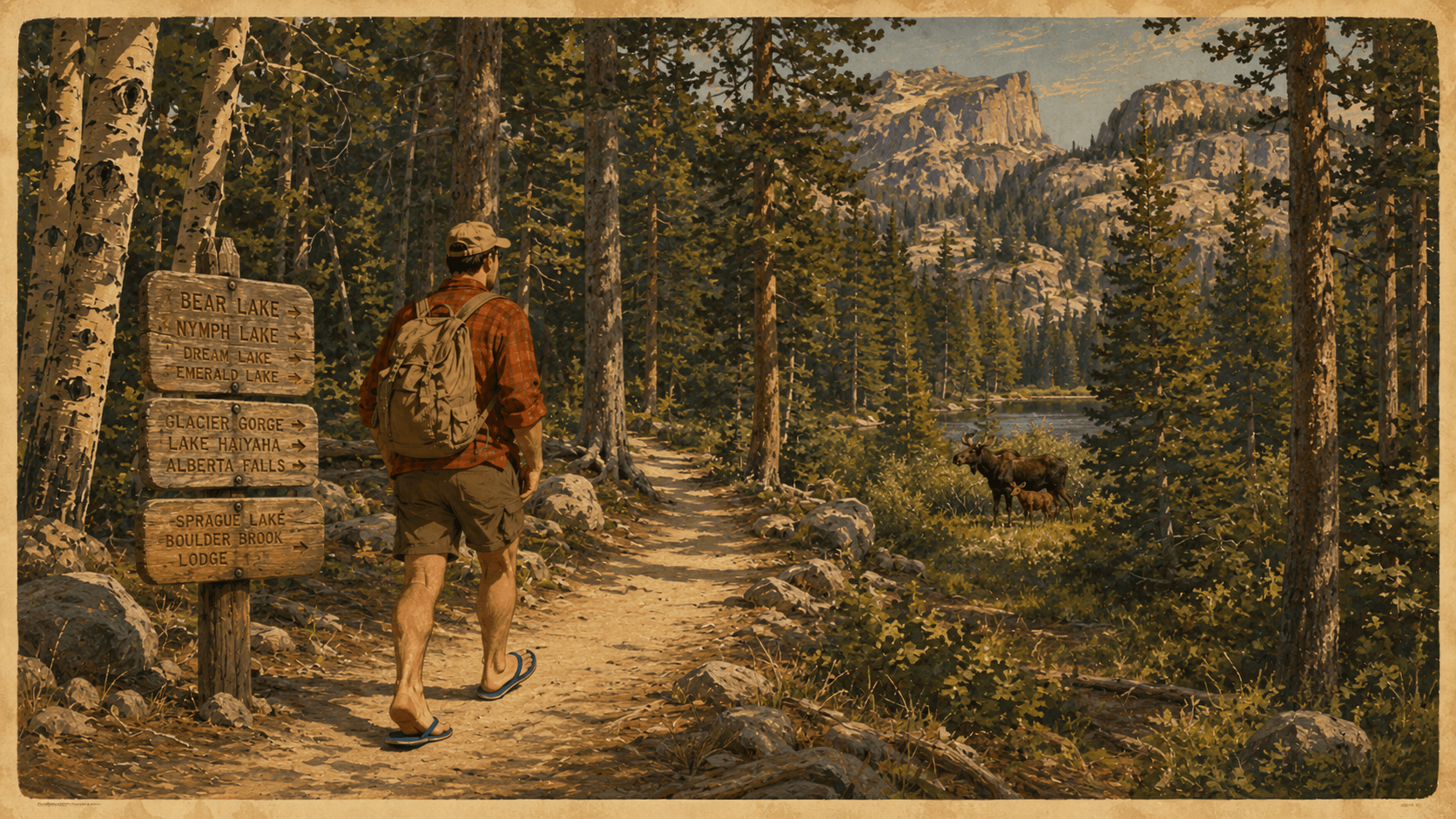
It's the footwear that gives it away first. Flip-flops on a trail meant for real boots. A cotton hoodie packed for a mountain town that can drop twenty degrees between breakfast and lunch. A gas station soda the size of a fire extinguisher, treated like a legitimate hydration plan at 7,500 feet. Locals have watched the pattern long enough to know it isn't random. It's a season, and it starts almost exactly when school lets out.
How Long Has This Migration Actually Been Happening?The flip-flops are new. The migration is not.
Long before rental SUVs and cell phone maps, people were making this same trip by train and wagon, at a fraction of the speed and considerably worse suspension. Joel Estes found this valley in 1859 on a hunting trip and decided it was worth living in, moving his family of thirteen children into the valley the following year. The winters wore him down fast. By 1866, he traded the entire claim for two oxen and left for good.
Estes didn't stay long, but the people who came after him kept arriving anyway, drawn by the same thing that pulls in the flip-flop crowd today. Downtown grew up around that traffic. Outfitters to get visitors into the hills. Cafes to feed them when they came back out. Cabins, then motels, then condos hugging the hillside, each one built by somebody who fell for the valley on a short trip and wanted a reason to make it longer.
How Many People Actually Come Through Here Now?The numbers explain why the sidewalks feel different in June than they do in February.
Rocky Mountain National Park draws more than 3.3 million visitors in a typical recent year, and the overwhelming majority of them funnel through Estes Park to get there. The town's year-round population sits a little over 6,300 people. For a few months each summer, the valley hosts a daily crowd that outnumbers its own residents many times over, all moving through the same handful of downtown blocks to reach the same handful of entrance stations.
That math is exactly why the timed entry reservation system exists in the first place. The park tested several approaches to managing the crowding, and the results were clear enough that the Day Use Visitor Access Plan, was finalized in May 2024, making the reservation system permanent rather than a pilot program.
What Happens at the Entrance Station When Someone Forgot to Plan Ahead?
This is where the migration runs into its first real obstacle.
The Beaver Meadows Entrance Station, about four miles west of downtown on Highway 36, is the busiest gate into the park and the one most visitors hit first. Every summer, somebody pulls up around ten in the morning, certain they can talk their way through without a reservation. The ranger asks the question politely. The visitor stares back like the words "timed entry" are brand new to the English language. For most of them, they are. They booked the flight and the hotel. Nobody mentioned the homework.
From May 22 through mid-October, a reservation is required to enter most of the park between 9 a.m. and 2 p.m. Want the Bear Lake Road corridor too, with Dream Lake, Emerald Lake, and Alberta Falls. That window stretches to 5 a.m. to 6 p.m. The visitor who skipped this step gets turned around and told to come back after 2 p.m., or to try their luck at the 7 p.m. release the night before their next attempt.
What Mistakes Do First Timers Make Once They're Actually in the Park?The same three, almost every week, almost every group.
Wrong shoes. Wrong layers. Wrong hour. Conditions above treeline don't care what the thermometer read in Denver the day before. Afternoon thunderstorms in late June aren't a surprise plot twist. They're the schedule. The visitors who do it right look a little boring about it: real shoes, real layers, water, and a habit of being off exposed ridgelines before the clouds start building. The ones who do it wrong are easy to spot heading back down the trail around 1:15 in the afternoon, moving faster than they planned, glancing at a sky that turned on them without warning.
The early risers get the quiet trails and the easy parking.
The same visitors who block the crosswalk and mispronounce St. Vrain are also the reason the shops survive past Labor Day and the restaurants make it through a slow February. Decades of summer travelers turned into second home owners, long term renters, and eventually full time residents, one generation's vacation laid right over the last one's homestead claim.
A man in flip-flops on the trail to Bear Lake this week is doing roughly what a stranger asking Joel Estes' neighbors about a spare room would have done in 1875. Different footwear. Same instinct. Show up, fall for the place, spend the rest of the trip figuring out how to come back.
Moe never did find out how far past Bear Lake the man made it. He chose to believe the fella had the good sense to stop there. |
0 Comments
Join the conversation
Be the first to comment
Share your thoughts above.