No Roads. Lumpy Beds. Dirty Sheets. Presidents Welcome. He never changed his sheets, grew lettuce on useless ground, and hosted a president. |
FROM BUCK: March in Estes Park means the elk are restless and so is everybody else. The high country is still locked up but you can feel something shifting. It is not quite spring and not quite winter and the valley has that in-between quality that makes a man want to sit down with coffee and a good story.
Moe Pass stopped by Wednesday with that look on his face. The one I recognize. It means he has found something in the historical record that he cannot quite believe but also cannot argue with. I told him to sit down. I already knew what he had found.
"Squeaky Bob," I said. He nodded slowly. "The sheets." "And the lettuce," I said. "And the president."
We sat with that for a minute. Because some stories deserve a moment before you start telling them. The story of Robert "Squeaky Bob" Wheeler is one of them. A man with a voice like a rusty hinge, four tent cabins, and absolutely no interest in what his neighbors thought was possible.
PULL UP A CHAIR. THIS ONE'S GOOD.
How Squeaky Bob Wheeler Built the Most Famous Guest Ranch in the Rockies
Who Was Squeaky Bob Wheeler? Robert Lincoln Wheeler came from the Midwest, settled with his parents in Fort Collins, and spent his early years doing what young men in Colorado did in the late 1800s: looking for something worth doing at altitude. He served with Teddy Roosevelt's Rough Riders in the Spanish-American War. He came back to Colorado. He homesteaded 160 acres in Phantom Valley on the North Fork of the Colorado River around 1900, on the west side of what would eventually become Rocky Mountain National Park. His voice, reportedly the result of a severe bout of bronchitis in childhood, came out in a high-pitched squeak whenever he got excited. Which was often. The name Squeaky Bob stuck and never let go.
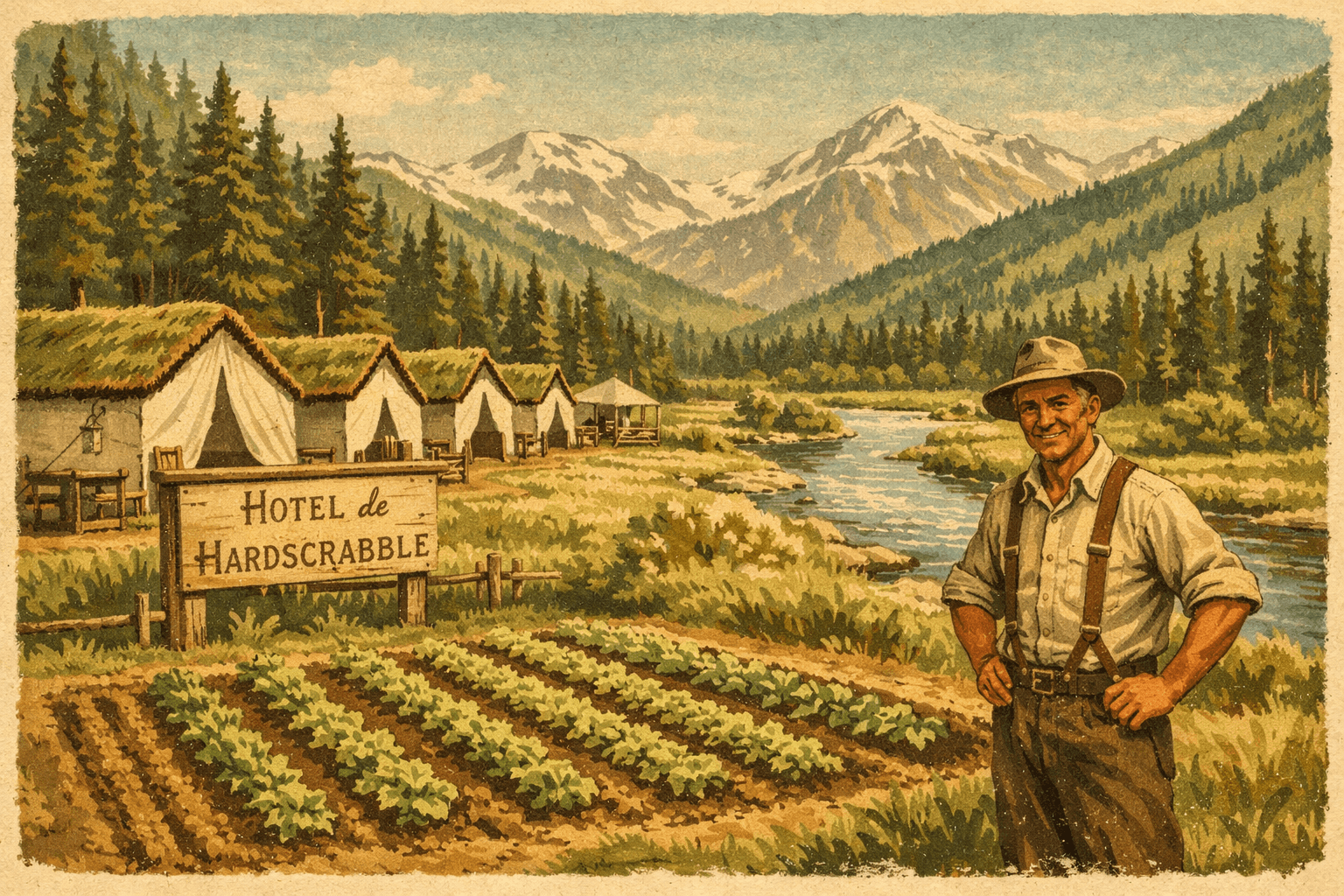
What Was the Hotel de Hardscrabble? In 1907, Wheeler got an idea. The meadow along the Colorado River was lush and green and far enough from everything that people who found it tended to stay longer than they planned. He set up four tent cabins and opened what he called the Hotel de Hardscrabble, also known as Camp Wheeler. He had no road to speak of. Access was by horseback or wagon over rough mountain terrain. The mattresses were lumpy. The accommodations were, by any reasonable standard, primitive. Nobody seemed to care.
What Wheeler had was food and stories. He was an exceptional cook. Sourdough biscuits. Venison steaks. Meals that people from Denver and Kansas City and Chicago talked about for years after they got home. And he had a voice that carried across a meadow and a fund of stories that kept guests around the fire long after the dishes were cleared. By the end of his first season he had expanded to 20 tent cabins. Word was moving fast.
How Did Squeaky Bob Handle the Sheets? Read More... |
Trivia Question❓Squeaky Bob Wheeler served in a famous military unit before homesteading in the Rockies. What was the name of that unit, and who commanded it? Answer at the bottom of the newsletter |

|
|
DID YOU KNOW?
|
Buck's Joke Of The Day |
Squeaky Bob Wheeler hosted a president, a Supreme Court Chief Justice, and the first director of the National Park Service. None of them got clean sheets. |
LOCAL HIGHLIGHT
If the Squeaky Bob story has you curious about the west side of the park, the Colorado River Trail is worth a visit. The trailhead sits at what was once the heart of Camp Wheeler, 9.4 miles north of the Grand Lake entrance. It is flat, well-maintained, and quiet in March. The meadow Wheeler farmed and cooked in is still right there, running along the river, looking exactly like the kind of place a man with a high-pitched voice and a good recipe for sourdough biscuits would decide to stay forever. |
💡 Answer to Trivia Question: Teddy Roosevelt's Rough Riders, officially the 1st United States Volunteer Cavalry, commanded by Colonel Leonard Wood with Roosevelt as Lieutenant Colonel. Wheeler served in the unit during the Spanish-American War of 1898 before returning to Colorado and eventually homesteading in Phantom Valley on the west side of what became Rocky Mountain National Park. |
CLOSING FROM BUCK A man with a squeaky voice and four tent cabins built something that presidents came to find. He grew lettuce on ground nobody believed in. He cooked food people still talked about fifty years later. He never changed a sheet in his life and somehow that became part of the charm. Moe put his gloves back on at the door and said, "I want to go walk that parking lot." I told him it was a good trailhead. Wheeler would have appreciated the foot traffic.
Stay smart, stay safe, and leave the mountains more stubborn than everyone who told you what couldn't grow up here. — Buck Timber Estes Park, Colorado |
This above story account draws from Mary L. Cairns' 1946 book "Grand Lake: The Pioneers," Robert C. Black's "Island in the Rockies: The History of Grand County Colorado to 1930," the 1947 Colorado Magazine article "Squeaky Bob Wheeler's Hunting and Ranch Life in the North Park Country" by Mr. and Mrs. James Rose Harvey, and the National Park Service's historical records on Rocky Mountain National Park. The broad facts are solid and well documented. A few scenes have been shaped for the telling. Think of it the way you would any good mountain story passed down over a hundred years: the bones are true, and the telling has gotten better with time. — Buck |
Share The Mountain Thread with someone who loves this valley. themountainthread.com/signup |