THE CON THAT BUILT ALLENSPARK |
Uncovering the twisted web of deception that transformed a small town - Allenspark's shocking history exposed! |
This account draws from Colorado Public Radio's 2019 report "The Fake Gold Rush That Put Allenspark On The Map," Boulder County landmark designation records, the National Park Service's 2006 mining survey of Rocky Mountain National Park, and the documented history of Allenspark, Colorado. The corporate fraud is verified through official county records. The shotgun salting detail comes from oral history preserved by Allenspark resident and amateur historian Edie DeWeese, whose family has lived there since 1904. No forensic evidence from the 1890s exists to confirm it, but the story has held together for over a hundred years in a small town where people tend to know the difference. The broad facts are solid. Some scenes have been shaped for the telling. Think of it the way you would any good historical drama: based on true events, with a few gaps filled by a storyteller who has lived in this valley long enough to know how these things usually go. -Enjoy The Story, Buck |
Moe Pass came by Thursday with coffee and what he called "something you are going to want to hear." He sat down at the kitchen table, pulled off his gloves, and told me he had been reading about Allenspark. I told him I already knew a story about Allenspark.
He said he doubted it was the same one.
He was wrong. We had both stumbled onto the Clara Belle Mining and Reduction Company, which is either the funniest or the most embarrassing chapter in the history of Colorado gold mining, depending on whether you were the one holding the shotgun or the one writing the check.
Last week I told you about the Agnes Lowe stunt up at Rocky Mountain National Park. A fake cavewoman, a crowd of two thousand, a ranger waiting in the trees with a change of clothes. This one is different. You better pull up a chair. |
SIT DOWN. THIS ONE'S GOOD.
The Men Who Shot Gold Into the Walls
How Two Nebraska Lawyers Built a Town They Were Trying to Rob
What Is the Clara Belle Mining Scam? Allenspark, Colorado sits at 8,428 feet on the Peak to Peak Highway, about fifteen miles south of Estes Park. It is quiet up there. Small. The kind of place where the same families have lived for four generations and everybody knows whose cabin is whose. It was not always quiet. In 1896, Allenspark was the site of a gold rush. Investors came from as far away as Omaha, Nebraska. A mill was built. Claims were staked. Money changed hands. Not one meaningful ounce of gold ever came out of the ground.
What came out instead was a story.
Who Was Alonzo Allen? The man the town is named after, Alonzo Nelson Allen, arrived in Colorado from Columbus, Wisconsin, during the gold rush of 1859. He prospected. He ran cattle. He built the first cabin in the high meadow in 1864. He never found significant gold. He died in 1894, the same year a forest fire took his cabin to the ground.
When Allen died and his cabin burned, the land was essentially open. The pioneer era was over. What came next was something different. Something from Omaha.
Who Were the Men Behind the Clara Belle? John Bishop, William McCollister, and C.L. Tripp were not miners. They were Nebraska attorneys.
McCollister and Tripp had practiced law together. They understood contracts, corporate structures, and the specific kind of paperwork that makes a fraudulent venture look like a sound investment.
In 1896 they formed the Clara Belle Mining and Reduction Company. The name was chosen carefully. Clara was Tripp's wife. Belle was McCollister's. Naming a mining company after your wife signals permanence. Legacy. The kind of long-term thinking that reassures a man writing a large check. It says: we are not here to take your money and run. We are here to build something for our families. They were absolutely here to take the money and run.
Why Did Investors Believe Them? Their timing was sharp. The silver crash of 1893 had rattled every investor between St. Louis and Denver. People were desperate for the next great find. Eight miles south of Allenspark, the town of Ward was a genuine gold and silver producer. The Switzerland Trail railroad was on its way. Real ore. Real money. The Clara Belle men pointed at Ward and said: look at that. Now look north. Same mountains. Same rock. Same veins. The same veins did not run north. But the investors from Omaha did not know that.
How Did the Shotgun Gold Scam Work? The most enduring detail of the Clara Belle story, passed down through Allenspark families for over a century, is how they prepared the mine for investor visits.
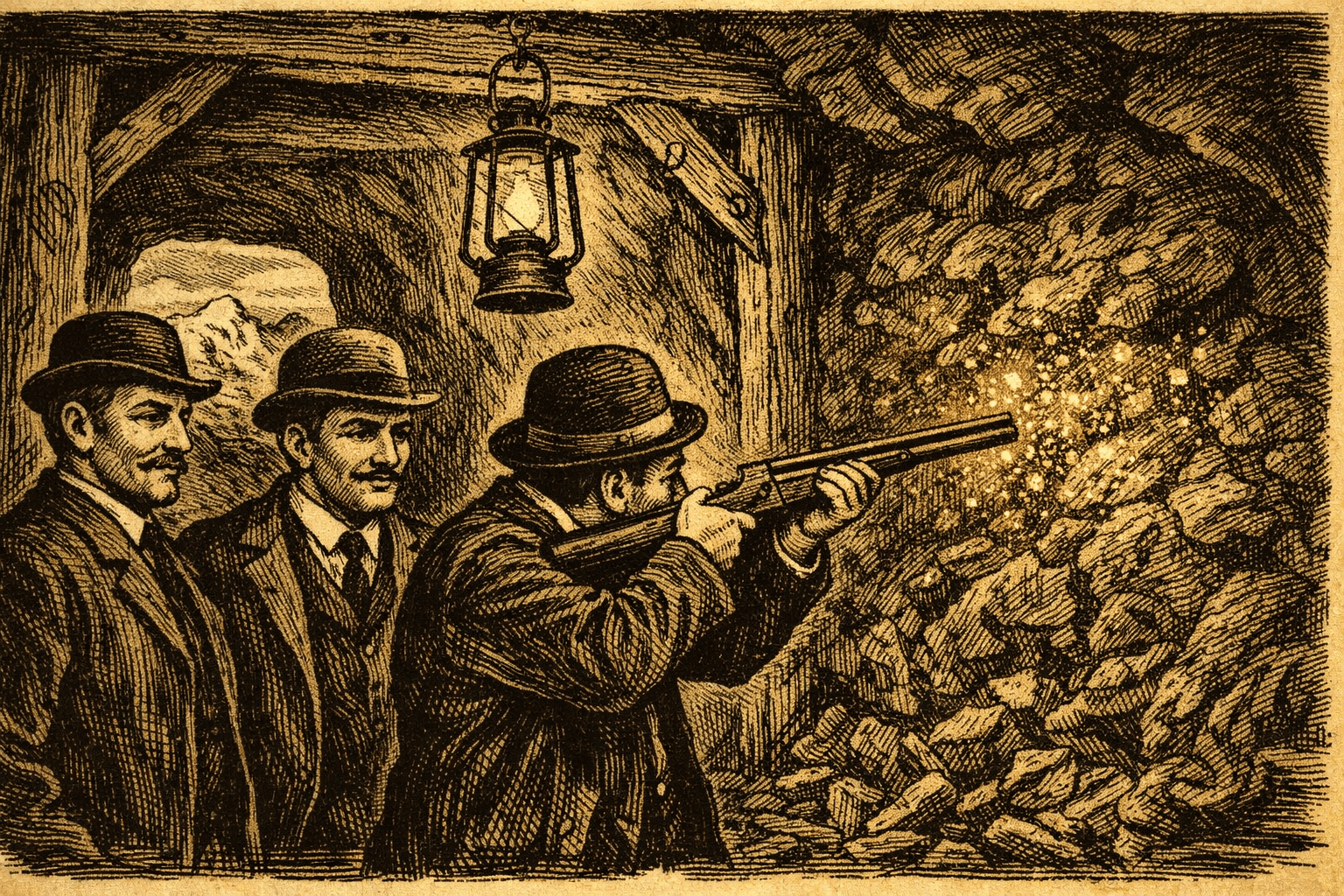
They loaded gold flakes into shotgun shells and fired them directly into the rock walls of the mine shafts. The flakes embedded in the natural fissures of the stone, creating what looked, by lantern light in a dim mine shaft, exactly like a primary gold vein freshly exposed by the drill. When the Omaha investors arrived for their inspection tours, they were led in by the experts. They saw the glitter in the walls. They signed the checks.
What Was the "Tripp Process"? Tripp added a second layer. He claimed to have invented a proprietary extraction technology. The "Tripp Process" was supposedly capable of pulling more gold from raw ore than any conventional method on the market. If an investor looked at the rock and wondered whether it was rich enough, Tripp had the answer ready: doesn't matter, because the process makes low-grade ore profitable. It was a con designed to survive its own doubt. Fake gold in the walls. Fake technology to extract it. Two frauds, stacked on top of each other.
How Did the Scam End? A mill was built near Horse Creek around 1902. There are photographs in the Denver Public Library of Allenspark residents at the Clara Belle mine, ore carts and cable systems visible behind them. Real equipment. Real workers. No real gold.
By 1910 all significant mining had stopped. The NPS survey of the district is blunt about it: the Allenspark mines were "speculative ventures that never produced mineral beyond the odd lot sold for mill tests." The Clara Belle mill was a total failure. Bishop, McCollister, and Tripp had long since moved on.
What Did the Clara Belle Leave Behind? Here is the part that stays with me.
Boulder County historical records describe the Clara Belle Mining and Reduction Company as "the impetus which established Allenspark as a legitimate town." The platting of the village, the post office, the roads, the buildings, all of it came from the speculative capital that three lawyers attracted with a shotgun full of gold flakes and a fake patent. The fraud failed. The town it built did not.
When the mines went quiet, the people who had come to Allenspark looked around at the high meadows and the views and the cool summer air and decided to stay. The investors who had been conned into buying land built summer cabins instead. Failed miners found steadier money feeding and housing the people who came up from the plains to breathe the altitude.
A con man's infrastructure became a community's foundation.
Moe finished his coffee and looked out toward the peaks. "Two lawyers from Nebraska," he said. "Never worked a mine in their lives." "Named the company after their wives," I said. He shook his head slowly. "That's either the coldest thing I've ever heard or the most romantic." I told him I had been thinking about it for two days and still hadn't decided.
Allenspark is still up there at 8,428 feet. Still quiet. Still small. The Clara Belle mill is gone. The mine shafts have collapsed. The gold that was shot into the walls has long since weathered out. What's left is the town. |
0 Comments
Join the conversation
Be the first to comment
Share your thoughts above.