The Mountain Thread
Latest News
|The Mountain Thread
Latest News

Subscribe

Two Old Men Got on a Train in Wyoming.

|
The Mountain Thread

The Mountain Thread

Archives

Two Old Men Got on a Train in Wyoming.

Two Old Men Got on a Train in Wyoming.
What they remembered when they got to Estes Park changed the name of everything.

Buck Timber

Mar 19, 2026

Arapaho Sacred Geography and

This Week in Estes Park

Moe Pass came by the other evening with coffee and a question. He had been reading trail signs up near the Mummy Range and wanted to know why the old maps called it something different. The Arapaho name, he said, had never come up in any of his ranger training. Nobody had told him about the White Owls.

I told him to sit down.

There is a version of this valley that most people walking its trails have never heard. Not the pioneer story. Not the hotel story. Not even the mining story. The one that came before all of those. The one where the names on every ridge and peak and high meadow are not labels but explanations. Where a mountain is not a mountain but a record of something that happened there, told in a language that was spoken here for centuries before anyone arrived with a surveying rod.

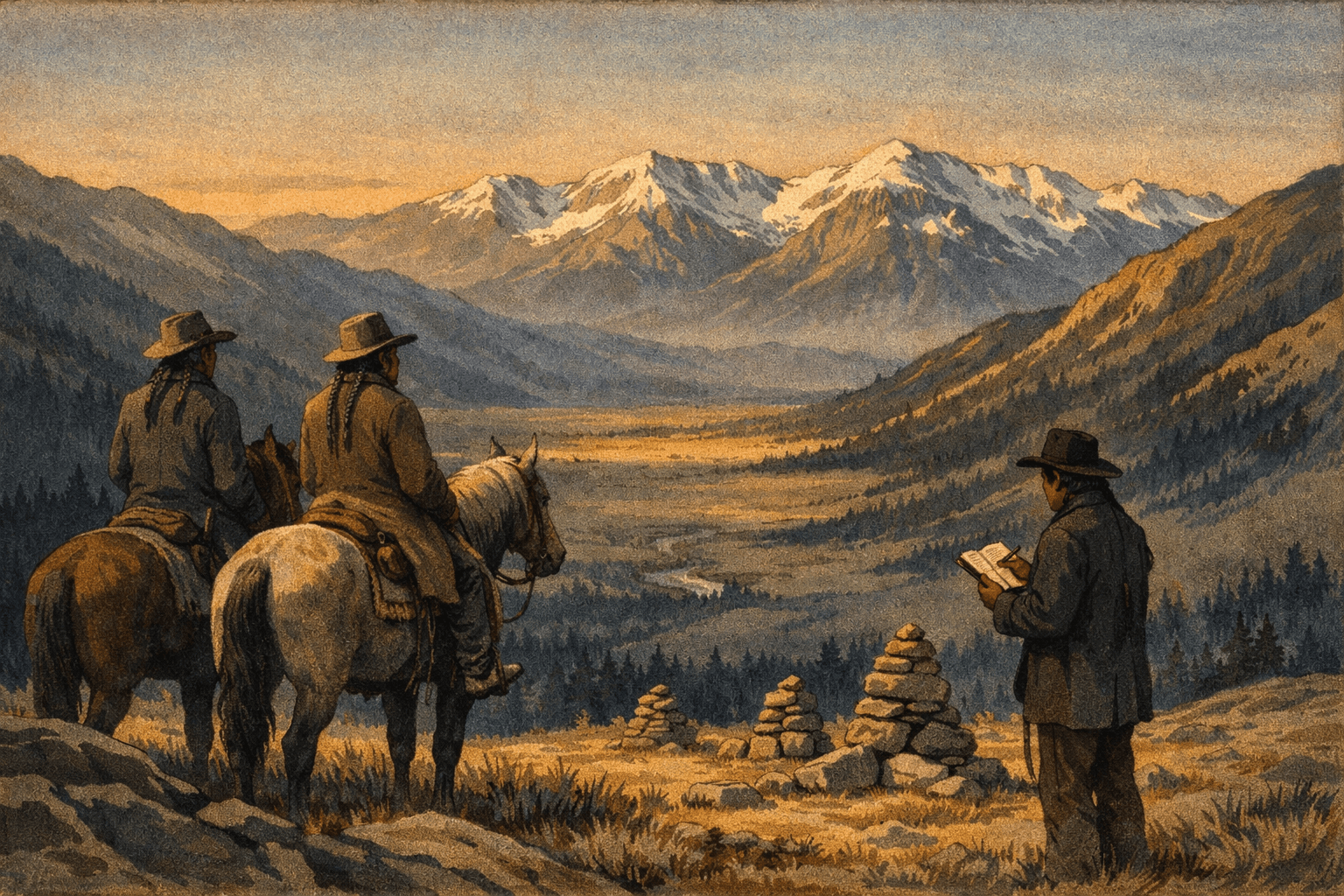
In 1914, two elderly Arapaho men came back to Estes Park for the first time since their childhood. They were brought by a woman from the Colorado Mountain Club who wanted the peaks named before the new national park was formalized. What those two men told her that summer is still sitting in the record, mostly unread.

Moe put down his coffee. "Why doesn't anyone talk about this?"

That is what I said.


PULL UP A CHAIR. THIS ONE'S GOOD.


Who Were the Arapaho of Estes Park?

Before Joel Estes rode into the valley in 1859, before Lord Dunraven tried to buy it, before F.O. Stanley drove his steam car up the switchbacks, the people who knew this place best called it something else entirely.

In Arapaho, the Estes basin was known as "The Circle" — a reference to the shape of the valley and its central place in their world.

They were not casual visitors. The Northern Arapaho summered in what is now Rocky Mountain National Park at least through the 1850s. They hunted, camped, fought battles, and built a geography of meaning across the entire high country. Trails went by specific names. Peaks held specific stories. The land was not blank.

They were pushed out as settlers arrived. By the time the park was formally established in 1915, the Arapaho had been living on the Wind River Reservation in Wyoming for decades. Their names for this place had not made it onto any official map.

That almost did not change.


What Brought Two Old Men Back to the Valley in 1914?

In the summer of 1914, a woman named Miss Harriett W. Vaille was under pressure. She chaired the Nomenclature Committee of the Colorado Mountain Club. The Chief Geographer of the U.S. Geological Survey was pushing her to produce names for the features of the proposed national park. She could have invented them. She did not.

Instead, she traveled to the Wind River Reservation in Wyoming and persuaded two elderly Arapaho men to make the journey back to a place they had not seen since childhood.

Their names were Gun Griswold, age 73, a judge on the reservation, and Sherman Sage, age 63, the reservation's chief of police. They arrived at the Longmont train station on July 14, 1914, accompanied by Tom Crispin, a 38-year-old interpreter who was half Arapaho, half white, and well suited to the task.

A young Princeton student named David Hawkins came along to take notes. A local guide named Shep Husted led the horses. And a man named Oliver W. Toll, Miss Vaille's cousin, agreed to manage the whole expedition.

For two weeks, they rode. Past Poudre Lakes. Down the North Fork of the Colorado. Through Lulu City. By way of Flat Top and Hallett's Peak. They spent a night at Squeaky Bob's place on the Colorado. They visited the stone ruins of what local settlers had been calling "Indian Fort" near the Hondius Ranch.

Gun Griswold and Sherman Sage looked at those ruins and corrected the record. It was not an Indian fort in the general sense. It was the Apache Fort. The site of a specific battle, around 1855, when a party of fifty Apache arrived and clashed with the Arapaho across Beaver Park. Sherman Sage had been about four years old. He remembered it. He read the event from the stone markers the warriors had left, small and large piles placed according to custom to mark what happened where.

At the end of the trip, Toll and the three Arapaho men drove to the Agricultural College at Fort Collins and made dictaphone recordings of the Indian place names. The recordings sat in an archive. Most people driving Trail Ridge Road today have no idea any of this happened.


What Is Gianttrack Mountain?

High on the eastern ridge, there is a peak the Arapaho called hinenitee tohnooxeiht. It means, as directly as it can be translated: "where a person made tracks."

The story behind that name is short and has never been explained away.

Warriors traveling the ridge found footprints in the rock. Human footprints. The size of them was wrong. Too large. Much too large. The warriors looked at what was in front of them, and they turned around. They did not follow the tracks to see where they led.

That is the full account. No resolution. No explanation. No monster revealed and defeated. Just men who looked at something and decided the sensible response was to leave.

The name stayed. The mountain still carries it. If you have hiked that ridge and felt something uncomfortable about the scale of things up there, the Arapaho named that feeling a long time before you arrived.


What Did the Arapaho Believe About the Mummy Range?


Read More...

Trivia Question❓

In 1914, two elderly Arapaho men returned to Estes Park to help name features of the new Rocky Mountain National Park. What were their names, and what roles did they hold on

the Wind River Reservation?

Answer at the bottom of the newsletter

Mountain real estate moves fast.

If you have been watching the Estes Park market or thinking about what property looks like in the high country right now, Peak Capital Mortgage built a free search tool so you can watch it on your own time.

Browse current listings nationwide with one simple signup.

No commitment, no pressure, just listings.


This is not a commitment to lend. All loans subject to underwriter approval. Terms and conditions apply, subject to change without notice. Company NMLS: 2347925, 970-577-9200, Licensing Disclaimers Licensed in: CO, TX, LA, FL, AZ, MT, NM, WY, KS and MS

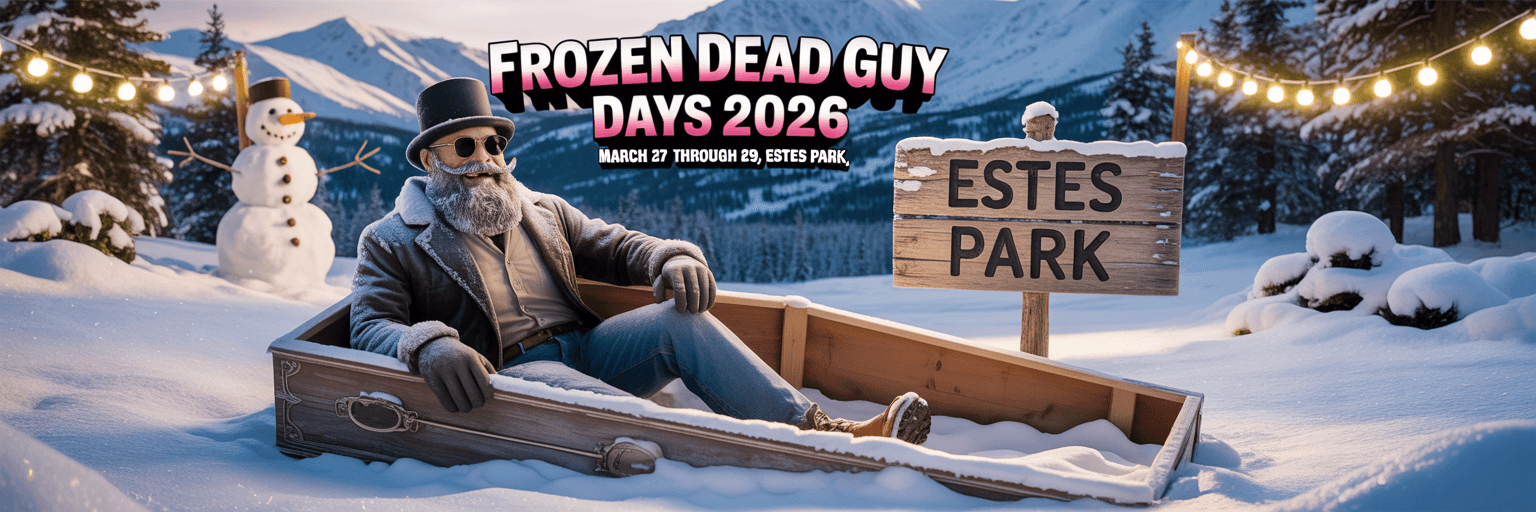
FROZEN DEAD GUY DAYS 2026 March 27 through 29, Estes Park

Friday, March 27

  • Royal Blue Ball at The Stanley Hotel. Live music, immersive entertainment, and ice king and queen costumes. Fancy attire. No excuses.
  • Frozen Dead Bar Crawl. Themed cocktails at participating bars around town. Runs 2:00 p.m. to 12:30 a.m. Pace yourself accordingly.

Saturday, March 28

  • Cryogenic Cannibal Chase 8K. A morning run through Estes Park in costume. Undead attire strongly encouraged. Personal dignity optional.
  • Legendary Coffin Races. Teams race handmade coffins around an obstacle course while shooting hoops through a giant skull. This is a real event. Buck Timber did not make that up.
  • Live music all day at the Estes Park Events Complex. Andy Frasco and the U.N., Rick Lewis Project, Polkanauts, Gasoline Lollipops, Pigeons Playing Ping Pong, and Estes Park's own Buster and the Boomers.

Sunday, March 29

  • Polar Plunge at The Stanley Hotel. Jump into freezing water. Grandpa Bredo would respect it.
  • Bands and Bloodys Brunch at locations around town. Bloody Marys and live music. The civilized end to an uncivilized weekend.

Getting There Free parking at 691 N. St. Vrain Avenue. Shuttle service through Explore Estes. Details at visitestespark.com.

Tickets and full schedule at frozendeadguydays.com. Save 15% with code COFFIN15 through March 21.

DID YOU KNOW? 


  • In Arapaho, the Estes basin was known as "The Circle" — a reference to the shape of the valley and its central place in their world. The Northern Arapaho summered here through at least the 1850s, with established trails, camps, and named landmarks across the entire high country, long before the first Euro-American settler arrived in 1859.
  • Sherman Sage, one of the two Arapaho elders who returned in 1914, was 63 years old and served as the Wind River Reservation's chief of police. His fellow traveler, Gun Griswold, was 73 and a reservation judge. Between them they carried the living memory of a landscape that had nearly been renamed entirely.
  • Trail Ridge Road follows nearly the same route as an ancient Arapaho trail called Child's Trail. The road that millions of visitors drive each summer was walked by Arapaho people for generations before a road crew ever touched it.
  • The Arapaho method for catching eagles on Longs Peak involved a concealed hunter and a stuffed coyote used as bait. When an eagle dropped toward the decoy, the hunter grabbed it by the feet. The feathers were used for war regalia. This practice was documented by Gun Griswold in 1914 in reference to his own father.

Buck's Joke Of The Day

A 73-year-old judge and a 63-year-old chief of police got on a train in Wyoming and rode to Longmont to name a national park.

The U.S. Geological Survey had been waiting on those names for months.

They should have asked sooner.

(The names were recorded on a dictaphone at the Agricultural College in Fort Collins. This was 1914. The technology was brand new. The knowledge was several centuries old.)

LOCAL HIGHLIGHT


Gianttrack Mountain sits on the eastern ridge of Rocky Mountain National Park over 11,500 feet. It is a real peak with a real trail and a real name that most people who have hiked past it could not tell you the meaning of.

Now you know what it means. If you want to go stand on the ridge where those footprints were found, start at the Lumpy Ridge Trailhead off Devils Gulch Road north of Estes Park. Parking is limited so go early. It is a full day out and back, roughly 7.7 miles round trip, rated difficult. Snow is still present at elevation this time of year, so traction devices and layers are not optional.

The warriors who found those tracks turned around. You do not have to. But you might want to slow down first.

💡 Answer to Trivia Question:

Gun Griswold, age 73, was a judge on the Wind River Reservation. Sherman Sage, age 63, was the reservation's chief of police. Both had spent time in the Estes Park area as children in the 1850s, before the Arapaho were displaced from the region. They returned in July 1914 at the invitation of Harriett W. Vaille of the Colorado Mountain Club to identify and name features of the proposed Rocky Mountain National Park.

UNTIL NEXT WEEK

Moe finished his coffee and stood up at the door. He said he was going to go pull the Toll report and read it front to back.


I told him it was in the archive at the Colorado Historical Society. He said that was fine. He had a library card.


Some things deserve a closer look than they got the first time around. The names on these peaks are one of them.


Stay smart, stay safe, and leave the mountains better named than you found them.


Buck Timber The Mountain Thread themountainthread.com/signup

- Buck Timber Estes Park, Colorado

This account draws from Oliver W. Toll's 1914 field notes, the RMNP Historical Data archive, oral traditions recorded from Gun Griswold and Sherman Sage at the Wind River Reservation, and the place name scholarship preserved in High Country Names by Louisa Ward Arps and Elinor Kingery. The broad facts are solid. Some scenes have been shaped for the telling. Think of it the way you would any good historical drama: based on true events, with a few gaps filled by a storyteller who has lived in this valley long enough to know how these things usually go. - Buck

Share The Mountain Thread with someone who loves this valley. themountainthread.com/signup

/>
The Mountain Thread

© 2026 The Mountain Thread.

The Mountain Thread is your community-first newsletter for Estes Park, weaving together local stories, events, and hidden gems from life in the Rockies. With a warm and neighborly tone, it keeps you connected to the people and places that make Estes Park special.

© 2026 The Mountain Thread.