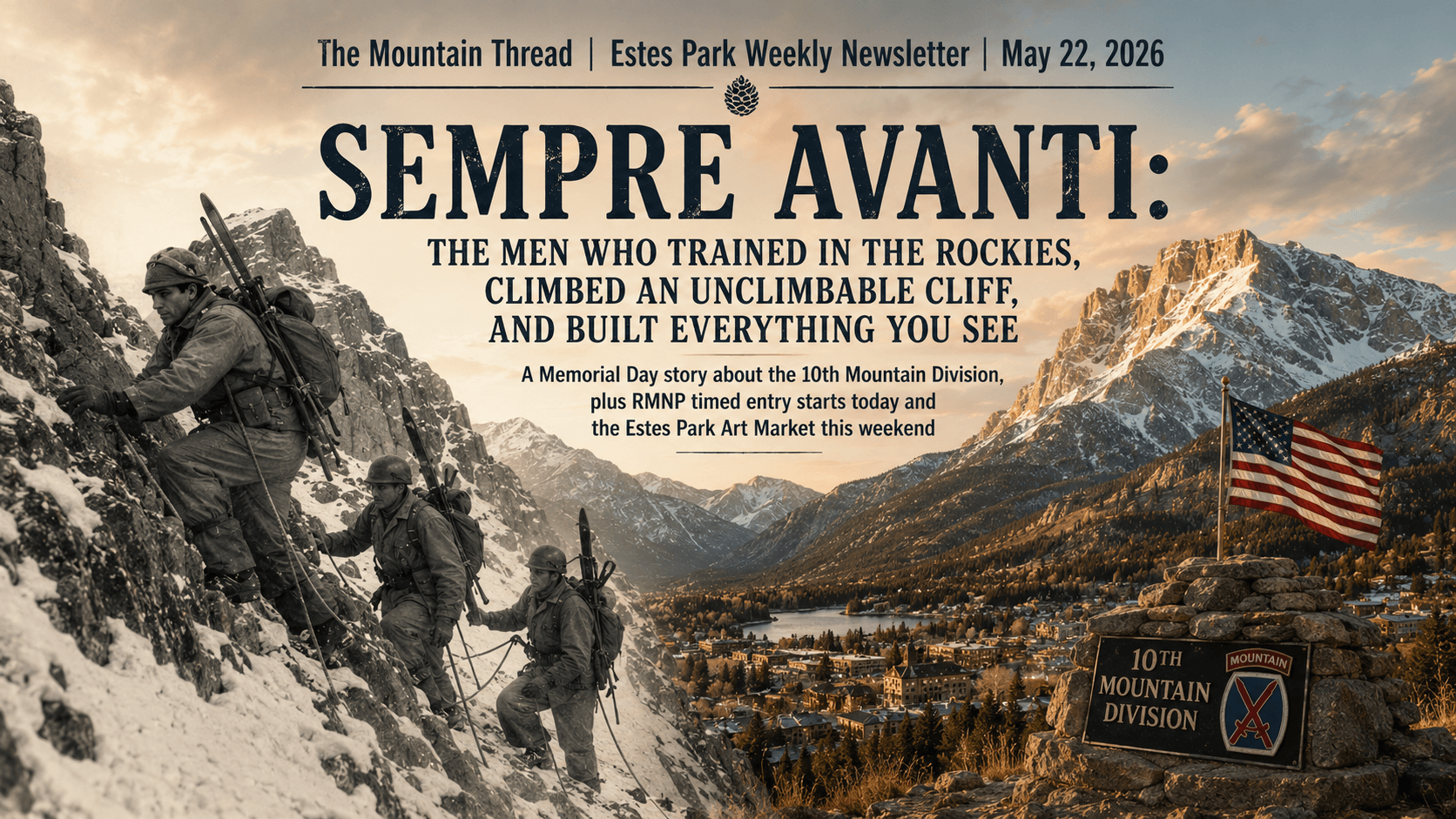
Sempre Avanti A Memorial Day story about the 10th Mountain Division, plus RMNP timed entry starts today and the Estes Park Art Market this weekend
The Mountain Thread | Estes Park Newsletter | May 22, 2026 |
 |
BEFORE THE COFFEE GETS COLD
Moe called Wednesday afternoon and said he had been walking along the Riverwalk and looked up and saw the red car making its way across the sky above town.
Moe stopped by Wednesday morning and said he had been thinking about last week's newsletter. The red car. Robert Heron. The cables he built for a war and then brought home to a resort town. He wanted to know more about the men on the other end of those cables.
I told him to sit down. This was going to take a few minutes. Memorial Day weekend is here. The timed entry reservations for Rocky Mountain National Park start today. The Art Market opens tomorrow in Bond Park. Trail Ridge Road is still closed.
And somewhere in the Italian Apennines in February 1945, a group of men from Colorado climbed a cliff in the dark, in single file, with unloaded weapons, and changed the course of the war. Most people know D-Day. Almost nobody knows Riva Ridge. They should.
SIT DOWN. THIS ONE'S GOOD. |
How Did the 10th Mountain Division Start?
It started with a ski patrol president and a letter to a general. In the late 1930s, Charles Minot "Minnie" Dole, head of the National Ski Patrol, watched newsreels of Finnish soldiers on skis defeating a larger Soviet invasion force during the Winter War of 1939. He had a thought. He wrote to General George C. Marshall, Army Chief of Staff, proposing a division trained specifically for mountain and winter warfare.
Marshall was not initially interested. Dole kept writing.
Eventually Marshall said yes.
The recruiting process was unlike anything the Army had done before. Volunteers had to provide three letters of recommendation attesting to outstanding character and athletic ability. Joining felt more like applying to an exclusive club than enlisting. The National Ski Patrol became the only civilian recruiting agency in U.S. military history.
They needed a place to train. They needed mountains. They needed cold.
They built Camp Hale.
What Was Camp Hale?
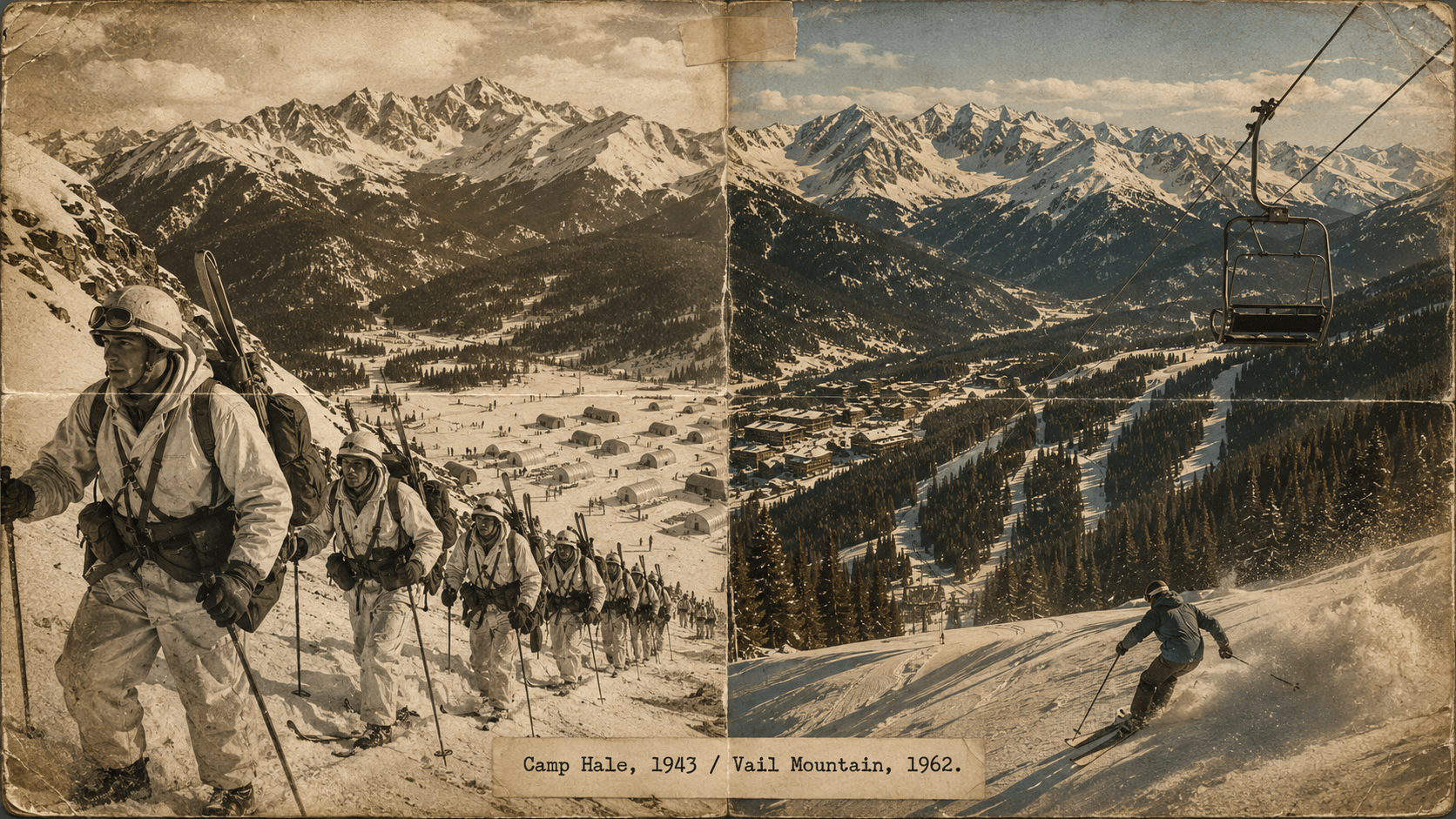
In April 1942, construction began on a military installation in the Pando Valley near Leadville, Colorado, at an elevation of 9,238 feet. By November of that year it was done. The entire camp, 1,457 acres, built in seven months at a cost of $30 million.
At peak, approximately 14,000 to 15,000 soldiers trained there simultaneously.
The training was what you would expect from a division being prepared to fight in the Alps. Skiing from morning to night. Summer hikes of 25 miles with full packs. Rock climbing. Cold-weather survival. Mule teams and sled dogs for supply transport. Winter maneuvers called the "D-Series" conducted at temperatures as low as 35 degrees below zero, with orders banning open fires for tactical realism.
Some soldiers skied from Camp Hale all the way to Aspen on their days off. Some of those soldiers would later build Aspen.
The altitude caused constant health problems. The coal-powered camp sat in a narrow valley that trapped its own pollution in toxic inversion layers. Soldiers coughed through the winter. They called it "Camp Hell."
They trained there anyway. For two years.
What Happened at Riva Ridge?
Read More... |
Trivia Question❓The 10th Mountain Division trained at Camp Hale, Colorado, before fighting in Italy in World War II. What was the elevation of Camp Hale, how many soldiers trained there at peak, and what did soldiers nickname it? Answer at the bottom of the newsletter |

Explore the collection at AlpenglowBeauty.com and enjoy 20% off with code RIDGE20 through May 31. |
|
RMNP UPDATE
Timed entry reservations begin today, May 22.
Starting today, permits are required to enter the park between 9 a.m. and 2 p.m. for general access and between 5 a.m. and 6 p.m. for the Bear Lake Road Corridor. A separate park entrance fee or pass is required in addition to the permit. If you did not grab a reservation in the May 1 release, 40 percent of permits are released at 7 p.m. MDT the night before your desired entry date on Recreation.gov.
No permit is needed outside those windows. Early morning and late afternoon entry remains open without a reservation.
Trail Ridge Road remains closed. The road is closed on the east side at Many Parks Curve and on the west side at the Colorado River Trailhead. No opening date has been announced. Call 970-586-1222 for current status.
In late May, Trail Ridge Road typically opens for the season. This year, between the May snowstorm and the delayed plowing schedule, opening timing remains uncertain. Check before you go.
Bear Lake Road is open year-round. Lower elevation trails are accessible. Wildflowers begin blooming at lower elevations in late April or early May, and with the staggered bloom from the May snowstorm, late May wildflowers on south-facing slopes below 9,500 feet are worth the trip.
One thing worth knowing for Memorial Day weekend visitors: a day can begin warm and sunny, then afternoon thunderstorms can roll in, bringing cool and wet weather in just a few hours. Pack layers. Start early. Be off exposed ridgelines by early afternoon.. |
DID YOU KNOW?
The 10th Mountain Division was created in Colorado in 1943 and trained at Camp Hale near Leadville. It was the only unit in the history of the United States Army to be organized specifically for mountain and winter warfare.
Riva Ridge was captured in February 1945, which allowed Allied forces to finally break through the line and advance through Europe. The Germans had considered the cliff unscalable. The 10th Mountain Division climbed it at night with unloaded weapons and muffled piton hammers. Not a single man died during the ascent itself.
The Tennessee Pass Memorial, dedicated on Memorial Day 1959, honors the WWII fallen of the 10th Mountain Division. Upon its gleaming red granite surface are etched the names of 1,000 soldiers who made the ultimate sacrifice. The annual Memorial Day service at Tennessee Pass is open to the public. It is about two hours from Estes Park and worth the drive.
During World War II, the 10th Mountain Division suffered 992 killed in action and 4,154 wounded in action in 114 days of combat. The division's motto is Sempre Avanti. Always Forward. |
Buck's Joke Of The Day |
Pete Seibert trained at Camp Hale at 9,238 feet, fought at Riva Ridge, was seriously wounded by German mortar shells, came home, became a ski patrolman, climbed a mountain in the Eagle River Valley, and founded Vail.
He named the longest ski run Riva Ridge. The lift ticket cost five dollars. The Germans who held that ridge in 1945 did not get a run named after them.
(Vail opened December 15, 1962. Pete Seibert is buried in Vail Memorial Park. Some people leave better things behind than others.) |
💡 Answer to Trivia Question: Camp Hale was built at 9,238 feet elevation in the Pando Valley near Leadville, Colorado. At peak, approximately 14,000 to 15,000 soldiers trained there simultaneously. The toxic coal smoke that settled in the narrow valley, the extreme cold, and the brutal training regimen earned it the nickname "Camp Hell" among the soldiers who trained there. The entire camp was built in seven months at a cost of $30 million. Most of the buildings were demolished in 1945. The site is now part of the Camp Hale-Continental Divide National Monument. |
UNTIL NEXT WEEK
Moe finished his coffee and sat quietly for a moment. He said he had driven past the Tennessee Pass Memorial a dozen times over the years on the way to somewhere else. He had never stopped.
I told him the annual Memorial Day service is public. Open to anyone. Sunday at Tennessee Pass, two hours south of here, near Leadville. Names of 1,000 men etched in red granite. The same pass where they trained. The same mountains they left.
He said he was going to go this year. I told him to bring flowers if he could. The Foundation puts flowers on grave sites every Memorial Day for the soldiers buried there, but the monument itself is better with people standing in front of it. He said he understood.
992 killed. 4,154 wounded. 114 days. They called it Camp Hell and they trained there for two years and they climbed a cliff in Italy in the dark and they came home and built Vail and Aspen and Arapahoe Basin and 38 backcountry huts and 350 miles of trail.
Sempre Avanti.
Always forward. Happy Memorial Day. Go outside this weekend. The mountains they helped protect are still there. Stay smart, stay safe, and leave the mountains worthy of the people who fought for them.
.- Buck Timber The Mountain Thread themountainthread.com/signup |
This account draws from the 10th Mountain Division Foundation, the Colorado Snowsports Museum, the U.S. Army historical record, the Vail Daily, and the documented history of Camp Hale. The broad facts are solid. Some scenes have been shaped for the telling. Think of it the way you would any good historical drama: based on true events, with a few gaps filled by a storyteller who has lived in this valley long enough to know how these things usually go. or the telling - Buck |
Share The Mountain Thread with someone who loves this valley. themountainthread.com/signup |