The Red Car Is Running Again. The Story Behind It Started in a War. A WWII tramway engineer, a free-span cable above town, and what to do in Estes Park this weekend.
The Mountain Thread | Estes Park Newsletter | May 14, 2026 |
 |
BEFORE THE COFFEE GETS COLD
Moe called Wednesday afternoon and said he had been walking along the Riverwalk and looked up and saw the red car making its way across the sky above town.
He said it the way people say something when they cannot quite believe it is still true. Seventy summers that cable has been running and it still catches people off guard when May comes around and the tram opens for another season.
I told him it has been doing that since 1955. He said that was a long time to keep carrying people over a town without calling attention to itself.
He was right. That is exactly what it has been doing. And this week, that red car has a story worth sitting down for.
Trail Ridge Road is still closed. The May 5–6 storm buried the upper road under fresh snow on top of whatever the winter left behind. Plowing crews will work it when conditions allow. No opening date announced. Call 970-586-1222 for current status or check nps.gov/romo before you go.
The wildflowers are coming up in waves the way two feet of May snow promised they would. South-facing slopes below 9,500 feet are worth your time this weekend.
Timed-entry reservations for May 22 through June 30 are still available on Recreation.gov. No permit is needed before May 22. Forty percent of reservations are released at 7 p.m. MDT the night before your visit date for last-minute planners.
This weekend the Environmental Film Festival runs Friday and Saturday at the Historic Park Theatre. Good films, good cause, good excuse to be downtown on a May evening when the air is doing that particular thing it does after a big storm clears out. The story this week is about the red car.
SIT DOWN. THIS ONE'S GOOD. |
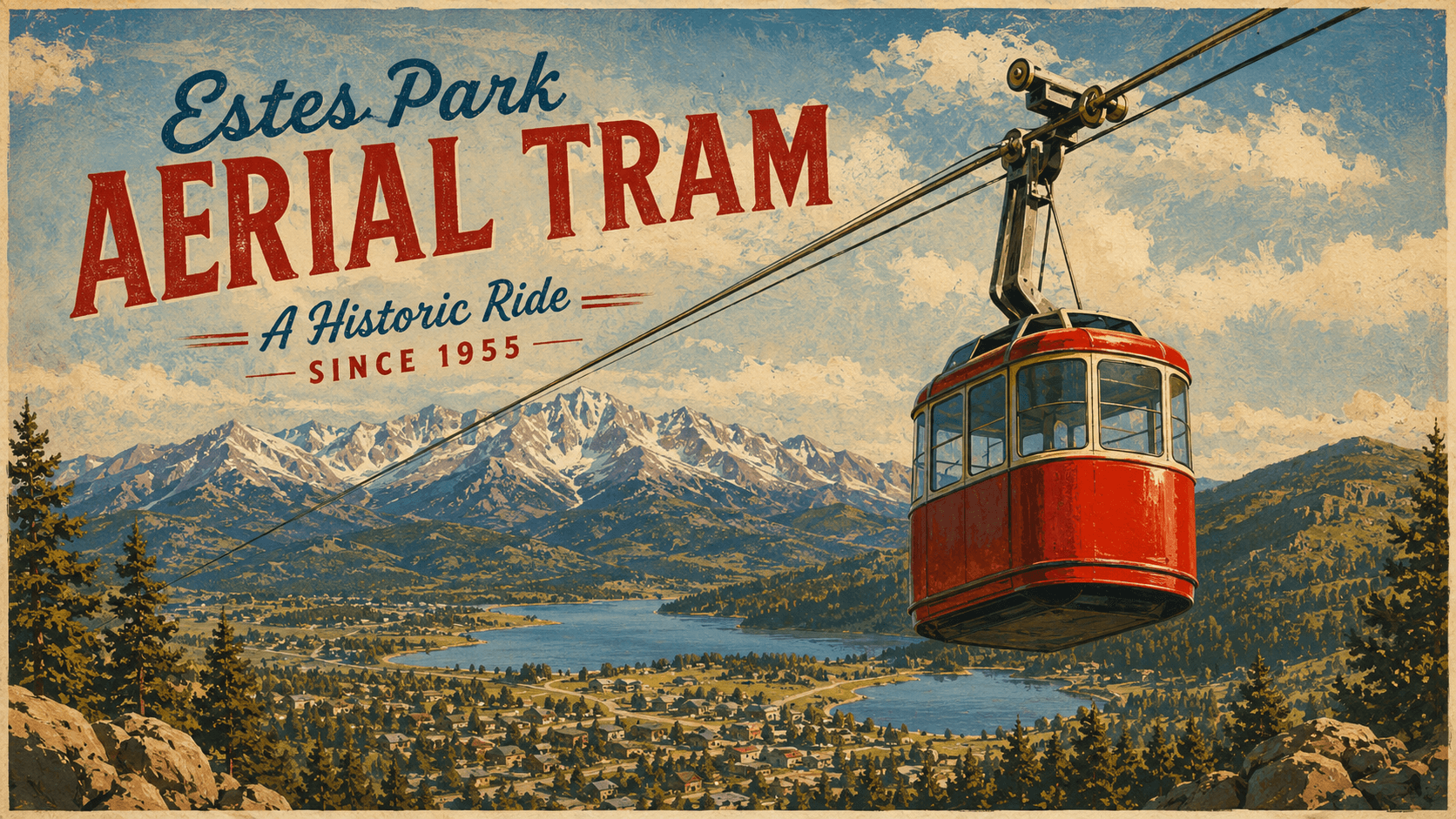
What Is That Red Car, Exactly?It lifts off from a small station near 2nd Street and Riverside. No towers. No intermediate supports. One long stretch of cable — 2,630 feet of free span — running in a clean arc from downtown Estes Park up the side of Prospect Mountain, where the cabin docks at a station perched on a rocky knoll at 8,708 feet with a view of the whole valley and most of Rocky Mountain National Park laid out behind it.
The cabin is cherry red. It has been cherry red since 1955. It carries twelve passengers and hangs, at mid-span, roughly 200 feet above the trees. The cable hums. The town gets smaller. The mountains get bigger. The vertical rise is 1,060 feet. More than three million people have made that trip since the summer it opened.
It is the oldest aerial tramway in Colorado and widely regarded as the first scenic-only aerial tramway in the United States. Built not for skiing, not for industry, but simply to take people from a valley floor to a better view.
Who had the idea? The Engineer and the Cliff Robert Heron was a Colorado engineer when the U.S. Army came looking for people who understood how to move things on cables up steep terrain.
The year was 1943. The Army had a problem in the Italian Apennines. The 10th Mountain Division was fighting on slopes that supply trucks could not handle. They needed food, ammunition, and medical equipment hauled up. They needed wounded soldiers brought back down. The task was assigned to Heron's firm: design a portable tramway for use in Italy and Germany, something that could be rigged on near-vertical terrain in winter, in a war zone, under fire.
He built it. The 10th Mountain Division used portable cableways in the assault on Riva Ridge in February 1945, one of the most difficult mountain operations in American military history. Soldiers and supplies went up. Casualties came down. The cables held.
When the war ended, Heron went to Europe to study what the Swiss and Austrians had been doing with permanent passenger tramways. He saw the free-span design: no towers, no intermediate supports, just two terminal stations and a long arc of cable between them, tensioned by counterweights. Elegant. Conservative. Honest engineering. He came home to Colorado and started Heron Engineering.
The Town With a Mountain and No Ski AreaRead More... |
Trivia Question❓The Estes Park Aerial Tramway opened in 1955 and its engineer had a military background that helped shape the design. What division of the U.S. Army did Robert Heron design military cableways for during World War II, and where did that division famously fight in the Italian mountains in February 1945? Answer at the bottom of the newsletter |

Explore the collection at AlpenglowBeauty.com and enjoy 20% off with code RIDGE20. |
|
RMNP UPDATE
Trail Ridge Road remains closed following the May 5–6 storm. Fresh snow was added to the upper road at a point when plowing was already in progress from winter conditions. No opening date has been announced. Call 970-586-1222 for current road status or check nps.gov/romo before you head up.
Lower-elevation trails are accessible and post-storm conditions have been improving through the week. Expect mud, lingering drifts in the trees, and rapidly changing conditions as snow melts off south-facing slopes.
Timed-entry reservations for May 22 through June 30 are available now on Recreation.gov. No permit is required before May 22. Starting May 22, permits are required between 9 a.m. and 2 p.m. for general park entry and between 5 a.m. and 6 p.m. for the Bear Lake Road Corridor. A separate park entrance fee or pass is required either way. |
DID YOU KNOW?The Estes Park Aerial Tramway opened on June 20, 1955, with a grand opening on August 3, 1955, and is widely regarded as the first scenic-only aerial tramway in the United States — built entirely for sightseeing, not for ski access or industry.
The tram spans 2,630 feet of free cable with no towers, climbs 1,060 vertical feet, and reaches a summit elevation of 8,708 feet. Each of the two cherry-red gondola cabins carries twelve passengers. The Heron Engineering Company purchased 240 acres on Prospect Mountain for the project and built it for an estimated $150,000.
Robert Heron's connection to tramway engineering began when the 10th Mountain Division contracted his firm during World War II to design portable cableways for use in Italy and Germany. He later built some of the first double, triple, and quad chairlifts in the American West. The little red tram above Estes Park has outlasted almost everything else he installed. |
Buck's Joke Of The Day |
The 10th Mountain Division contracted Robert Heron's firm to design military cableways for the mountains of Italy and Germany during World War II.
After the war he went to Europe to study passenger tramways. Then he came back to Colorado, bought 240 acres on a mountain above a resort town, and built a cherry-red sightseeing car so families could look at elk from 8,708 feet.
The 10th Mountain Division used his cables to assault a ridge in Italy. The people of Estes Park have used his cables to take pictures and feed chipmunks.
Both groups were very satisfied with the results. |
💡 Answer to Trivia Question: Robert Heron designed military cableways for the 10th Mountain Division, the U.S. Army’s elite mountain warfare unit, which used those portable tramway systems during the assault on Riva Ridge in the Italian Apennines in February 1945 — one of the most difficult mountain operations in American military history. A decade later, the same engineer applied the same principles of cable tension and free‑span geometry to build a cherry‑red scenic tram above a Colorado resort town. |
UNTIL NEXT WEEK
Moe said he was going to ride the tram Saturday morning if the weather held.
I told him to go early, before the clouds build over the Divide. The morning light on the high country after a big storm is worth whatever it costs to get there.
He said he would bring coffee. I told him the cabin holds about twelve people and to be considerate. He said he would bring twelve coffees. That is not how the tram works, Moe. He said he would figure it out at the dock.
That is probably the correct approach. Some things are better sorted at the dock than planned in advance. Robert Heron built a cable system that has been carrying people to the top of Prospect Mountain for seventy summers. He figured most of it out before anyone else in America thought a scenic tram in a resort town was something worth doing.
Sometimes the best reason to build something is that the mountain is right there and you know how cables work. Stay smart, stay safe, and look up when you walk downtown this weekend.
- Buck Timber The Mountain Thread themountainthread.com/signup |
This account draws from the Estes Park Aerial Tramway's documented history, Heron Engineering records, National Park Service archives, and the living history of the Estes Valley. The broad facts are solid. Some scenes have been shaped for the telling - Buck |
Share The Mountain Thread with someone who loves this valley. themountainthread.com/signup |