Trail Ridge Road - The Highway Above the Clouds The story of the 73-year-old contractor, a half-ton blast & the men who built the highest continuous paved road in North America. |
Before the Coffee Gets ColdMoe Pass stopped by Tuesday morning with coffee and a look on his face that meant he had been thinking about something on the walk over. He had been up to the Many Parks Curve overlook earlier that morning, as far as the road goes this time of year, and stood there looking at the tundra. What he saw up there did not make him feel better. Some measurements are calling it the lowest snowpack on record for this time of year. Trail Ridge is bare in places that are not supposed to be bare in March. That is not a weather inconvenience. That is a water supply problem for everyone downstream.
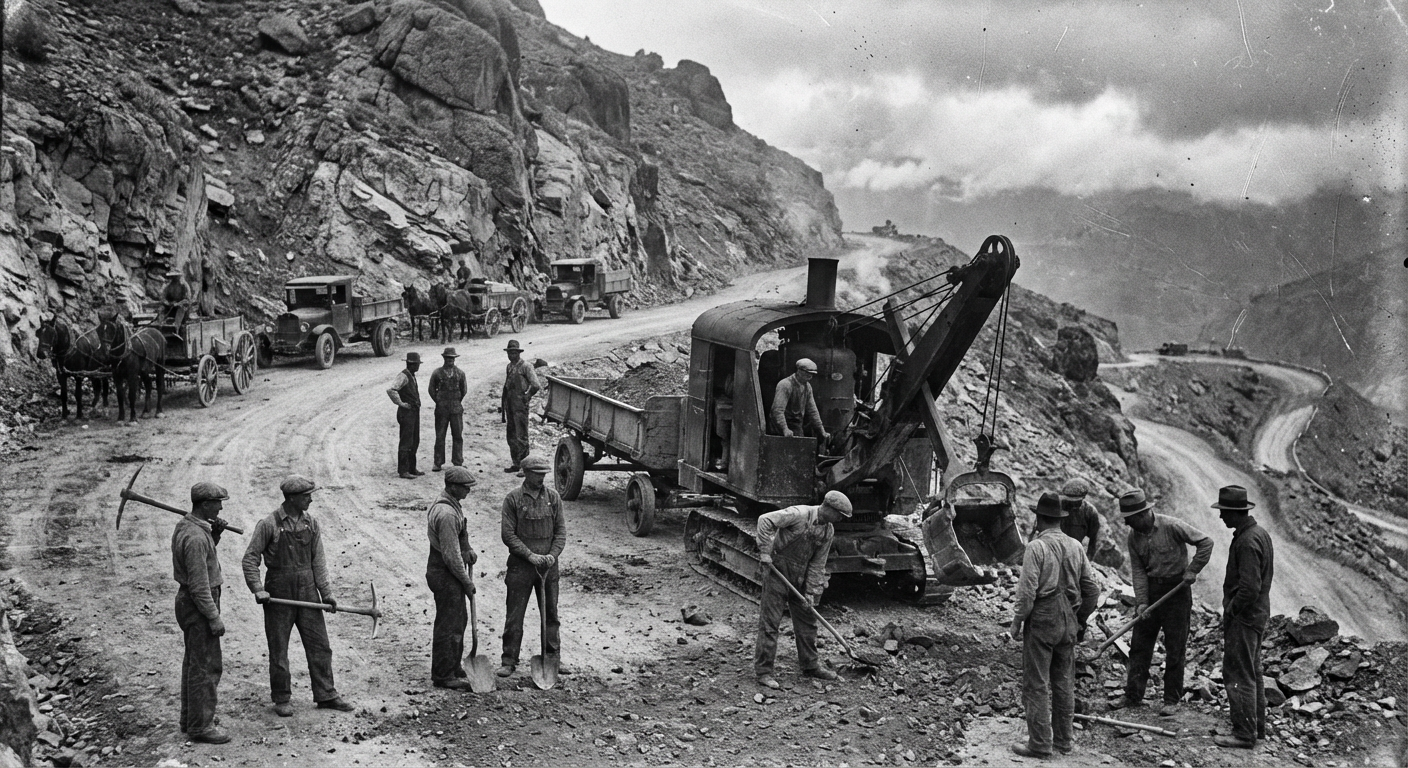
He came inside, set down his coffee, and asked if I had ever thought about what it actually took to build the road we all take for granted every summer. I told him I had been thinking about it all week. There is a gate up there right now, closed at Many Parks Curve. Plowing crews will work it when conditions allow and the road will open when it is ready. Given what little snow is up there, it may open earlier than most years. But most people driving it in June give the road itself about as much thought as they give the asphalt in a grocery store parking lot. They should think about it more. Because the story of how that road got there is genuinely one of the better ones in the history of this valley.
It involves:
Moe picked up his coffee and said, "Well let's hear it" So here it is. SIT DOWN. THIS ONE'S GOOD.
The Road That Shouldn't ExistHow a 73-year-old contractor, a Bureau of Public Roads engineer with a feel for the country, and a trail the Arapaho had been using for centuries became the highest paved road in North America
Why Did They Build It at All?Before Trail Ridge Road, there was Fall River Road. Fall River Road was the park's first high-country route, built between 1913 and 1920. It was:
It got the job done the way a bad tool gets the job done: technically, but not well. By the late 1920s the National Park Service wanted something better. Something that could handle real traffic, connect the east side of the park to the west reliably, and let visitors actually see what they had come to see instead of gripping the dashboard on a switchback. The answer was a road over the top:
The reasons were practical: Jobs. The Depression meant men needed work and the government needed projects. Trail Ridge Road was both. Access. Scientists wanted to study the alpine tundra. Tourists wanted to see it. Before the road you walked in or you did not go. Connection. The road would link Estes Park to Grand Lake without going around the entire park. They started construction in September 1929. The full route to Grand Lake was not completed until 1938. But the first section, east side to Fall River Pass, opened on July 15, 1932. The Estes Park Trail newspaper called the whole project the "Eighth Wonder of the Modern World" in 1931. It was not finished yet when they wrote that. Who Was the Man Who Built It?Read More... |
Trivia Question❓Trail Ridge Road replaced an earlier high-country route through Rocky Mountain National Park. What was that road called, when was it built, and what were the two main engineering flaws that made a replacement necessary? Answer at the bottom of the newsletter |
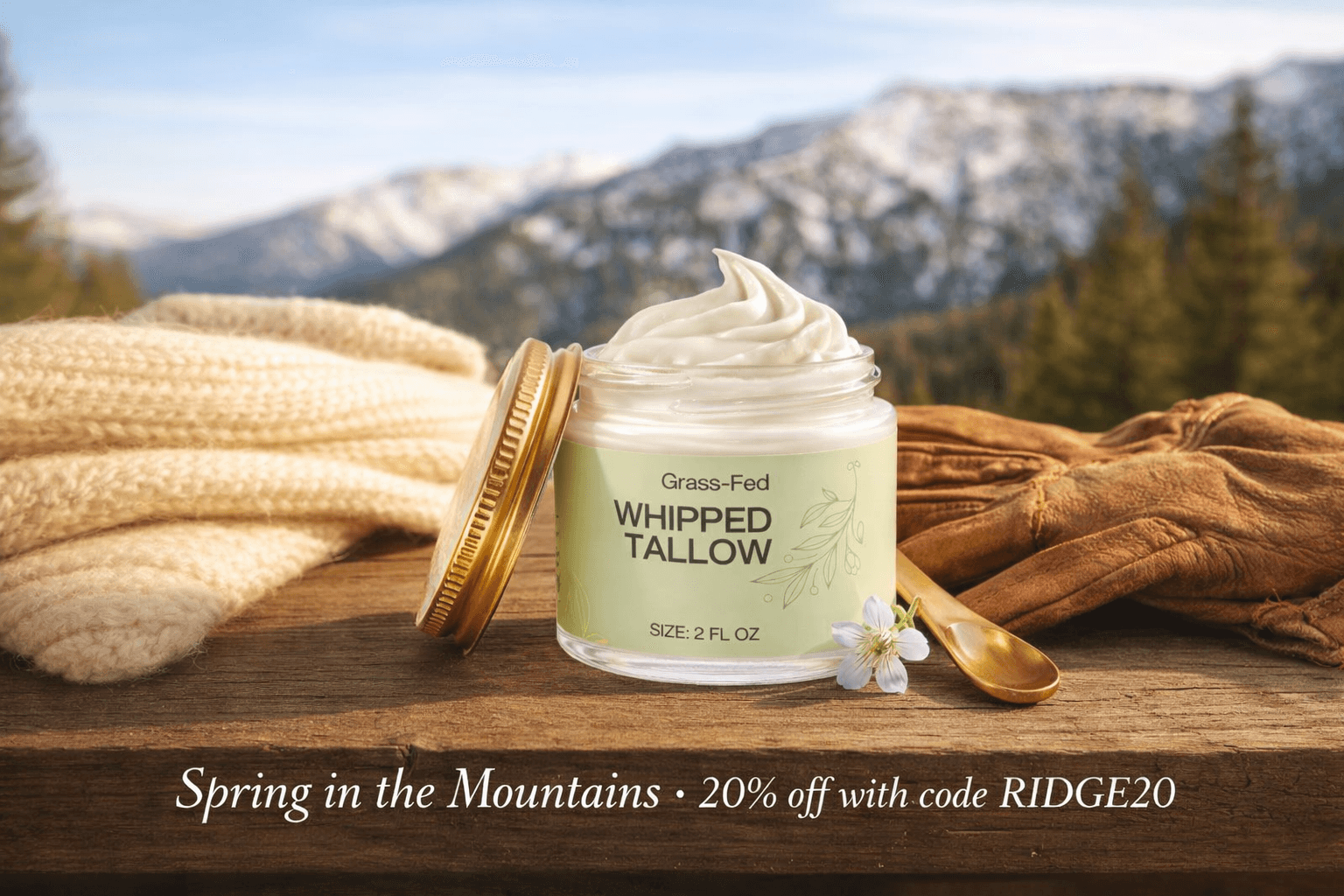
Explore the collection at AlpenglowBeauty.com and enjoy 20% off with code RIDGE20. |
|
 |
LOCAL HIGHLIGHT - BIGFOOT DAYS COMING SOON
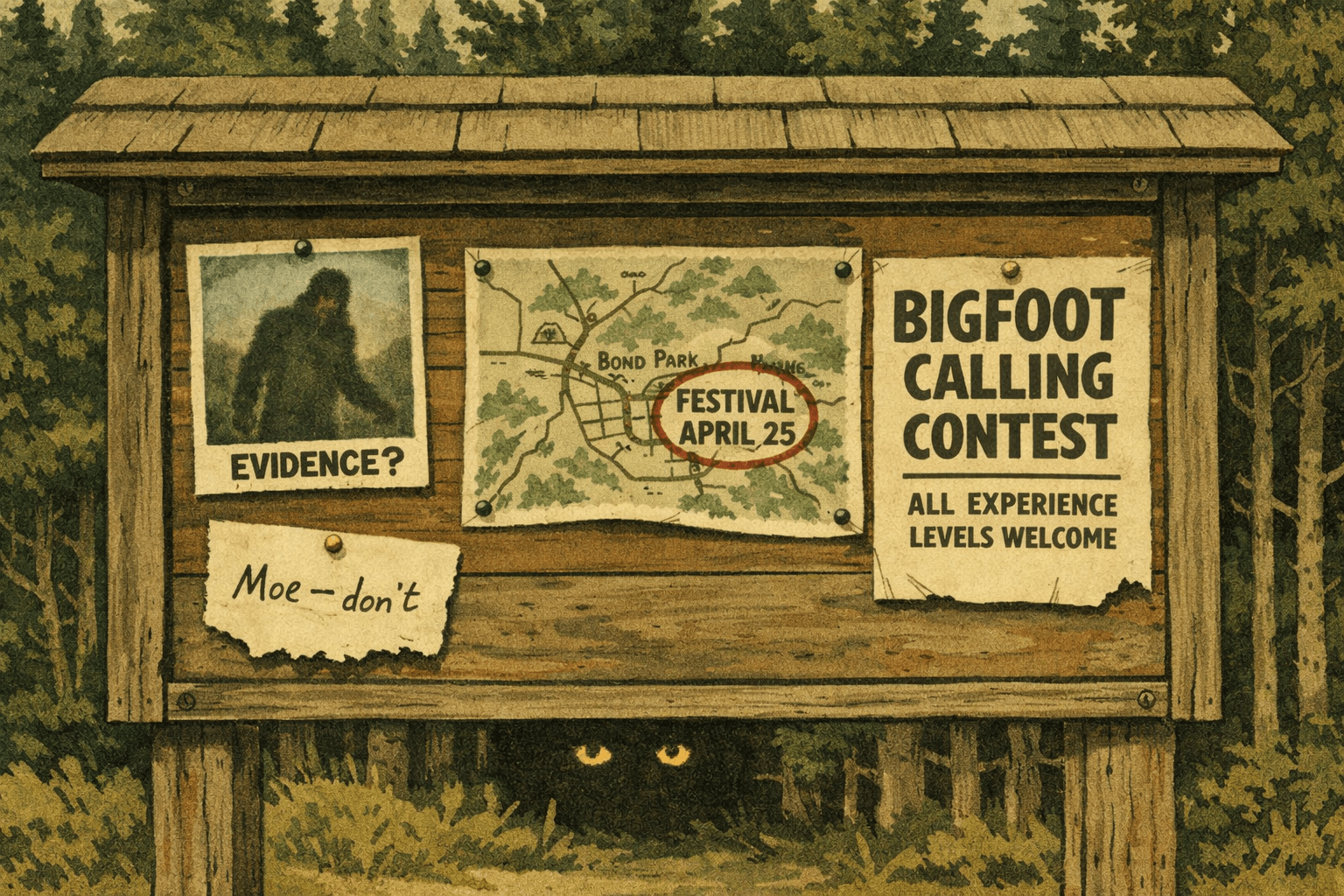
Estes Park has a well-established habit of throwing festivals for things that may or may not exist. Last weekend it was a frozen Norwegian. Next up is a large hairy creature nobody has ever managed to photograph clearly. Bigfoot Days is April 24-25 in Estes Park, and it is a legitimate good time even if your relationship with the evidence is skeptical. Friday, April 24 kicks off with the Bigfoot BBQ, a ticketed dinner with Bigfoot television celebrities, food, drinks, music, and the kind of conversation you did not expect to be having on a Friday night in the Rockies. Tickets are limited to 150. Check eventsinestes.com/bigfoot-days for availability. Saturday, April 25 is the main event. The free outdoor festival runs 10 a.m. to 4 p.m. in Bond Park, featuring appearances and talks from Bigfoot TV celebrities and experts, Colorado Bigfoot sighting stories, live music, axe throwing, inflatable games, craft and food vendors, and a Bigfoot calling contest, which is exactly what it sounds like. If you want to run first, the Bigfoot Half Marathon and 5K finishes downtown right at the festival. Lumpy Ridge Brewing hands you a beer at the finish line. That is a reasonable way to spend a Saturday morning. Saturday evening wraps up at the Historic Park Theatre with a 7 p.m. premiere of The Squatch, a new film by Tom Chaney. Red carpet arrival, a comedian set, Q&A with the director and cast, poster giveaway, and merchandise. Free admission. Moe heard about the Bigfoot calling contest and said he was not sure what the protocol was if something answered. I told him that was probably the point. More information at eventsinestes.com/bigfoot-days or call 970-586-6104. |
DID YOU KNOW?
Colonel W.A. Colt, the contractor who built the east side of Trail Ridge Road, was 73 years old when he won the contract in September 1929. He had started his career on the Erie Canal in the 1870s and had previously built the road over Wolf Creek Pass in the San Juan Mountains. He used 492 of his 500 allotted contract days. Total cost of his contract including engineering fees: $440,940.87. The Rock Cut blast on Monument Ridge in August 1930 involved 178 separate drilled shots wired together and detonated simultaneously, releasing more than half a ton of explosives at once. Most blasts on the project used about 30 shots. The Rock Cut was the exception. The Estes Park Trail newspaper called the entire project the "Eighth Wonder of the Modern World" in 1931, before it was finished. Trail Ridge Road follows a route the Arapaho called taieonjbaa, meaning "Where the Children Walked." The trail was so steep that children could not be carried on travois and had to walk alongside. The Bureau of Public Roads survey noted the road would follow this existing pack trail and would cross rather than run atop it, leaving segments intact as foot trails. The earliest Trail Ridge Road has ever opened is May 7, 2002. The latest was June 26, 1943, when the Department of Interior stopped plowing entirely during World War II and visitors had to wait for the snow to clear on its own. The road has been opening every spring since 1932. |
Buck's Joke Of The Day |
What do you do after the Erie Canal, Wolf Creek Pass, and a railroad through Missouri? You build a road at 12,000 feet in the Rocky Mountains at age 73. Retirement was apparently not discussed. |
💡 Answer to Trivia Question: The road Trail Ridge replaced was Fall River Road, built between 1913 and 1920. Its two main engineering flaws were grades up to 16 percent, far too steep for comfortable or safe vehicle travel, and curves with 20-foot radii, making the road dangerously tight for the vehicles using it. It was also prone to snowslides. Trail Ridge Road was engineered with a maximum grade of 5 percent and far gentler curves, a significant improvement in both safety and accessibility. Old Fall River Road still exists inside the park and opens to one-way uphill vehicle traffic in early July each year. |
UNTIL NEXT WEEK Moe finished his coffee and put his jacket on at the door. He said he was going back up to Many Parks Curve to look at that snowpack one more time. I told him it would still be thin when he got there. He said he knew that. He just liked looking at it anyway. Some things are worth paying attention to even when the news is not good. The snowpack is one of them. The road is another. Colonel Colt used 492 of his 500 days to build something that has outlasted everyone who built it. The least we can do is notice it when we drive across it. Stay smart, stay safe, and leave the mountains better understood than you found them. - Buck Timber The Mountain Thread themountainthread.com/signup |
This account draws from the Historic American Engineering Record (HAER No. CO-31), National Park Service construction archives, Bureau of Public Roads engineering documents, and the 1914 Arapaho place-name expedition led by Oliver W. Toll. The broad facts are documented. Some scenes have been shaped for the telling. Think of it the way you would any good historical drama: based on true events, with a few gaps filled by a storyteller who has lived in this valley long enough to know how these things usually go. - Buck |
Share The Mountain Thread with someone who loves this valley. themountainthread.com/signup |