The Mountain Thread | Estes Park | August 20, 2026 |
 |
BEFORE THE COFFEE GETS COLD
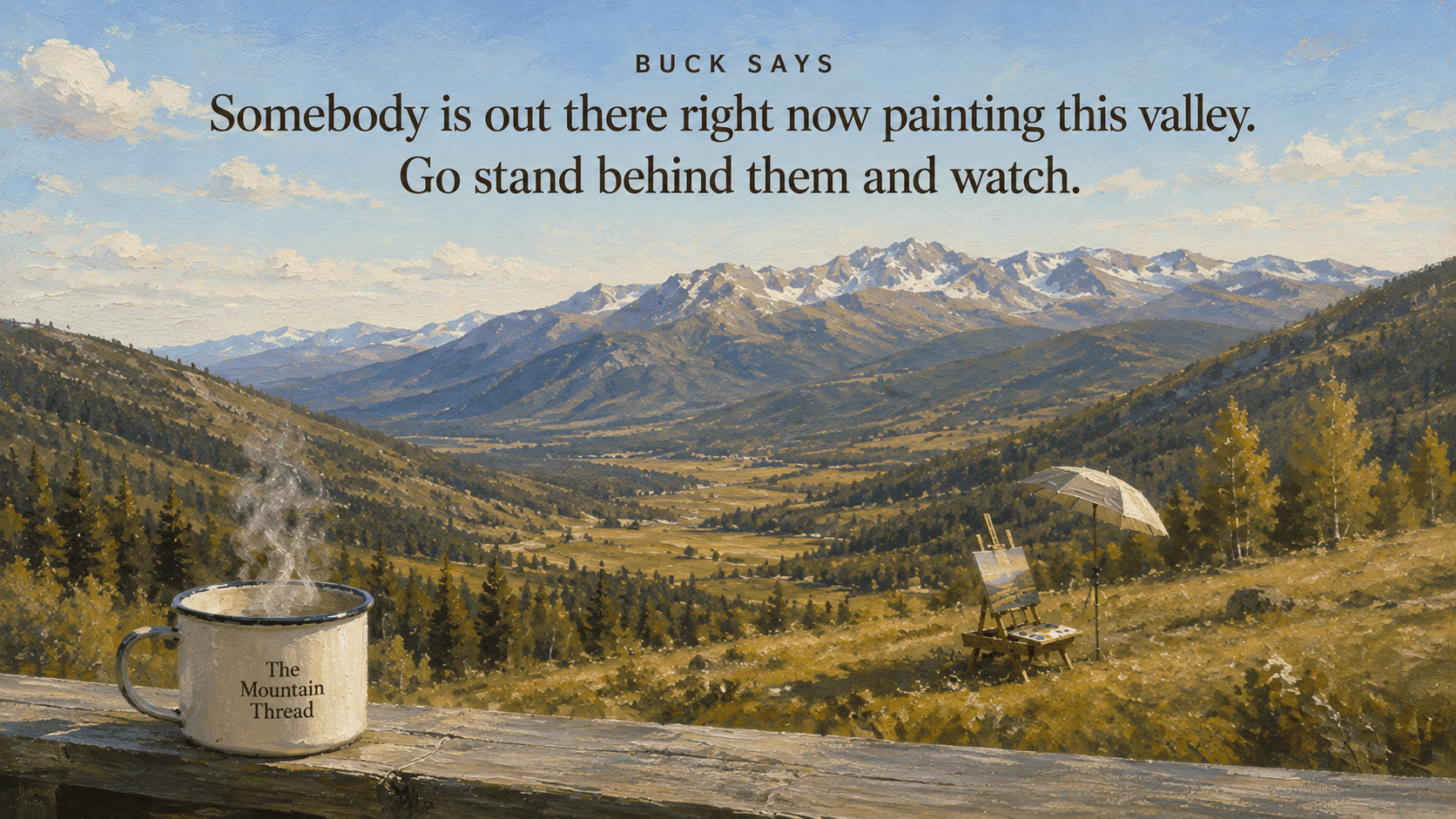
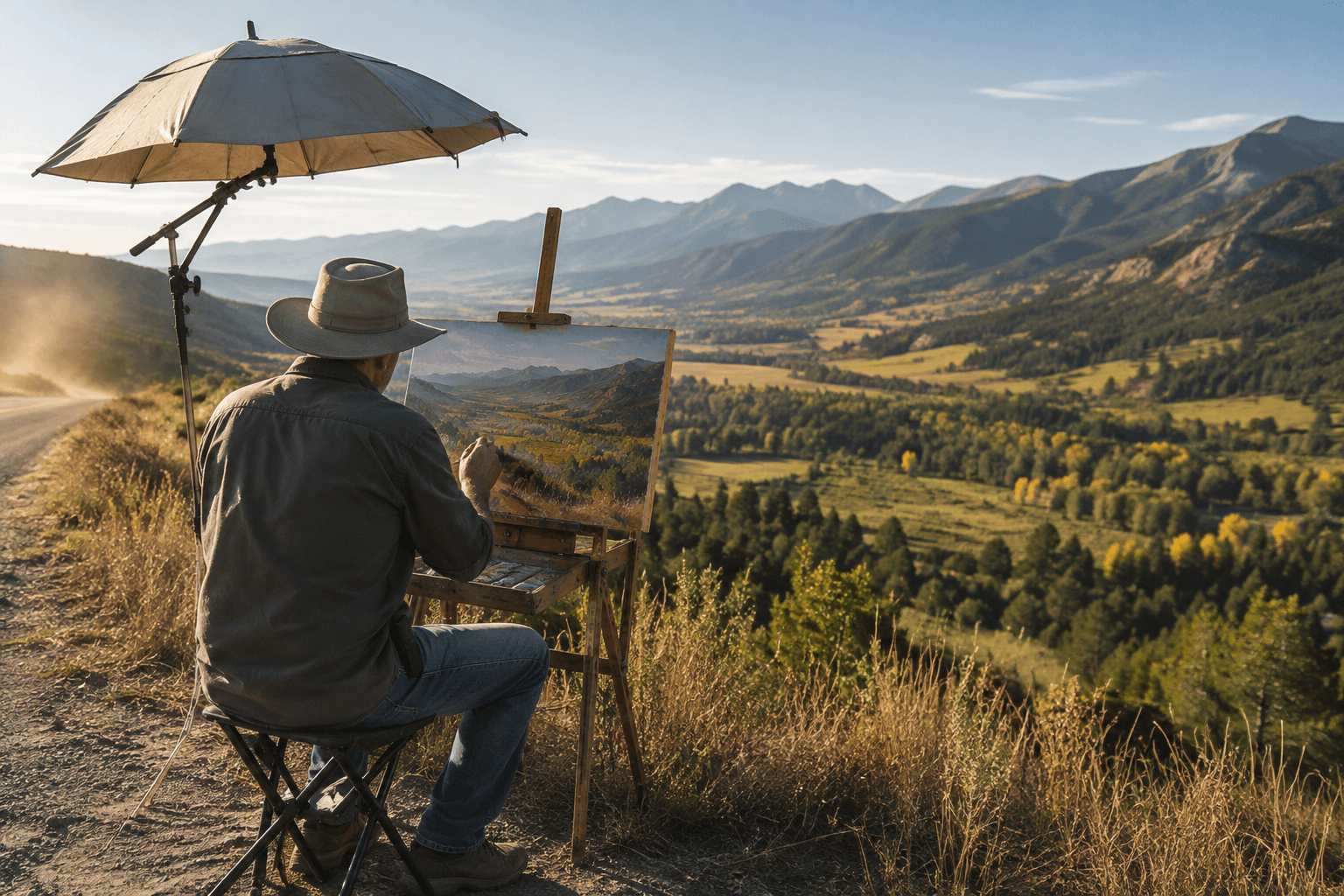
Moe and I came around the bend out past the Beaver Meadows entrance yesterday and found a woman set up right on the shoulder. Easel, folding stool, and a massive umbrella clamped to a tripod. She was painting like her life depended on it. Didn't even look up when we drove past.
Moe wanted to know what the damn hurry was. The hurry is that the sun doesn't care about your art project. It keeps moving, the shadows shift, and the mountain you started painting an hour ago looks like a different mountain now. It's a race against the daylight.
Estes Valley Plein Air is running through next Tuesday, which means there are artists scattered all over Rocky Mountain National Park and a fifty-mile radius of this town trying to paint fast enough to beat the rotation of the earth. Saturday morning they're all coming downtown to Riverside Plaza for a Quick Paint, where they race an actual clock in front of a crowd.
You should go watch. It's free, it's outside, and there's something highly entertaining about watching somebody stress out over a shadow moving across a pine tree.
I told Moe that. Then I told him about the local guy who spent sixteen years losing that exact same race, except he was doing it with a camera.
Sit Down. This One's Good. |
Who Was Fred Payne Clatworthy?
Moe knew the name. Most people who've lived here long enough do. It's one of those names you see on a historical plaque around town and nod at without having any clue what the guy actually did. I told him: for about forty years, Fred was who you bought your postcards from. He ran a tiny shop down on Elkhorn Avenue, fourteen feet by twenty. The inventory list tells you everything you need to know about surviving in a mountain town in 1905. He sold fresh eggs, vegetables, cameras, film, leather goods, and candy. By 1906 he'd locked down one of the first Eastman Kodak agencies in the state. Then he put a soda fountain in next door, which was the first one this town had ever seen. Moe said that's a bizarre mix of inventory. I told him it's the exact list of what people actually needed, from a guy who was paying attention. Apparently the town liked the way he ran things, because they elected him mayor in 1918. And the whole time he was selling eggs and soda, he was out in these valleys making some of the first color photographs anybody in the American West had ever laid eyes on.
What Did He See in 1898 That He Could Not Photograph?
Fred came out of Ohio on a bicycle in June of 1898. Moe asked how far a guy could possibly get on an 1890s bicycle. Turns out, pretty far. He hit Denver by July 17 and logged about 6,000 miles over the next year. Rode that bike until he couldn't, switched to a burro to get through Arizona, hopped a steamship out of Portland, and finally caught a train back home. He was hauling twenty pounds of gear. A money belt with $125 in it, a cook kit, a sleeping bag, some spare clothes, and a heavy camera with a wooden tripod and glass plates. On July 19, riding into Colorado, he wrote in his diary about the columbine and the lilies and the wild forget-me-nots. Then he wrote a line I've been thinking about all week. "The ground for miles was the most brilliant colored carpet I had ever seen." Moe asked if he took a picture of it. He couldn't. That's the punchline of the whole story. Color photography didn't exist yet. The guy was sitting on a bicycle in the middle of the best field of wildflowers in the West, holding a camera that could bring home absolutely none of it. He got to sit with that for sixteen years.
How Hard Was It to Make a Color Photograph in 1914?
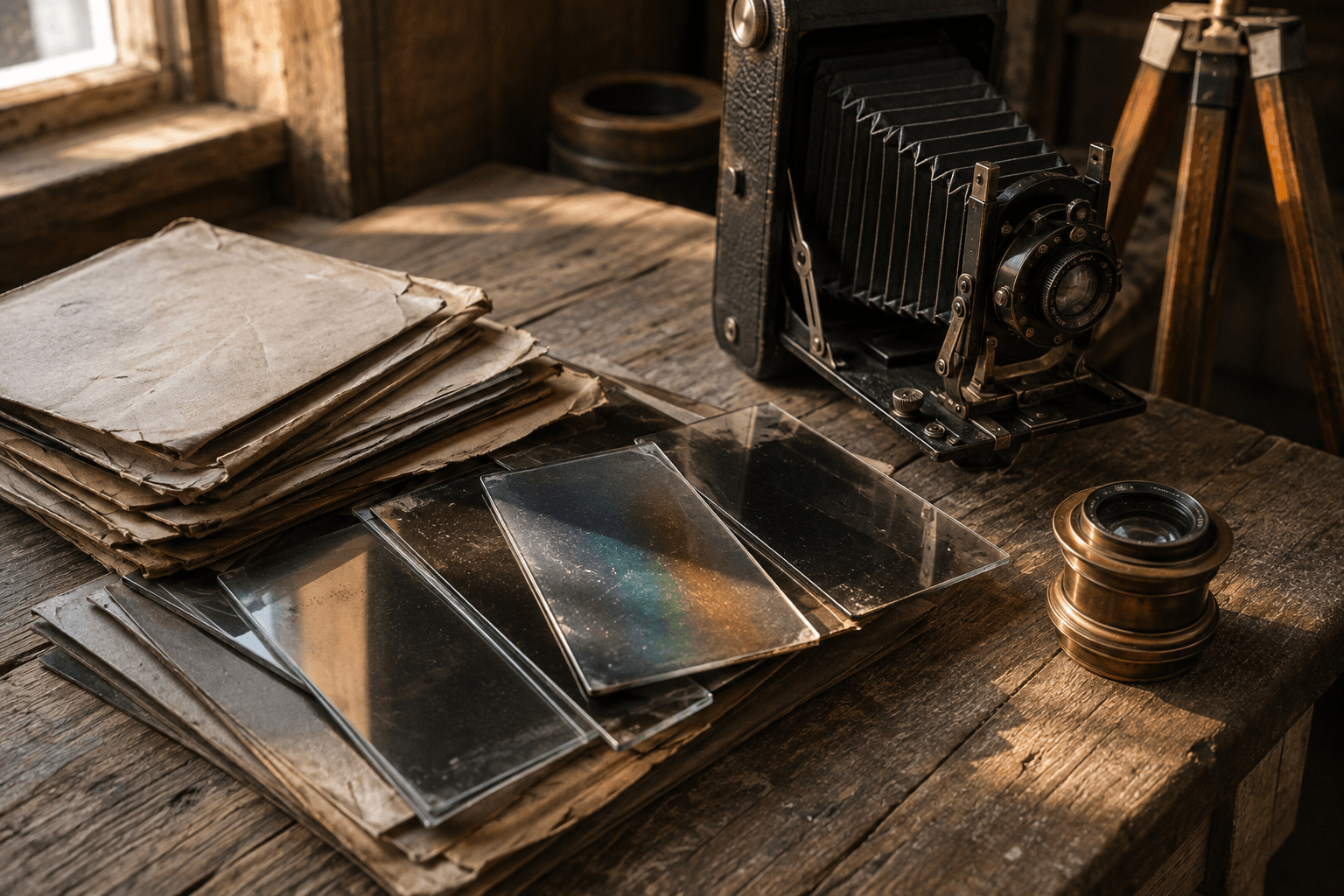
In the summer of 1914, a Denver amateur named Clark Blickensderfer showed Fred how the autochrome process worked. Moe made me stop and explain it twice, because it sounds like a massive pain in the ass. You take a sheet of glass. You cover it in potato starch that's been dyed and ground finer than dust, roughly four million grains per square inch. You roll it flat, coat it with silver emulsion, put a yellow filter over the lens, and then you hold completely still. In full sun the shutter has to stay open for a full second. If a cloud gets in the way, you're standing there holding your breath for ten seconds or more. Moe said a second doesn't sound that hard. A second is a lifetime when you're on a granite ridge with a wooden tripod and the wind coming off the Continental Divide is trying to blow you into the next canyon. But here's the part that gets me. The plate that came out of that camera was it. There's no negative. You couldn't walk back to the shop on Elkhorn and run off ten more copies. Whatever you carried down the trail was the only copy of that photograph in existence, and it was made of glass. He did it anyway. He shot Moraine Park. He shot Sprague Lake with Hallett Peak standing behind it. He got Longs Peak right when the aspens were turning. He shot Flattop from right near his own front door. Moe asked how many of those plates he broke on the way down. Nobody wrote that down. My guess is he quit counting because it made him too mad.
What Happened at the Smithsonian in January 1917?....Read More... |
 |
This Weekend
Estes Valley Plein Air Quick Paint and Auction. Saturday, August 22, 8:30 a.m. to noon, Riverside Plaza. Juried and invited artists get a short window to finish a piece outdoors with you standing right there watching, and then the work goes up for auction. The paint-out runs through Tuesday, August 25, so you'll be seeing easels on road shoulders all week. The gala and awards are Friday, August 28, and the exhibition opens August 29 at the Art Center and runs into late September.
John Denver Tribute Concert. Saturday, August 22, 5 to 9 p.m., Reusch Auditorium at the YMCA of the Rockies, 2515 Tunnel Road. $30. Brad Fitch and the TropiCowboy Band, twentieth year of doing this. Proceeds go to the Estes Park Rotary Club Foundation scholarship fund.
"Rooted," free screening. Friday, August 21, doors at 5:30, program at 6, Historic Park Theatre. A short documentary by Treston Chee about Tribal access to traditional homelands and watershed restoration, with a panel discussion after. It's free, but the Estes Valley Land Trust wants you to RSVP.
Free Movie Saturday. August 22, 10 a.m., Historic Park Theatre. Grease, which is now forty-five years old. Sit down before you do that math.
Estes Valley Farmers Market. Thursday, 8 a.m. to 1 p.m., Visitor Center parking lot, 500 Big Thompson Avenue. Running into mid-September.
Music. The Rock Inn's got somebody every night from 5 to 8. Alex Thoele Thursday, Jon Pickett Friday, the Random and True Jazz Duo Saturday, Elia King Sunday. Snowy Peaks has J.K. Halvorson on the back patio Friday from 5 to 7, and Marty Astry with paella Sunday afternoon. |
Trivia Question❓Estes Park elected its second mayor in 1918. He's remembered now for something else entirely, and if you've ever bought a postcard in this town, you've handled his descendants.
Who was he? Answer at the bottom of the newsletter |
| ★★★★★ |
|
|
|
 |
RMNP UPDATE
The fire ban is still on, and it's still the strict version. Stage 2 restrictions have been in place park-wide since June 29 with no end date announced. No campfires anywhere, charcoal briquettes included, and liquid gas stoves are out too. What you can use is a twist-on butane or propane canister stove you can shut off, in developed campgrounds, picnic areas, and designated wilderness sites. Smoking only inside a closed vehicle or standing on pavement with three feet of clear ground around you. The Estes Valley Fire Protection District is at Stage 2 as well, so don't assume the rule stops at the park line.
The west side shuts down Monday. From August 24 through August 30, the Colorado River Trail and the Grand Ditch in the Kawuneeche Valley close completely so crews can run phase two of the Poudre Headwaters Project, clearing non-native brook trout out of the ditch system to make room for greenback cutthroat, which is the state fish. East Inlet, North Inlet, Tonahutu, Green Mountain, Coyote Valley, Onahu and Timber Lake all stay open, and so do the Holzwarth Historic Site and Harbison Meadows. If the Colorado River Trail was your plan for next week, move it up to this one.
Then it's elk season. The annual meadow closures kick in September 1 and run through October. Horseshoe Park, Upper Beaver Meadows, Moraine Park, Harbison and Holzwarth go off limits to foot and horse travel off the roads and trails from 5 p.m. to 10 a.m. daily. Stay 75 feet back from any elk and don't call to them. The bulls are already stripping velvet off their antlers, which is the reliable sign the whole circus is about two weeks out.
Timed entry runs through mid-October, and the thing most people don't know is that extra permits go up at 7 p.m. the night before. |
DID YOU KNOW?
A color photograph in 1914 cost about thirty times the exposure of a black and white one. Full sun took roughly a second, overcast took ten or more, and what came out of the camera was a positive with no negative behind it. One copy, made of glass, and no way to print another.
Rocky Mountain National Park got bigger on February 14, 1917. An act of Congress pushed the eastern boundary out four or five miles and added 25,256 acres.
This town's first soda fountain was opened by a photographer. Fred Payne Clatworthy ran it next to his shop on Elkhorn, where he was already selling eggs, candy and Kodak film out of a room fourteen by twenty feet.
The bulls are shedding velvet right now. The rut doesn't really get going until the middle of September, but the antlers are getting stripped this week, and the meadow closures start September 1. |
Joke Of The Day |
I tried to take a color photo in Estes Park, but every shot came out absolutely perfect, mountains, elk, aspens, brilliant blue sky. My camera sued me for unrealistic beauty standards. |
💡 Answer to Trivia Question: Fred Payne Clatworthy. He ran a shop on Elkhorn Avenue selling groceries, curios and camera film, and he made some of the first color photographs of the American West. About a hundred of his plates ran in National Geographic between 1923 and 1934. History Colorado, the state history museum in Denver, still has 1,019 of them. |
UNTIL NEXT WEEK
Go stand behind somebody painting on Saturday. Not close enough to bug them. Close enough to see how fast they've got to work. And if you were planning on the Colorado River Trail, go this weekend. It closes Monday for a week.
There's more to the Fred Clatworthy story than fit in here. What he hauled up mountains to get those pictures, what happened in that room in Washington in January of 1917, and the one line his father wrote him that makes the whole thing land.
"Stay smart, stay safe, and leave the mountains brighter than the first time anybody saw them in color."
This account draws from the 2004 National Register nomination for the Clatworthy Place, History Colorado's finding aid and its published excerpts from Fred's 1898 diary, the Estes Park Museum collection, the National Science and Media Museum on how autochrome actually worked, and the National Park Service. The facts are as solid as I could get them. I arranged this for the telling, not the facts, and where the record went quiet I said so instead of filling it in. His father really did write to warn him off photography, and the town really did elect him mayor.
- Buck Timber The Mountain Thread themountainthread.com/signup |