The Town That Ran Out of Elk |
Every elk holding up traffic on Elkhorn Avenue this week descends from a shipment somebody paid for in 1913. Two federal documents can't agree how big it was. |
Were There Ever No Elk in Estes Park?
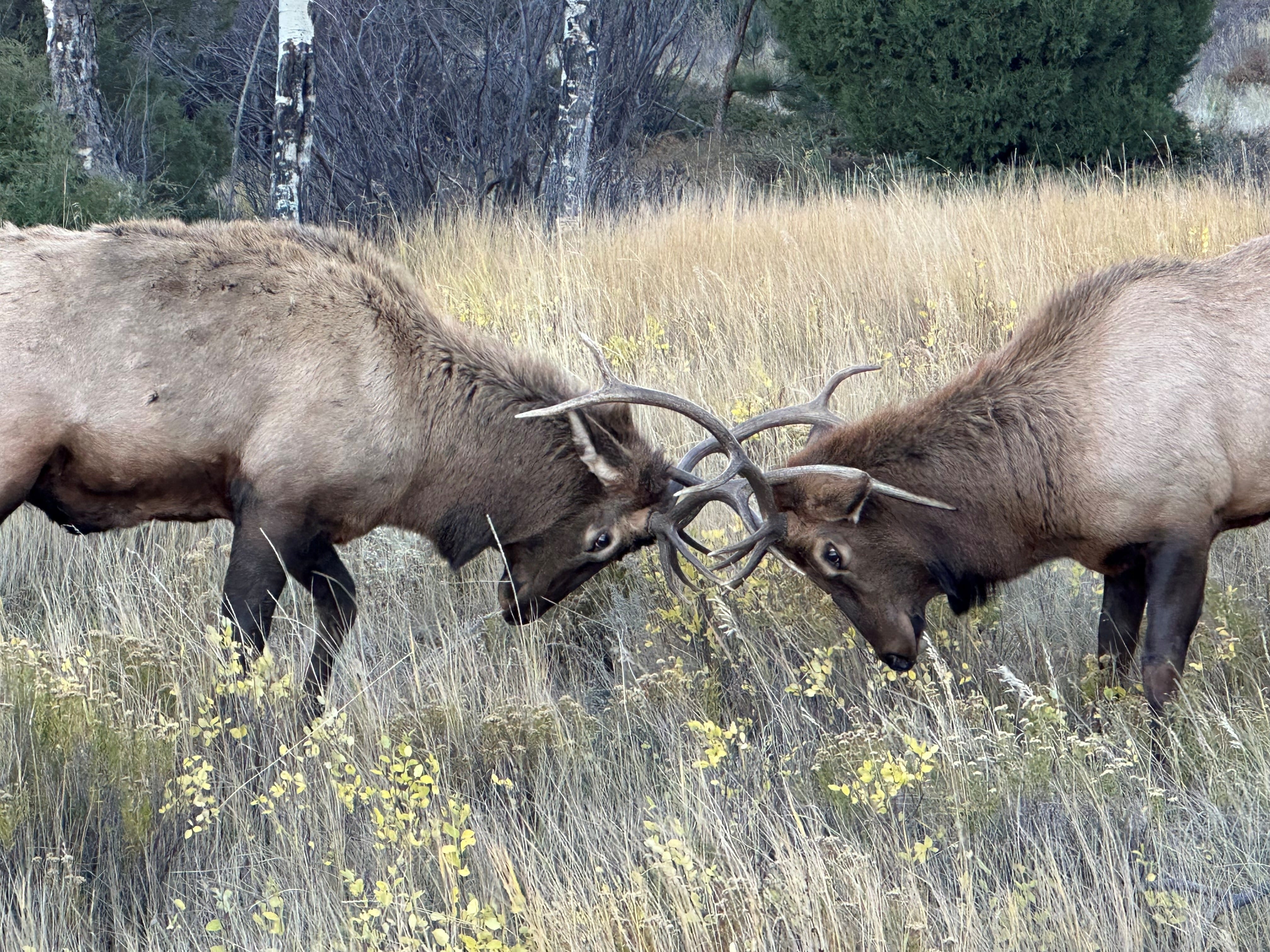
For about thirty years there were none at all. Moe and I sat on Elkhorn Avenue Tuesday evening and watched four cars stop dead for one bull who had decided the centerline was his. Somebody's kid hung out a back window with a phone. The bull didn't care. Moe said the elk run this town in September. They do now. They didn't in 1890. There were no elk left in the Estes Valley by then, and there hadn't been for a decade. People with rifles and wagons shot every one of them and sold the meat in Denver. Moe said he'd heard that and never quite believed it. Believe it. It's the best documented part of the whole story.
How Do You Kill Off Every Elk in a Valley?
With a wagon, a repeating rifle, and a buyer at the other end. Abner Sprague, who settled Moraine Park and wrote about the early years, laid it out. "Our [elk] only lasted about three years," he wrote. "They came down from their high range just before Christmas, 1875, by the thousands and were met by hunters with repeating rifles and four horse teams; hauled to Denver for three or four cents per pound." A 2006 National Park Service report on the ecological role of elk in this park quotes that passage, and that's where I read it. Three or four cents a pound. By the thousands. Joel Estes, the man this town is named for, wrote about his own hunting in the same flat tone: "One fall and winter the writer killed one hundred head of elk, besides other game, such as mountain sheep, deer, and antelope." Moe wanted to know how long it took. Not long. Market hunting here ran out in the late 1870s, and it ran out for the reason you'd guess. The last elk anybody wrote down was killed in 1878. After that a person could live in this valley thirty years and never hear a bugle.
So Who Brought Them Back?
A booster club and the Forest Service. In 1913 and 1914 the Estes Park Protective and Improvement Association worked with the U.S. Forest Service to bring elk down from Yellowstone and turn them loose here. The Association was the local improvement outfit of its day. The kind of group that fixes a road, argues about signs, and decides the town needs elk back. Moe assumed the national park did it. The park didn't exist yet. Rocky Mountain National Park was established January 26, 1915. The elk beat it here by more than a year. Everything you'll photograph this weekend got to this valley before the thing that protects it did.
How Many Elk Were in That Shipment?
Pick a document, pick a number. The Colorado Encyclopedia says forty-nine elk came down from Yellowstone. That 2006 Park Service report says twenty-eight. Both are serious sources and they don't agree. Moe asked which one is right. I don't know. Nobody I can find has reconciled it. My guess, and it is a guess, is that one number counts what got loaded and the other counts what was standing here a year later, since the trip was hard and the first winter harder. Label that a theory. It is not a fact. Moe asked how they actually got here. Train? Wagon? Same answer. The records I can reach don't say, and I'm not inventing a boxcar to round the story off. Somebody's archive in this state has a receipt for this. I'd like to see it.
What Happens When You Add Elk and Subtract Wolves?
Arithmetic. By 1915 the herd sat around thirty head. By 1930 it was roughly 350. That is plain arithmetic with nothing hunting them. The wolves were gone from this country by about 1900, shot and poisoned out. The grizzlies went with them. Colorado shut elk hunting down across most of the state from 1903 to 1933, and nobody hunted inside a national park at all. Moe said it sounds like the town got exactly what it asked for. It got more than it asked for. Nobody in 1913 sat down and worked out what 350 elk do to a willow flat in February.
Why Did Rangers End Up Shooting 1,045 of Them?
The willows told on them. Through the 1930s and 40s, people studying the winter range kept finding the same thing. The elk were eating it faster than it grew back, and the aspen and the willows took the worst of it. The park's answer, starting in 1944, was to shoot elk and to trap and truck others out. Between 1944 and 1953 park staff removed 1,045 animals. The culling ran off and on until 1962. Moe went quiet for a second, then said the part I was getting to. They sent away for elk, and thirty years later they were shooting them. That's the shape of it. In 1969 the park switched to leaving the herd alone and letting weather and forage settle the question. That held until the numbers and the willows argued again. The plan they run on now dates to 2008, a twenty-year job with fencing on up to 600 acres, vegetation work, and culling kept in reserve. About 130 female elk were removed between 2009 and 2011. Lately the Park Service says the culling hasn't been needed.
So Are These the Same Elk?
Their great-great-whatever grandparents came in on somebody else's dime. Not the same animals, no. Same line, though. The ones that came down from Yellowstone and lived through it, plus whatever wandered in from the rest of Colorado across a century. Worth knowing when you're standing in Bond Park this weekend with a brat and a beer, hearing one go off on the hill behind town. Moe asked whether that makes the whole thing artificial. It makes it deliberate. Somebody decided on it in 1913. Somebody paid the bill. The hundred years since have been one long argument about what to do next. The bull standing in the middle of Elkhorn Avenue holding up four cars knows none of it. He's loud, and he's home.
WHERE THIS CAME FROM
This account draws from the Colorado Encyclopedia's articles on elk culling and Rocky Mountain elk, a 2006 National Park Service report on the ecological role of elk in this park, which is where Abner Sprague's and Joel Estes's own words come from, the Park Service's elk and vegetation management background pages, and the Park Science piece by Johnson and colleagues on a century of elk management here. The facts are as solid as I could get them. I arranged this for the telling and I did not arrange the facts, and where two federal documents flatly disagree on how many elk arrived, I said so instead of picking the prettier number. A town that had eaten every elk in its own valley really did pay to have more brought down from Yellowstone |
0 Comments
Join the conversation
Be the first to comment
Share your thoughts above.