The Elk Didn't Ask for a Bugling Contest |
Elk Fest gives the humans a turn. Out in the meadow, they're better off listening. |
Why Are People Bugling in Bond Park?
The town put it on the program.
Moe asked whether I was entering the bugling contest at Elk Fest.
I told him I hadn't spent this many years making a fool of myself for free to start doing it on a schedule.
The Town of Estes Park lists a contest among the wildlife exhibits, music and storytelling for October 3 and 4. Admission is free. The elk weren't consulted about any of this.
Moe said that seemed fair. They don't consult us before starting.
There's something I like about a town willing to put that on an event page. You can learn about wildlife and listen to somebody attempt the noise in the same visit. One requires curiosity. The other requires a willingness to be recognized at the grocery store afterward.
Moe wanted to know how a person prepares.
I suggested starting with the part where you stand quietly and listen. He said that didn't sound competitive.
It isn't. That's why I thought we might be good at it.
Who Was Samson, and Why Does Estes Park Still Care?
If you've heard the name but never the story, pull up a chair.
Samson was a huge bull elk who spent his winters around the YMCA of the Rockies. Staff and visitors got used to seeing him return. In a town full of elk, this one became a familiar face.
In Colorado Life, writer Sarah Holdt spoke with YMCA staff who remembered those visits. You get the sense that seeing Samson again was part of the season, like the first snowfall.
Then, on November 11, 1995, a poacher killed him on the YMCA grounds. People who had watched him year after year were heartbroken and angry.
But Samson's story didn't end that November.
His mounted head later appeared at Elk Fest, where his story helped teach visitors about poaching. Two researchers who attended the festival recorded that display in Mad about Wildlife (2005), page 154.
And if you know the bronze elk at Highways 7 and 36, you've already met his memorial.
That's why his name still belongs in an Elk Fest conversation. Behind the music and the bugling contest is a town that cared about one particular elk, and still remembers losing him.
I'd say the best way to remember Samson is to give the living elk plenty of room.
What Is the Elk Trying to Say?
He's talking to other elk. You're overhearing it.
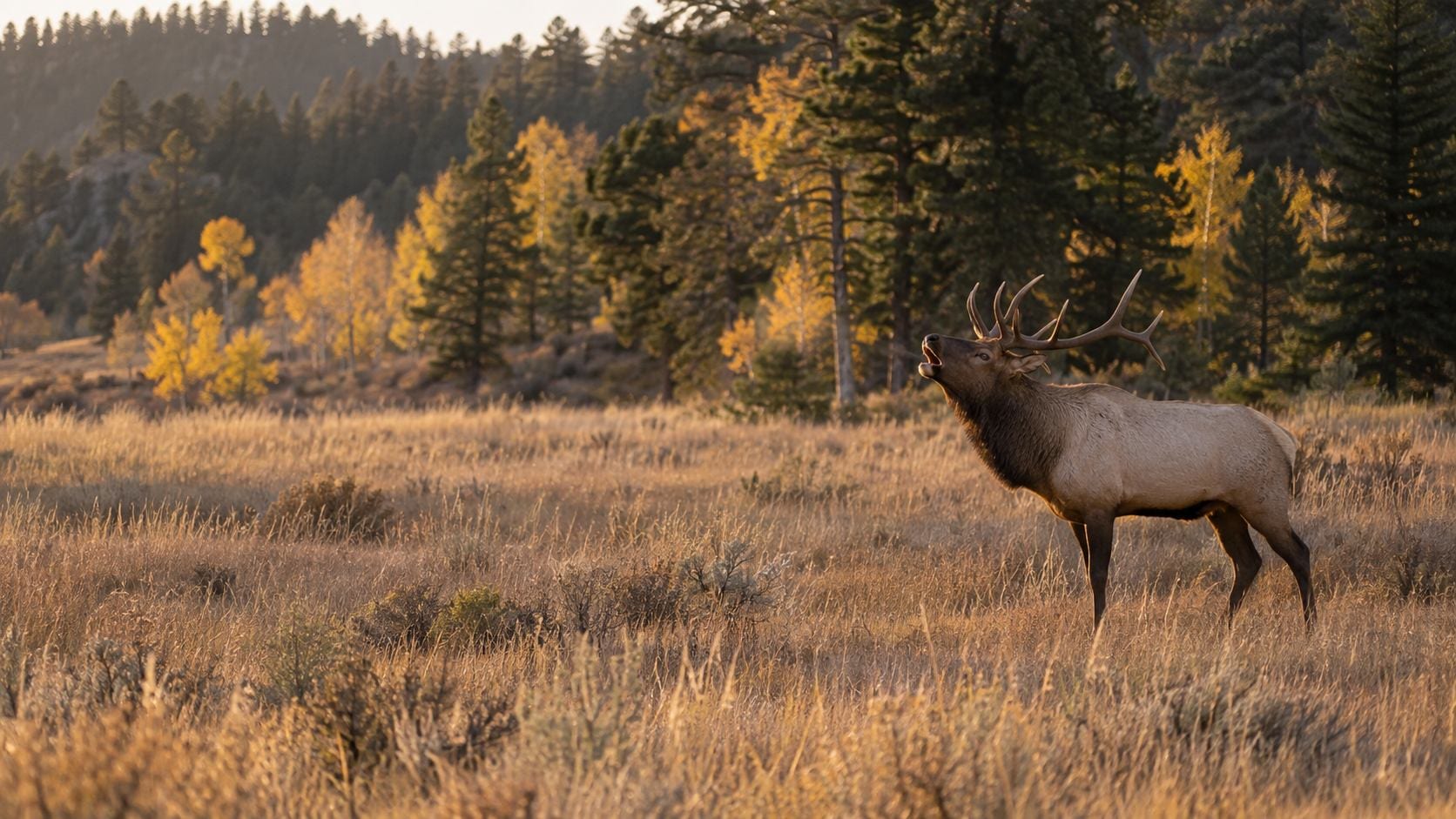
The rut is the elk's mating season. The National Park Service's explanation of bugling describes calls that announce a bull's presence, address cows in his group, or warn another bull away. One noise to our ears doesn't mean one message to theirs.
Moe asked if every bugle meant a fight.
No. The Rocky Mountain Elk Foundation describes bulls sizing one another up and displaying before a confrontation turns physical. A rival can back off. Locking antlers isn't the only possible ending.
That makes the listening more interesting. Watch the other animals, too. A call isn't happening in an empty room, and the elk beside the caller are part of what you're there to see.
Moe said he could usually tell what I meant from my tone.
He has mistaken a request for more coffee for the end of a conversation. I'm not hiring him to translate wildlife.
Then he asked the better question. How does an animal that big make a sound that high?
How Does an Animal That Big Hit That Note?
That question has kept researchers busy, too.
A 2016 study in the Journal of Experimental Biology by David Reby and colleagues found evidence of two independently varying sound components in male bugles. Their analysis supported a low component from the vocal folds and a much higher one consistent with an aerodynamic whistle.
Air moving through a narrow passage was the proposed explanation for that high part. A single animal, with more going on than one straightforward bellow.
Moe put his cup down. He wanted to know if that meant the bull was doing two things at once.
That was the team's interpretation. But here's the part that gets lost when a research finding turns into a fun fact.
A 2025 paper in Current Zoology says the mechanism behind the highest component still isn't settled. Researchers have competing explanations involving vocal-fold vibration and aerodynamic whistling.
So I'm not telling you scientists finished the job in 2016. They offered evidence for an explanation, and the question stayed open.
Moe said he liked having an answer.
I do too. I like knowing whether we've actually got one even more.
Where Does the Audience Belong?
Back far enough to remain the audience.
The Park Service's elk-viewing guidance says to stay at least 75 feet from elk. If an animal changes what it's doing in response to you, give it more room. That number isn't a promise that every encounter is safe at exactly that distance.
In the national park, using calls to attract wildlife is prohibited. A contest on the festival program doesn't carry permission into a meadow.
Moe asked if that included a contest-quality performance.
Especially yours, I told him.
The park's 2026 compendium closes designated rut meadow areas to off-road and off-trail foot travel from 5 p.m. to 10 a.m., September 1 through October 31. Follow the posted boundaries. The view from an allowed spot is the view you get.
Go enjoy the festival. Listen to the human attempts, learn something at the exhibits, then give the actual elk the courtesy of a quiet audience.
You've got binoculars. You don't need a speaking part.
THE STORY BEHIND THE STORY
This account draws from the linked Town of Estes Park event listing, National Park Service guidance, Rocky Mountain Elk Foundation reporting, and the 2016 and 2025 research papers named above. Samson's history draws from Sarah Holdt's Colorado Life reporting, Visit Estes Park's sculpture guide, and Robert Granfield and Paul Colomy's chapter in Mad about Wildlife (2005), all linked above. Estes Park News, September 25, 2026, page 19, corroborated the festival dates and general activities. A few scenes and conversations were shaped for the telling; the event details, wildlife guidance and research findings come from the sources. Where the research leaves a question open, I leave it open too. Buck. |
0 Comments
Join the conversation
Be the first to comment
Share your thoughts above.