The Man Who Could Not Photograph What He Saw |
He sold eggs, candy and Kodak film out of a room fourteen feet by twenty, and made some of the first color photographs anybody had seen of the American West. |
Who Was Fred Payne Clatworthy?
Moe knew the name. Most people who've lived here long enough do. It's one of those names you see on a historical plaque around town and nod at without having any clue what the guy actually did. I told him: for about forty years, Fred was who you bought your postcards from. He ran a tiny shop down on Elkhorn Avenue, fourteen feet by twenty. The inventory list tells you everything you need to know about surviving in a mountain town in 1905. He sold fresh eggs, vegetables, cameras, film, leather goods, and candy. By 1906 he'd locked down one of the first Eastman Kodak agencies in the state. Then he put a soda fountain in next door, which was the first one this town had ever seen. Moe said that's a bizarre mix of inventory. I told him it's the exact list of what people actually needed, from a guy who was paying attention. Apparently the town liked the way he ran things, because they elected him mayor in 1918. And the whole time he was selling eggs and soda, he was out in these valleys making some of the first color photographs anybody in the American West had ever laid eyes on.
What Did He See in 1898 That He Could Not Photograph?
Fred came out of Ohio on a bicycle in June of 1898. Moe asked how far a guy could possibly get on an 1890s bicycle. Turns out, pretty far. He hit Denver by July 17 and logged about 6,000 miles over the next year. Rode that bike until he couldn't, switched to a burro to get through Arizona, hopped a steamship out of Portland, and finally caught a train back home. He was hauling twenty pounds of gear. A money belt with $125 in it, a cook kit, a sleeping bag, some spare clothes, and a heavy camera with a wooden tripod and glass plates. On July 19, riding into Colorado, he wrote in his diary about the columbine and the lilies and the wild forget-me-nots. Then he wrote a line I've been thinking about all week. "The ground for miles was the most brilliant colored carpet I had ever seen." Moe asked if he took a picture of it. He couldn't. That's the punchline of the whole story. Color photography didn't exist yet. The guy was sitting on a bicycle in the middle of the best field of wildflowers in the West, holding a camera that could bring home absolutely none of it. He got to sit with that for sixteen years.
How Hard Was It to Make a Color Photograph in 1914?
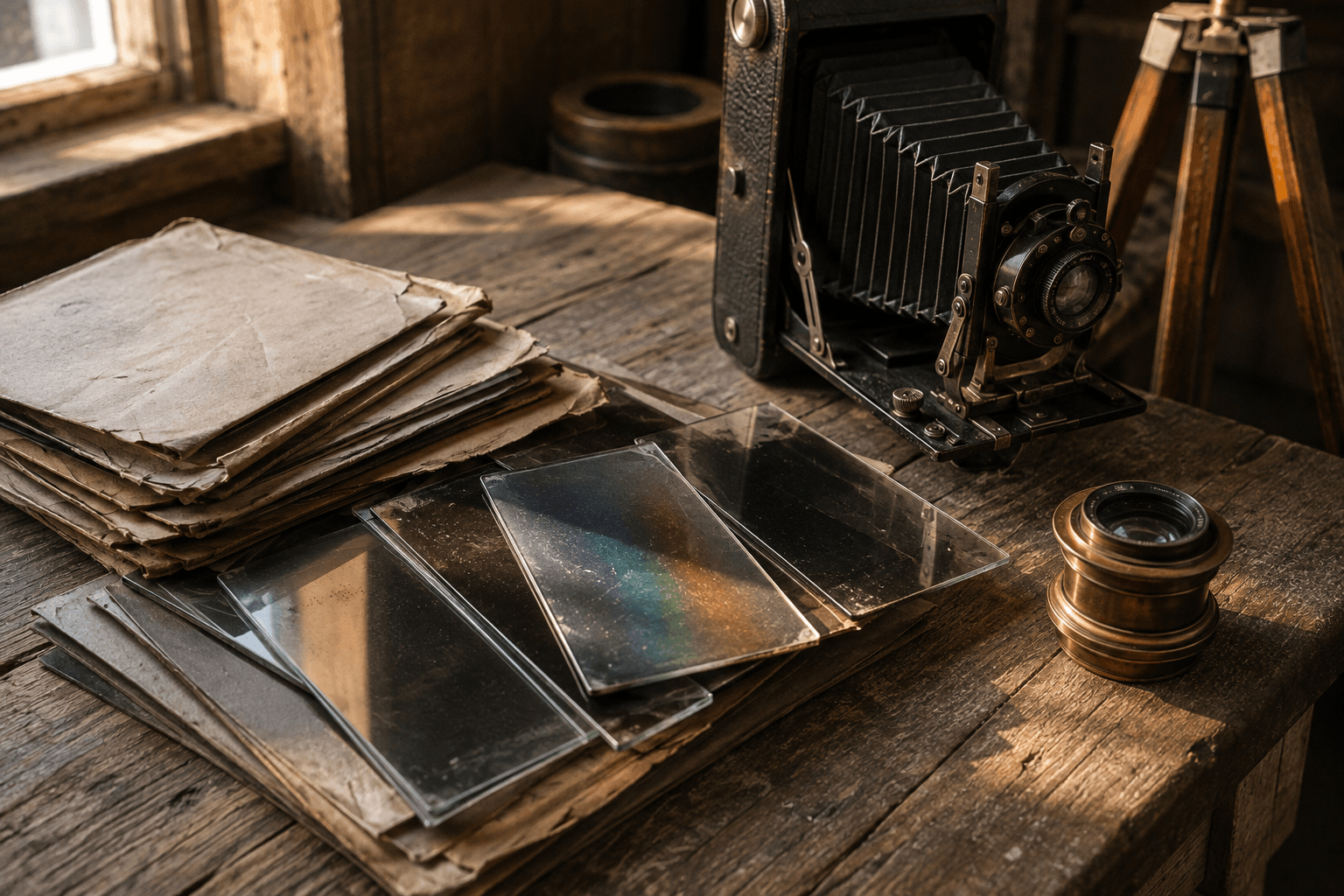
In the summer of 1914, a Denver amateur named Clark Blickensderfer showed Fred how the autochrome process worked. Moe made me stop and explain it twice, because it sounds like a massive pain in the ass. You take a sheet of glass. You cover it in potato starch that's been dyed and ground finer than dust, roughly four million grains per square inch. You roll it flat, coat it with silver emulsion, put a yellow filter over the lens, and then you hold completely still. In full sun the shutter has to stay open for a full second. If a cloud gets in the way, you're standing there holding your breath for ten seconds or more. Moe said a second doesn't sound that hard. A second is a lifetime when you're on a granite ridge with a wooden tripod and the wind coming off the Continental Divide is trying to blow you into the next canyon. But here's the part that gets me. The plate that came out of that camera was it. There's no negative. You couldn't walk back to the shop on Elkhorn and run off ten more copies. Whatever you carried down the trail was the only copy of that photograph in existence, and it was made of glass. He did it anyway. He shot Moraine Park. He shot Sprague Lake with Hallett Peak standing behind it. He got Longs Peak right when the aspens were turning. He shot Flattop from right near his own front door. Moe asked how many of those plates he broke on the way down. Nobody wrote that down. My guess is he quit counting because it made him too mad.
What Happened at the Smithsonian in January 1917?
In January of 1917, Fred stood up in a room in Washington in front of 600 politicians and showed them Colorado in color. Most of those men had never seen a color photograph of anything in their lives. The Denver Post reported that the audience "went away enraptured, and the next day the senate committee took the action that has been postponed for more than a year." On February 14, 1917, they moved Rocky Mountain National Park's eastern boundary out a few miles and added 25,256 acres. Moe asked me straight out if Fred's pictures were the reason the park got bigger. I told him I don't know. Nobody does. A newspaper printed those two facts right next to each other in 1917 and people have been connecting the dots ever since, and a connection isn't a fact. What I do know is that a guy who sold eggs and candy on Elkhorn Avenue carried a box of glass plates into a room in D.C., and a piece of legislation that had been stuck for over a year cleared up the next morning. Moe said that sounds like the pictures did it. I said that's exactly why I'm careful about it. We love a good story.
Can You Still See His Work?
About a hundred of his plates ran in National Geographic between 1923 and 1934. Wanamaker's in New York hung his enlargements for ten days. He toured the country lecturing to crowds of up to four thousand people, changing his slides with a little metal cricket clicker he worked with his thumb. He retired in 1948. At seventy-four he went to Europe with his daughter Barbara and photographed the Matterhorn. He kept working right up until a stroke hit him two weeks before he died in July of 1953, at seventy-seven. History Colorado has 1,019 of his glass plates. His old house on the side of Prospect Mountain went on the National Register in 2004. The little shop on Elkhorn is long gone. There's one last detail I keep turning over. When Fred was fifteen, his father wrote him a letter. The advice was simple. "Don't fall so in love with photography as to want to follow it by and by." Moe didn't say anything to that for a few seconds.
Saturday morning there'll be painters down at Riverside Plaza with a couple of hours and a blank board, trying to get this valley down before the light changes on them. Fred worked his later years out of a studio on Riverside Drive, a short walk from where those people will be standing. Different tools. Same exact assignment. Moe said he's going to go watch them. I told him I'd bring the coffee. Where This Came FromThis account draws from the 2004 National Register nomination for the Clatworthy Place, History Colorado's finding aid and its published excerpts from Fred's 1898 diary, the Estes Park Museum collection, the National Science and Media Museum on how autochrome actually worked, and the National Park Service. The facts are as solid as I could get them. I arranged this for the telling, not the facts, and where the record went quiet I said so instead of filling it in. His father really did write to warn him off photography, and the town really did elect him mayor. |
0 Comments
Join the conversation
Be the first to comment
Share your thoughts above.