The Man Who Almost Owned Every Mountain You Can See |
Colorado turns 150 on Saturday. In the year it became a state, an Irish earl was quietly buying this valley out from under everyone in it. |
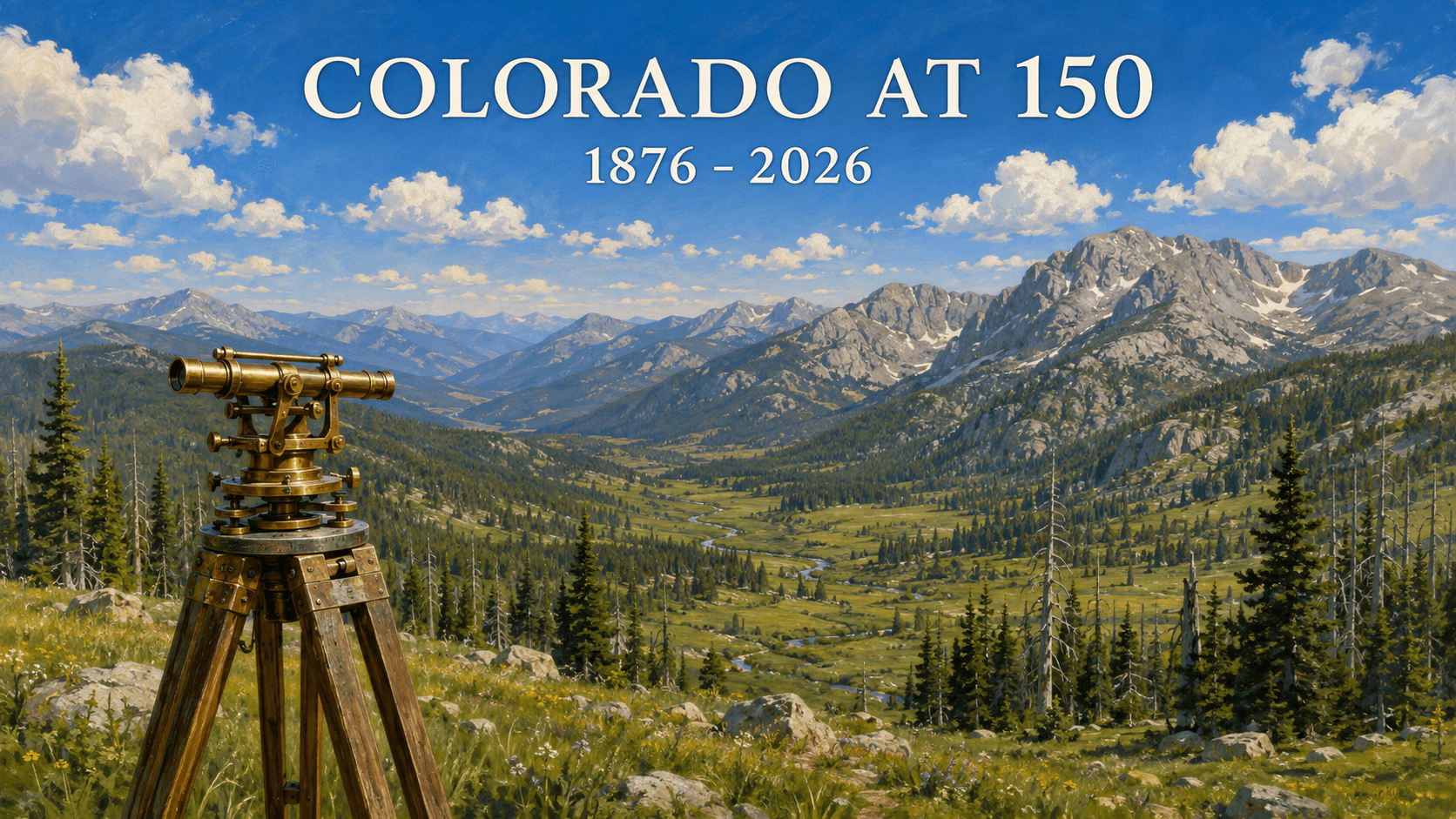
On Saturday, Colorado turns a hundred and fifty years old. The paperwork went through on August 1, 1876, one hundred years and one month after the Declaration of Independence, which is how it picked up the nickname Centennial State.
Here's the part that doesn't make the birthday cards. In 1876, the year Colorado became a state, most of what you can see from downtown was being quietly assembled into the private hunting grounds of a man who lived four thousand miles from here.
His name was Windham Thomas Wyndham-Quin, the fourth Earl of Dunraven. He turned up in December of 1872 after hearing at a party in Denver that the hunting up this way was worth the ride. It was. He came back in 1873. He came back again in 1874. And somewhere in there the idea took hold that a man in his position shouldn't have to keep showing up as a guest.
He could just own it.
The trouble was the law. Dunraven was a British subject, and the Homestead Act was not written with British subjects in mind. He couldn't walk into a land office and claim so much as an acre.
So he had other people do it.
His agents went down into the Front Range towns and found men who, for a fee, would walk into the Denver land office and swear out a homestead claim on 160 acres they had no intention of ever living on. More than thirty-five men filed. Then those claims were sold on to Dunraven's outfit, the Estes Park Company, at something in the neighborhood of five dollars an acre.
The parcels weren't picked at random either. They were picked along the water. In dry country, whoever holds the creek holds everything the creek touches, and Dunraven's people understood that better than most. On paper the company held around 8,000 acres. In practice it controlled something closer to 15,000. Some of the newspapers at the time put the figure a good deal higher than that.
Nobody was fooled, and nobody was quiet about it. In August of 1874 the Larimer County Express called the whole business "one of the most barefaced land steals of this land-stealing age." The U.S. Attorney in Denver took it to a grand jury. The grand jury did nothing at all.
What Dunraven ran into instead was people. Not lawyers, at first. Just people who were already here and had no intention of leaving. The most stubborn of them was a one-eyed trapper named James Nugent, who everybody called Rocky Mountain Jim. He lost the eye to a grizzly in July of 1869 and never much bothered to soften how he looked about it. The English traveler Isabella Bird met him in 1873 and wrote him down as a man of obvious genius with real courtesy toward women, and also as a desperate character prone to ugly fits, which is about as complete a description of anybody as you are likely to get in one sentence.
What mattered to Dunraven was where Jim's cabin sat. It was at the head of Muggins Gulch, right on the only decent way into the park. Whatever the English Company wanted to do with this valley, it had to get past that cabin first, and Jim had made it clear he was not inclined to let it.
On June 19, 1874, Jim was shot outside Griff Evans's ranch. Evans was a Welshman who had bought out the original Estes homestead, and he had thrown in with Dunraven early. Jim lingered with the wound for the better part of three months and died that September.
Why it happened depends entirely on who you ask, and everybody who could settle it has been dead a long while. Evans and Jim had bad blood over Evans's teenage daughter, and Dunraven himself later waved it off as a feud over a woman. Others at the time were certain it was about the valley and about who was standing in the way of it. The way I heard it, both of those can be true at the same time. Evans went to trial and was acquitted in August of 1875, largely because nobody would say what they had seen. Then came the part Dunraven had not planned on, which was the slow kind of resistance. Alexander MacGregor was an attorney, and unlike most people here he could fight the earl on his own ground. He and his wife Clara had started their ranch in 1873, north of town, and he spent years contesting the company's claims in the places where contesting them actually counted. Homesteaders kept arriving. Claims kept getting disputed. Taxes came due.
In the end it was not the grand jury or the newspapers that beat him. It was the sheer grinding nuisance of trying to hold a valley from across an ocean. Dunraven put it plainly enough himself: people came in disputing claims and kicking up rows, the land taxes fell into arrears, there was constant litigation, and the whole show simply could not be run from home.
He made his last visits in the 1880s and let it go. In 1908 he sold out to F.O. Stanley and B.D. Sanborn. Stanley built the hotel that still sits up on the hill. The earl's own wooden hotel, the one locals had called the English Hotel, burned down in 1911. Dunraven died in Ireland in 1926 at eighty-five, having spent the better part of a decade trying to make this valley private and the rest of his life not thinking about it much.
Rocky Mountain National Park was established in 1915. That is the part worth sitting with on Colorado's birthday. A man with a title and real money spent the better part of ten years trying to make sure almost nobody could set foot here. He lost, slowly, to a trapper who would not move, a lawyer who would not quit, and a steady supply of ordinary people who kept filing paperwork and refusing to go away.
Now millions of people a year walk in for the price of a park pass. MacGregor Ranch is still there, still a working cattle ranch, and you can walk through it this week.
GO SEE IT
Colorado Day: Saturday, August 1. History Colorado museums statewide are hosting free events for the 150th.
This account draws from National Park Service records, the Larimer County Express of August 1874, Isabella Bird's 1873 account of James Nugent, and the documented history of the Estes Park Company. The broad facts are solid. Thirty-five men really did file claims on land they never meant to live on. - Buck
|
0 Comments
Join the conversation
Be the first to comment
Share your thoughts above.