The Mountain Thread | Estes Park | July 30, 2026 |
 |
BEFORE THE COFFEE GETS COLD
Moe asked me what the plan was for Saturday.
"Colorado turns a hundred and fifty," I said. "Figure that's worth looking up from your coffee for."
"I can manage that," Moe said.
"Something I didn't put together until this week," I said. "Those two girls up on the ledge last week. That was the night of July thirty-first, 1976. Colorado became a state on August first, 1876."
Moe set his cup down and did the math.
"The eve of the hundredth," I said. "Near enough to the day."
"So what's the story this week," he said.
"Went looking for a different one out of 1876. Found it. The year Colorado became a state, somebody was already trying to buy this whole valley out from under everybody in it."
"Did he get it?"
"Almost," I said.
SIT DOWN. THIS ONE'S GOOD. |
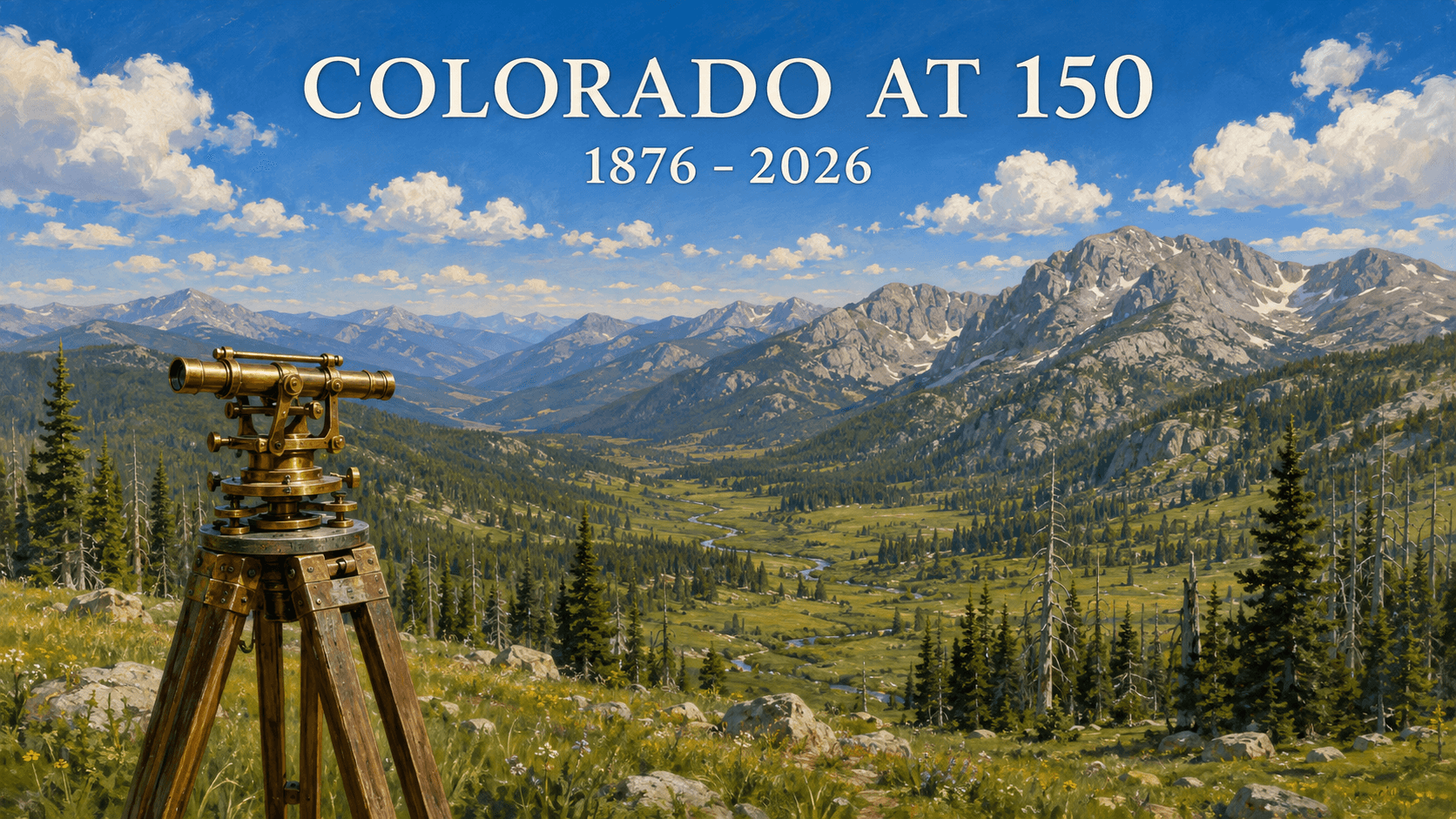
On Saturday, Colorado turns a hundred and fifty years old. The paperwork went through on August 1, 1876, one hundred years and one month after the Declaration of Independence, which is how it picked up the nickname Centennial State.
Here's the part that doesn't make the birthday cards. In 1876, the year Colorado became a state, most of what you can see from downtown was being quietly assembled into the private hunting grounds of a man who lived four thousand miles from here.
His name was Windham Thomas Wyndham-Quin, the fourth Earl of Dunraven. He turned up in December of 1872 after hearing at a party in Denver that the hunting up this way was worth the ride. It was. He came back in 1873. He came back again in 1874. And somewhere in there the idea took hold that a man in his position shouldn't have to keep showing up as a guest.
He could just own it.
The trouble was the law. Dunraven was a British subject, and the Homestead Act was not written with British subjects in mind. He couldn't walk into a land office and claim so much as an acre.
So he had other people do it.
His agents went down into the Front Range towns and found men who, for a fee, would walk into the Denver land office and swear out a homestead claim on 160 acres they had no intention of ever living on. More than thirty-five men filed. Then those claims were sold on to Dunraven's outfit, the Estes Park Company, at something in the neighborhood of five dollars an acre.
The parcels weren't picked at random either. They were picked along the water. In dry country, whoever holds the creek holds everything the creek touches, and Dunraven's people understood that better than most. On paper the company held around 8,000 acres. In practice it controlled something closer to 15,000. Some of the newspapers at the time put the figure a good deal higher than that.
Nobody was fooled, and nobody was quiet about it. In August of 1874 the Larimer County Express called the whole business "one of the most barefaced land steals of this land-stealing age." The U.S. Attorney in Denver took it to a grand jury. The grand jury did nothing at all.
What Dunraven ran into instead was people. Not lawyers, at first. Just people who were already here and had no intention of leaving. The most stubborn of them was a one-eyed trapper named James Nugent, who everybody called Rocky Mountain Jim. He lost the eye to a grizzly in July of 1869 and never much bothered to soften how he looked about it. The English traveler Isabella Bird met him in 1873 and wrote him down as a man of obvious genius with real courtesy toward women, and also as a desperate character prone to ugly fits, which is about as complete a description of anybody as you are likely to get in one sentence.
What mattered to Dunraven was where Jim's cabin sat. It was at the head of Muggins Gulch, right on the only decent way into the park. Whatever the English Company wanted to do with this valley, it had to get past that cabin first, and Jim had made it clear he was not inclined to let it.
On June 19, 1874, Jim was shot outside Griff Evans's ranch. Evans was a Welshman who had bought out the original Estes homestead, and he had thrown in with Dunraven early. Jim lingered with the wound for the better part of three months and died that September.
Why it happened... Read More... |
Trivia Question❓An Irish earl spent the 1870s trying to turn the entire Estes valley into his own private hunting preserve. As a foreign national he couldn't legally claim a single acre of it himself, so how did he end up controlling roughly 15,000 of them? Answer at the bottom of the newsletter |
| ★★★★★ |
|
|
|
 |
RMNP UPDATE
Trail Ridge Road is open to through travel. Timed entry reservations are required from 9 a.m. to 2 p.m. for general park access, and from 5 a.m. to 6 p.m. for the Bear Lake Road Corridor. The general timed entry system runs through October 12 this year, and the Bear Lake Corridor permits run through October 18. Reservations go through Recreation.gov, and additional ones release nightly at 7 p.m. Mountain time if you missed the first pass.
Old Fall River Road is open for the season, running one-way uphill from the Alluvial Fan area to Endovalley. Verify current status at nps.gov/romo or call 970-586-1222 before you head up. The phone line gets updated more reliably than the website.
Stage 2 Fire Restrictions remain in effect throughout the Estes Valley and in Rocky Mountain National Park. No campfires, no charcoal or wood grills, no open flames of any kind.
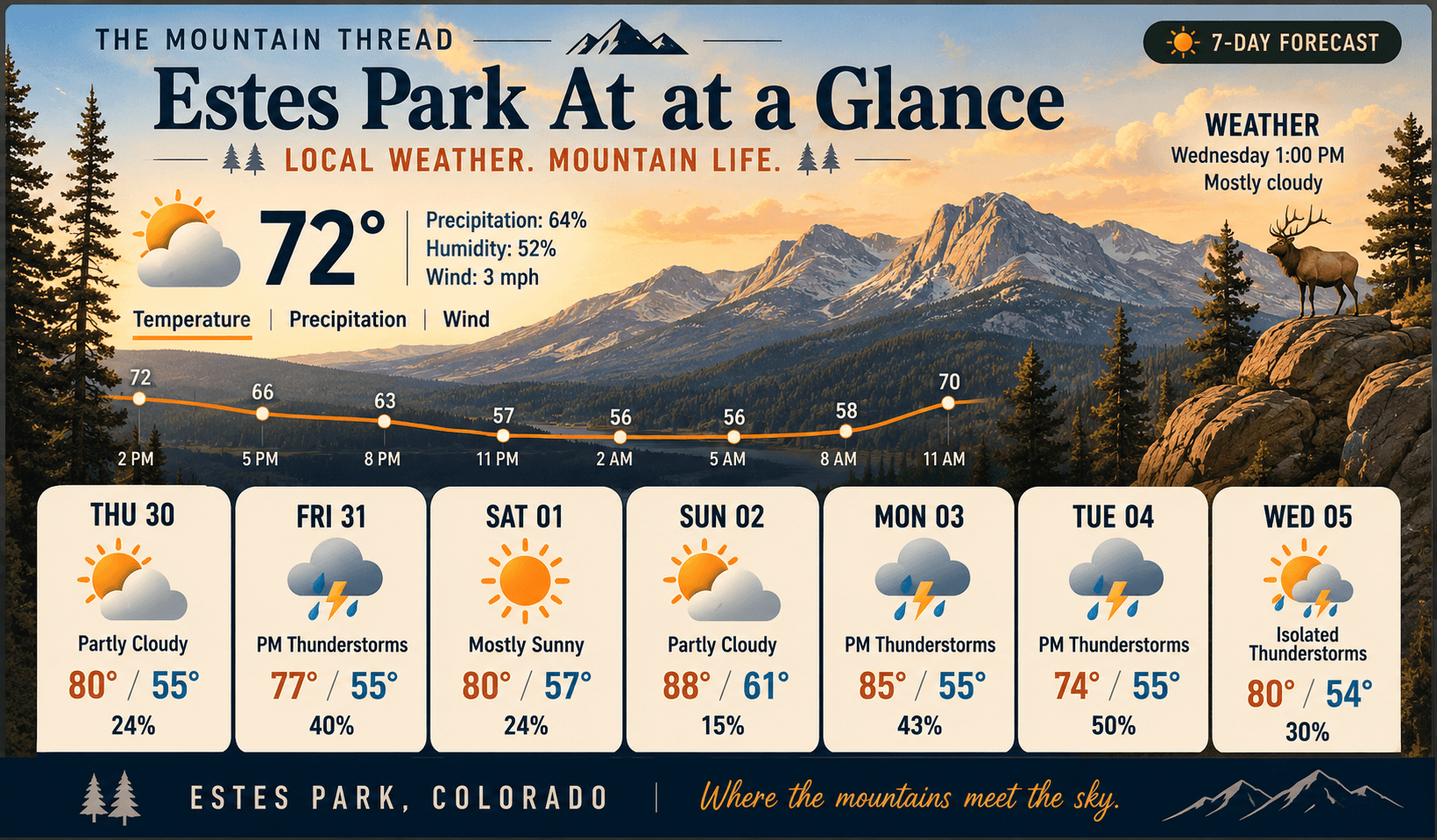
Afternoon thunderstorms are the daily pattern above treeline now. Start early and be off the exposed ridgelines by early afternoon. Looking ahead, the Perseid meteor shower peaks around August 11 through 13, and the park's dark skies are about as good a seat as you'll get for it. Worth putting on the calendar now. |
DID YOU KNOW?
Colorado entered the Union on August 1, 1876, one hundred years and one month after the Declaration of Independence, which is where the nickname Centennial State comes from. (Source: History Colorado)
The Earl of Dunraven sold his Estes Park holdings to F.O. Stanley and B.D. Sanborn in 1908. Stanley built the hotel that still stands above town. Dunraven's own wooden hotel, known locally as the English Hotel, burned down in 1911. (Source: National Park Service)
Elk were hunted out of the Estes Valley by around 1890, much of the meat sold to market down in Denver. In 1913 and 1914 the Estes Valley Improvement Association and the U.S. Forest Service brought forty-nine elk down from Yellowstone to restock the place, shortly before the park was established. (Source: National Park Service)
Rocky Mountain National Park was established in 1915, forty-three years after Dunraven first rode in looking for a place to hunt in private. (Source: National Park Service) |
Joke Of The Day |
A fellow asked me why land around here costs what it does. I told him an Irish earl tried to buy the whole valley back in 1874 and couldn't afford to keep it either. A hundred and fifty years of Coloradans looking at a price tag and saying "well, that can't be right." Practically a state tradition at this point. |
💡 Answer to Trivia Question: He paid other people to do it for him. Dunraven's agents recruited more than thirty-five men out of the Front Range towns to file homestead claims on 160-acre parcels they never intended to live on, then bought those claims out at around five dollars an acre. Because the parcels were chosen along the creeks, roughly 8,000 acres on paper gave him effective control of about 15,000. The Larimer County Express called it "one of the most barefaced land steals of this land-stealing age" in August of 1874, and a federal grand jury looked into it and did nothing. (Source: National Park Service, Larimer County Express) |
UNTIL NEXT WEEK
Moe wanted to know whether anybody ever paid for what happened to Rocky Mountain Jim. Nobody did, I told him. The man who shot him walked, the earl went home to Ireland, and the only thing that ever really beat either of them was a hundred stubborn people who wouldn't sell.
Tomorrow marks fifty years since the Big Thompson flood, with a symposium at the Estes Valley Community Center starting at 9 a.m. and a gathering at the Pulliam Building in Loveland from 2 to 4. Saturday is Colorado's hundred and fiftieth. MacGregor Ranch is open Tuesday through Saturday if you want to go stand on the ground this week's story is about.
Stay smart, stay safe, and leave the mountains open to whoever comes next.
This account draws from National Park Service records, Legends of America, the Larimer County Express of August 1874, Isabella Bird's 1873 account of James Nugent, and the documented history of the Estes Park Company. The broad facts are solid. Thirty-five men really did file claims on land they never meant to live on.
- Buck Timber The Mountain Thread themountainthread.com/signup |